

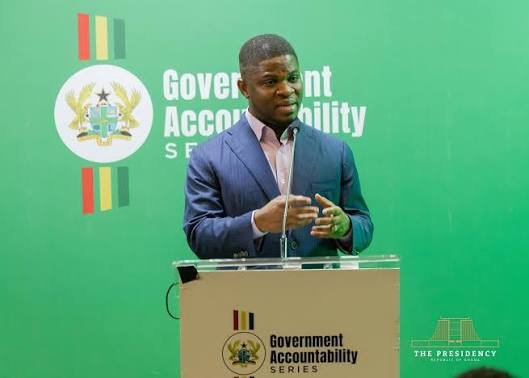
The Ghana Gold Board (GoldBod) has mobilised more than US$450 million from commercial banks, gold offtakers and other market participants without financial support from the Bank of Ghana (BoG), according to the Chief Executive Officer of the institution, Sammy Gyamfi.
Mr Gyamfi disclosed this during the Government Accountability Series briefing held in Accra on Wednesday, August 19, 2026, where he responded to allegations made by Minority Leader Alexander Afenyo-Markin regarding the financial operations and funding arrangements of the state-owned gold trading body.
The GoldBod CEO said the institution had successfully diversified its funding sources since March 2026, when it began the full implementation of its statutory mandate under the Gold Board Act, 2025 (Act 1140). According to him, GoldBod’s operations are no longer dependent on financing from the central bank, contrary to suggestions by critics. “GoldBod has demonstrated that it can raise significant capital from the market and finance its operations independently,” Mr Gyamfi stated.
He explained that the institution had adopted a number of innovative funding mechanisms to support its gold purchasing and trading activities after the Bank of Ghana ended its direct financing of the programme. One of the major funding channels involved advance-funding arrangements with international gold offtakers. Mr Gyamfi revealed that between March and May 2026, GoldBod secured nearly US$839 million through such agreements.

Under the arrangement, gold offtakers provided advance financing that enabled GoldBod to purchase gold from local suppliers. The gold was then sold to the Bank of Ghana at prevailing reference rates under an existing foreign exchange sale agreement between the two institutions.
He described the arrangement as a crucial source of liquidity that enabled GoldBod to continue purchasing gold from the local market while meeting its contractual obligations. Mr Gyamfi also highlighted another financing model known as a funded foreign exchange forward sales arrangement involving commercial banks.
According to him, the arrangement was piloted on August 3, 2026, and generated US$75 million in funding. He explained that the funds were used to purchase gold, convert the proceeds into dollars and settle transactions within 48 hours. The pilot programme, he said, was completed successfully without recording any losses. “The pilot arrangement worked efficiently and demonstrated the viability of the model,” he noted.
In addition to the pilot scheme, GoldBod generated substantial resources through its own trading activities and partnerships with aggregators. Mr Gyamfi disclosed that the institution raised US$164 million through the use of its seed capital, while a further US$270 million was generated through collaborations with aggregators who provided working capital for gold purchases.

Combined with the US$75 million raised through the funded FX forward sales arrangement, these initiatives generated approximately US$509 million. According to the GoldBod CEO, the figure clearly exceeds the US$450 million threshold and demonstrates the institution’s ability to mobilise significant resources without relying on central bank financing.
He stressed that the figures reflected the success of GoldBod’s evolving business model and underscored the institution’s growing financial independence. Despite the progress, Mr Gyamfi disclosed that the funded FX forward sales arrangement has temporarily been suspended pending broader consultations led by the Ministry of Finance.
The consultations were initiated following concerns raised by the Bank of Ghana regarding aspects of the programme. However, he expressed confidence in the future of the arrangement, revealing that 15 commercial banks had already submitted formal letters of interest indicating their willingness to participate once discussions are concluded. “This shows the confidence that the banking sector has in GoldBod and the opportunities the programme presents,” he said.
Mr Gyamfi also used the briefing to clarify what he described as misconceptions about GoldBod’s operations. He explained that the institution currently operates under a significantly different framework from the one previously used by the Bank of Ghana under the Domestic Gold Purchase Programme.

Under the former arrangement, the central bank primarily purchased gold to strengthen Ghana’s reserves and support foreign exchange management efforts. GoldBod’s current model, however, goes beyond simply acting as a purchasing agent. According to Mr Gyamfi, the Board now buys, owns, trades and sells gold under its own commercial agreements and offtake contracts.
He said this structure places greater responsibility on GoldBod to secure financing, manage risk and generate revenue from its trading activities. The CEO cited Section 18 of the Gold Board Act, 2025, as the legal basis for GoldBod’s authority to raise funds from financial institutions, gold offtakers and capital markets.
The latest dispute between GoldBod and the Minority in Parliament comes against the backdrop of ongoing debate about the country’s gold trading strategy and the financial implications of previous programmes. The controversy intensified after an International Monetary Fund (IMF) report indicated that the Bank of Ghana recorded losses exceeding US$1.7 billion under the Domestic Gold Purchase Programme in 2025.

While opposition lawmakers have questioned aspects of GoldBod’s operations, Mr Gyamfi insisted that the institution’s current model is designed to be more sustainable and less reliant on public financing.
He maintained that GoldBod’s ability to mobilise more than US$450 million from alternative funding sources demonstrates the viability of its strategy and positions the institution to play a leading role in Ghana’s gold sector while contributing to foreign exchange stability and economic growth.
Philbert Amiba Ayuusah