

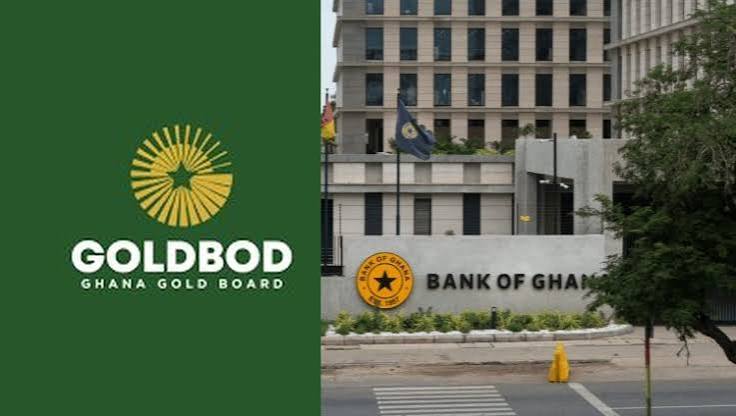
The Governor of the Bank of Ghana (BoG), Dr. Johnson Pandit Asiama, has announced that the central bank has stopped directly financing the Ghana Gold Board (GoldBod), describing the move as part of efforts to ease financial pressure on the Bank. Speaking at the 131st Monetary Policy Committee (MPC) press conference in Accra on Wednesday, Dr Asiama said the BoG was transitioning away from its previous role in funding GoldBod, with discussions ongoing on a new financing framework.
“The Bank of Ghana is no longer funding the GoldBod under the arrangement that existed before. We are moving away from a regime where we were running the transactions the way they used to be, and this will reduce the financial pressure on us going forward,” he said.

Dr Asiama explained that while the central bank would continue to play a role in the operations of GoldBod, the institution was exploring alternative funding arrangements. According to him, the government could assume full responsibility for financing the GoldBod or the institution could raise funds from the financial market.
“GoldBod has a number of choices. Either the government takes up its funding entirely or it resorts to the market for funding. We are still discussing what our role will be under the new arrangement, and the market will be informed once those discussions are concluded,” he stated.
The Ghana Gold Board was established to streamline the country’s gold purchasing and export activities, particularly within the small-scale mining sector, while helping to strengthen Ghana’s foreign exchange reserves.

On monetary policy, Dr Asiama announced that the Monetary Policy Committee had unanimously decided to maintain the policy rate at 14.0 per cent, citing the need to closely monitor developments in both the domestic and global economies before making any further adjustments.
He noted that Ghana’s economy remained resilient during the first quarter of 2026 despite prevailing global uncertainties. The governor also disclosed that headline inflation rose slightly to 4.3 per cent in June 2026, driven by increases in both food and non-food prices.Despite the marginal uptick in inflation, he said the country’s macroeconomic fundamentals remained broadly stable.

Dr Asiama further highlighted the strong performance of the banking sector, noting that banks continued to record robust growth and improved financial soundness as of June 2026. He also pointed to a significant expansion in lending to businesses, saying private sector credit was increasing at a rapid pace, an indication of improving confidence and growing economic activity.
The governor expressed optimism that ongoing macroeconomic stability, coupled with prudent monetary policy and continued financial sector resilience, would support sustained economic growth while keeping inflation within the Bank’s target range.
Philbert Amiba Philbert