

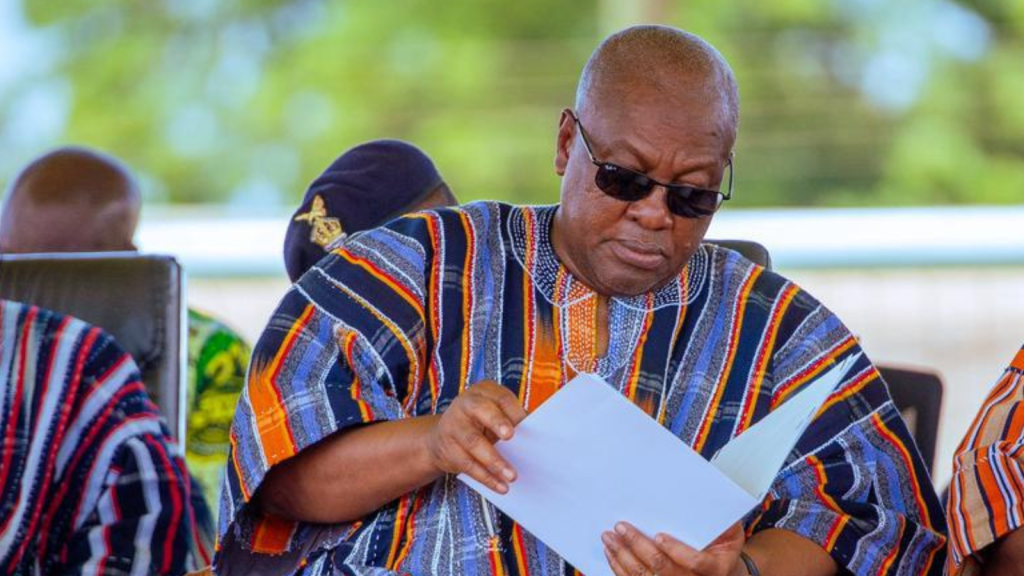
The job approval rating of President John Dramani Mahama has declined from 68 percent in December 2025 to 58.9 percent in May 2026, according to a new public opinion survey conducted by the Institute of Economic Affairs Ghana.
The poll indicates a noticeable shift in public perception of the president’s performance within a five month period, reflecting changing attitudes among voters amid ongoing economic and governance discussions in the country.
The Institute of Economic Affairs, a leading Ghanaian policy think tank known for conducting governance and political surveys, noted that while the approval rating remains above the halfway mark, the decline suggests growing public scrutiny of government performance as the administration progresses into its term.
President John Dramani Mahama, who leads the National Democratic Congress, returned to office following the 2024 general elections, with his administration focusing on economic recovery, job creation, and institutional reforms. The latest figures suggest that while a majority of respondents still approve of his leadership, there has been a reduction in overall satisfaction levels compared to the end of 2025.

Public approval ratings are often influenced by a range of factors including economic conditions, cost of living, employment levels, and perceptions of government effectiveness. Ghana has in recent months been navigating inflationary pressures, currency stability challenges, and fiscal adjustments, all of which may contribute to shifts in public sentiment.
Political analysts say the decline is not unusual for administrations in their early to mid-term stages, especially when governments implement reforms that may initially create short term economic discomfort while targeting long term stability.
The survey also highlights the importance of public communication and policy delivery in maintaining political support. Analysts argue that even when macroeconomic indicators show gradual improvement, citizens’ perceptions are shaped heavily by immediate living conditions, such as food prices, transport costs, and access to public services.
The IEA poll is widely referenced in Ghana’s political and policy circles and often used as a benchmark for assessing public sentiment on governance issues. However, like all opinion polls, it reflects a snapshot of perceptions at a particular time and may not fully capture longer term trends.

President Mahama’s administration has emphasised economic restructuring, improved fiscal discipline, and social intervention programmes as key pillars of its governance agenda. The government has also focused on job creation initiatives and strengthening key public institutions.
Despite the drop, a 58.9 percent approval rating still indicates that a majority of respondents support the president’s performance. However, the downward trend may signal increasing pressure on the government to demonstrate tangible improvements in key areas of public concern.
Political observers will likely watch future polls closely to determine whether the decline represents a temporary fluctuation or the beginning of a longer term trend in public opinion.
As Ghana approaches key policy and economic milestones in 2026, public approval ratings are expected to remain an important indicator of political stability and governance performance.