

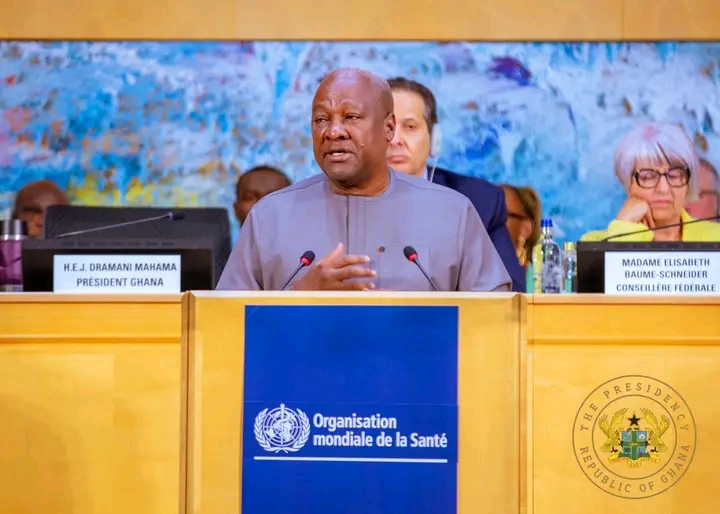
President John Dramani Mahama has revealed that Ghana lost approximately $78 million in healthcare funding following the suspension of several United States aid programmes, warning that the reduction in international support is placing growing pressure on African health systems and exposing the vulnerability of countries heavily dependent on donor financing.
Speaking at the 79th World Health Assembly in Geneva, Switzerland, President Mahama said the funding cuts have already affected major public health programmes across Ghana, including malaria prevention, maternal and child healthcare, nutrition initiatives, HIV testing, and the supply of antiretroviral medication.

The Ghanaian leader made the disclosure while advocating for what he described as “health sovereignty” for countries in the Global South, arguing that African nations must reduce their long-standing dependence on foreign aid and invest more aggressively in domestic healthcare systems capable of surviving global economic and political shocks.
“In Ghana, health financing from bilateral and multilateral partners has significantly decreased since 2025. Ghana lost $78 million in health funding following the closure of US aid programmes,” Mahama told delegates at the assembly.
According to him, the decline in aid is part of a wider global shift that has seen humanitarian and overseas development assistance fall sharply in the years following the COVID-19 pandemic. He noted that international health assistance has reportedly dropped by nearly 40 percent, creating serious financing gaps for developing countries already struggling with inflation, debt pressures, and rising healthcare demands.

Mahama also referenced the impact of funding suspensions in other African countries, particularly South Africa, where the halt of support under the United States President’s Emergency Plan for AIDS Relief, commonly known as PEPFAR, has reportedly disrupted HIV treatment programmes and left about 1.4 million people uncertain about continued access to medication.
The President warned that the continent risks severe long-term consequences if African governments fail to strengthen local healthcare financing and manufacturing capacity. He argued that Africa’s continued dependence on imported vaccines, pharmaceuticals, and externally funded public health programmes leaves the continent dangerously exposed during periods of geopolitical tension and donor fatigue.
“We do not come to Geneva to mourn the past. We come to build a future where a country’s health is not a byproduct of charity, but the result of sovereign capability,” Mahama stated during his address.

The Ghanaian leader used the global platform to promote the “Accra Reset Initiative,” a programme designed to push African countries toward greater healthcare independence through domestic investment, stronger insurance systems, local pharmaceutical production, and expanded healthcare infrastructure.
Mahama also highlighted reforms being implemented by his administration, including Ghana’s Free Primary Healthcare Programme, which seeks to remove financial barriers to basic healthcare services, particularly in rural communities. According to him, Ghana’s National Health Insurance Scheme currently covers an estimated 66 percent of the population, leaving roughly one-third of citizens outside the system.
The President further disclosed that Ghana’s 2026 budget has allocated approximately GH¢34 billion toward healthcare expenditure as the government attempts to strengthen the country’s health infrastructure and reduce dependence on external donor support.

The remarks come at a time when many African governments are reassessing economic and social policies amid tightening global financing conditions, rising debt servicing obligations, and growing uncertainty around future international aid commitments. Analysts say the reduction in donor support could force governments across the continent to rethink healthcare financing models and accelerate reforms aimed at building more self-sustaining systems.
The World Health Assembly, organised annually by the World Health Organization, has brought together heads of state, policymakers, global health institutions, and development agencies to discuss emerging healthcare challenges, pandemic preparedness, and sustainable financing for healthcare systems worldwide.
Mahama heads to Geneva to push Africa’s health independence agenda at World Health Assembly