

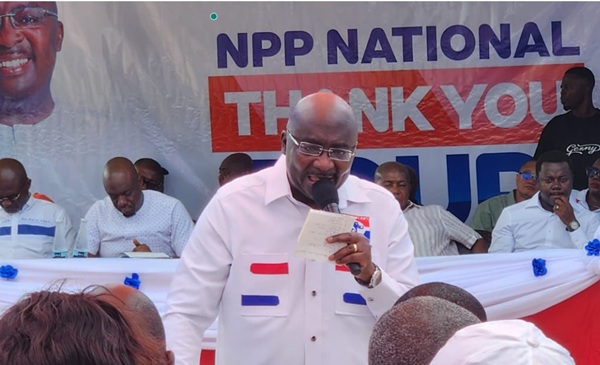
Former Vice President, Mahamudu Bawumia has taken a decisive step to consolidate the opposition New Patriotic Party by appointing all four of his former competitors in the January 2026 flagbearer contest into influential leadership roles within the party’s newly established policy committees, a move widely seen as an attempt to rebuild cohesion and reposition the party for the next electoral cycle.
The appointments come at a critical moment for the NPP as it regroups after losing power in the 2024 general elections to the National Democratic Congress. Party insiders say the formation of the policy committees is intended to craft a fresh governing agenda while avoiding the internal divisions that often follow tightly contested primaries.
A central figure in the new structure is Kojo Oppong Nkrumah, who has been named chairman of the Economy and Jobs Policy Committee. His appointment places him at the forefront of shaping the party’s economic message, an area expected to dominate political discourse in the coming years as Ghana continues to navigate post crisis recovery, debt restructuring, and job creation challenges.
Oppong Nkrumah, a former Information Minister and a key communicator within the party, is expected to lead a team tasked with developing practical proposals to address unemployment, private sector growth, and fiscal discipline. Analysts note that his selection signals a strategic effort to combine policy depth with strong public messaging, especially as economic credibility remains central to voter trust.
The other former contenders in the flagbearer race have also been assigned co chair roles across various committees, covering sectors such as governance, infrastructure, youth development, and social services. While their specific portfolios differ, the broader objective is clear: to integrate competing factions into a unified framework rather than allowing rival camps to evolve into long term divisions.

Political observers say this approach reflects lessons from past electoral cycles in Ghana, where internal party fractures have often weakened opposition strength. By giving former rivals meaningful responsibilities, Bawumia appears to be prioritising inclusion over consolidation of personal power, a move that could strengthen the party’s internal stability ahead of 2028.
The strategy also aligns with Bawumia’s public messaging since securing the flagbearer position, where he has repeatedly emphasised unity, innovation, and a renewed focus on policy driven politics. His leadership is expected to centre on repositioning the NPP as a credible alternative government, particularly on issues such as digital transformation, industrialisation, and economic resilience.
Beyond internal dynamics, the formation of the policy committees signals the beginning of a broader ideological reset within the party. With Ghana facing persistent economic pressures, including inflation, currency volatility, and youth unemployment, both major political parties are under pressure to present clear and actionable solutions.
The NPP’s policy teams are expected to engage stakeholders across academia, industry, and civil society to build proposals that reflect current realities while distinguishing the party’s vision from that of the ruling government. This consultative approach, if effectively implemented, could help rebuild public confidence in the party’s governance capacity.
However, challenges remain. Unity at the leadership level does not automatically translate into grassroots cohesion, and the party will need to ensure that its reconciliation efforts extend beyond top figures to regional and constituency structures. Additionally, the effectiveness of the policy committees will ultimately be judged by the quality and practicality of the ideas they produce.

There is also the question of political timing. With the next general election still two years away, sustaining momentum and relevance will require consistent engagement and clear communication. The NPP will need to balance internal rebuilding with external opposition, holding the government accountable while simultaneously presenting itself as a ready alternative.
For now, Bawumia’s move has been broadly welcomed within party circles as a pragmatic step toward healing post primary tensions and building a collective front. By integrating former rivals into the party’s strategic core, he is attempting to shift the narrative from competition to collaboration.
Whether this unity holds in the long term will depend on how effectively these committees function and whether the party can translate internal alignment into a compelling national message. But in the immediate term, the appointments mark a significant effort to reset the NPP’s trajectory and position it for a more coordinated and competitive return to power.
NPP announces plan to march “Yen Suro Ahunahuna” demonstration