

The Ghanaian sun does not negotiate. It arrives early, stays long, and operates at an intensity that makes the skincare advice written for temperate climates not just insufficient but sometimes actively counterproductive. The person in Accra reading a European skincare blog is receiving guidance calibrated for grey skies, low humidity seasons, and ultraviolet index readings that rarely exceed six. The average UV index in Accra sits between eight and twelve for most of the year, with harmattan dryness capable of stripping moisture from skin in ways that no British moisturiser was ever formulated to address. The result is a generation of Ghanaians spending significant money on skincare products that were not designed with them in mind, sometimes causing more harm than help.
What follows is an evidence-based account of what actually works for melanin-rich skin in Ghana’s specific climate, drawing on dermatological research, the science of how melanin behaves, and the realities of Ghanaian weather patterns.
Understanding what melanin does and does not do
The first thing to establish is what melanin actually provides and what it does not, because the myth that dark skin does not need sun protection has caused genuine harm.
Melanin is a photoprotective pigment. It absorbs ultraviolet radiation and dissipates it as heat, providing a natural sun protection factor estimated by researchers at roughly SPF 13 for very dark skin. This is meaningful protection compared to no melanin at all, but SPF 13 does not come close to what dermatologists recommend for daily outdoor exposure, which begins at SPF 30 and extends higher for prolonged sun exposure. Melanin-rich skin can and does sustain sun damage. The damage simply presents differently: not as the rapid, visible sunburn experienced by lighter skin, but as hyperpigmentation, uneven skin tone, accelerated photoaging, and in more serious cases, increased risk of skin cancers, which, while less common in darker skin, are often diagnosed later and at more advanced stages precisely because the myth of immunity discourages vigilance.

What melanin does provide is slower visible aging compared to lighter skin under equivalent UV exposure. The higher melanin content provides genuine photoprotection that delays the collagen breakdown, fine lines, and surface damage that UV radiation accelerates. This is a real advantage, but it is an advantage to protect, not to squander through neglect.
The climate problem: heat, humidity, and harmattan
Ghana’s climate creates two distinct skincare challenges that operate in near-opposite directions and require different responses.
For roughly eight to nine months of the year, the dominant conditions are heat and humidity. Accra’s average daily temperature hovers between 27 and 32 degrees Celsius, and relative humidity frequently exceeds 80%. In this environment, the skin’s sebaceous glands are working hard, sweat is constant, and the combination of heat, humidity, and urban pollution creates conditions in which heavy, occlusive moisturisers, designed to prevent moisture loss in dry climates, become problems rather than solutions. They sit on the skin’s surface, trap heat, mix with sweat and pollution, and contribute to clogged pores, breakouts, and a general congestion that makes the skin look dull rather than healthy.
Then comes harmattan, arriving between November and March in varying intensity depending on proximity to the Sahara, bringing dry, dusty winds that dramatically reduce humidity and strip the skin of moisture with surprising speed. The person who manages their skin reasonably well through the humid season frequently finds it cracking, flaking, and ashy during harmattan in ways that feel disproportionate to how dry the air seems.
Effective Ghanaian skincare must address both realities, which means a seasonal flexibility that most commercial skincare marketing, oriented toward year-round consistency, does not encourage.
What a functional routine actually looks like
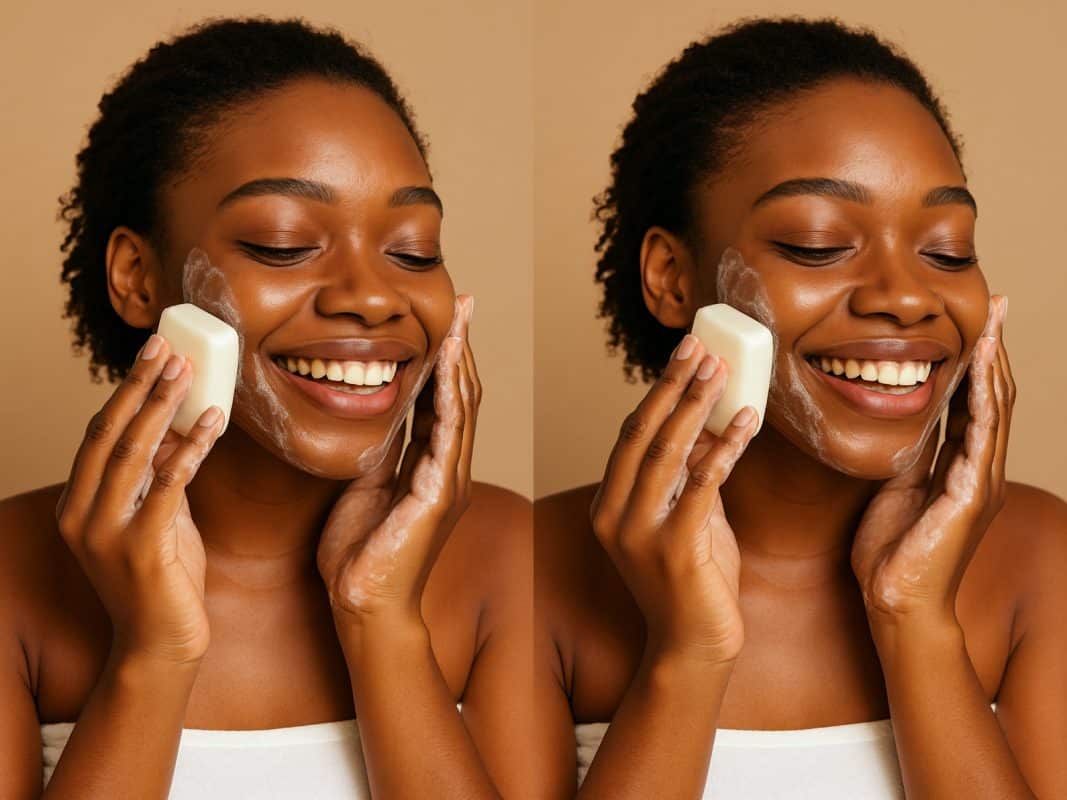
Cleansing is the foundation and the most frequently mismanaged step. The instinct, particularly among people managing oily or acne-prone skin, is to cleanse aggressively with high-lather, high-pH soaps that strip sebum completely. This is counterproductive. When the skin’s natural barrier is over-stripped, the sebaceous glands compensate by producing more oil, creating a cycle of greasiness and aggressive cleansing that makes both conditions worse. A gentle, low-pH cleanser, meaning one with a pH between 4.5 and 6.5 to match the skin’s natural slightly acidic environment, removes dirt, sweat, and pollution without destroying the moisture barrier.
In the humid season, a water-based or gel cleanser used twice daily is sufficient for most skin types. During harmattan, a slightly creamier formulation may be warranted for those with naturally drier skin, though the cleanser should still not be occlusive or heavy.

Sunscreen is non-negotiable and remains the most impactful single investment a Ghanaian can make in their skin’s long-term health and appearance. Hyperpigmentation, which is among the most common skin concerns for melanin-rich skin, is significantly worsened by UV exposure. Post-inflammatory hyperpigmentation, the dark marks left after acne, insect bites, or any skin injury, fades considerably faster when UV exposure is consistently limited. This means that every topical product targeting dark spots is working against itself if sunscreen is not applied daily.
The practical challenge in Ghana is finding a sunscreen that does not leave a white cast, which has historically been a significant barrier to adoption among people with darker skin tones. White cast is caused primarily by physical sunscreen filters, specifically zinc oxide and titanium dioxide, which reflect light and appear white or grey on the skin. Chemical sunscreen filters, including ingredients like avobenzone, octinoxate, tinosorb, and mexoryl, absorb UV radiation rather than reflecting it and typically leave no visible residue on dark skin. A number of African-formulated sunscreens and international brands now offer formulations specifically tested on darker skin tones, and these are worth seeking out.
For the humid season, a lightweight, non-comedogenic sunscreen with SPF 30 to 50 applied each morning is the target. For those who spend extended time outdoors, reapplication every two hours is the dermatological recommendation, though practically this is difficult for most working people. A mineral powder sunscreen can be used for midday reapplication over makeup or skincare without disrupting the face.
Moisturising in Ghana requires the seasonal adaptability mentioned earlier. During humid months, a lightweight, water-based moisturiser or even a simple hyaluronic acid serum, which attracts moisture from the environment into the skin, is frequently sufficient. The goal is hydration without occlusion. Heavy shea butter applied to the face in August in Accra will block pores in conditions the ingredient was not formulated to navigate, even though shea butter is an excellent ingredient in the right context. During harmattan, richer emollients are warranted. Shea butter, which is produced extensively in Ghana’s northern regions and has legitimate scientific support for its skin barrier properties, becomes genuinely useful during the dry season when the skin needs both moisture and a barrier to prevent that moisture from evaporating into the dry harmattan air.
The hyperpigmentation conversation
For melanin-rich skin, hyperpigmentation is the dominant cosmetic concern, and it deserves specific attention. The instinct to treat it aggressively with high-concentration actives frequently backfires, because many of the most potent brightening ingredients, particularly in high concentrations, cause inflammation, and inflammation in melanin-rich skin reliably causes more hyperpigmentation. This is the cruel irony of treating dark spots on dark skin: the wrong approach makes the problem it is trying to solve worse.

Ingredients with strong evidence for hyperpigmentation in darker skin tones include niacinamide, which reduces melanin transfer to skin cells and is well-tolerated by most skin types; azelaic acid, which is anti-inflammatory as well as brightening and therefore less likely to cause the reactive hyperpigmentation that more aggressive actives produce; vitamin C, which inhibits melanin production and provides antioxidant protection against UV-induced pigmentation, though formulations oxidise quickly and should be stored carefully in Ghana’s heat; and tranexamic acid, which has more recent but promising evidence for stubborn pigmentation.
The skin-lightening industry in Ghana also includes products containing hydroquinone, mercury, and high-concentration steroids, sold both formally and informally. Hydroquinone at low concentrations has legitimate clinical evidence and is used under medical supervision in many countries, but the unregulated products circulating in Ghanaian markets frequently contain concentrations that cause ochronosis, a bluish-black darkening of the skin, or mercury poisoning with systemic effects. The bleaching culture built around these products has caused documented harm, and it is worth stating plainly that the goal of skincare for melanin-rich skin is not to reduce melanin. It is to protect and even the skin that melanin produces.
Ingredients worth finding locally
Ghana’s own botanical resources include several ingredients with genuine skincare application. Shea butter’s emollient and anti-inflammatory properties are well-documented. Black soap, known in Twi as ose dudu and widely produced across West Africa, has antimicrobial properties and a centuries-old track record for managing oily and acne-prone skin, though commercial versions vary enormously in quality and formulation. Baobab oil is rich in omega fatty acids and absorbs readily into the skin without heaviness. Moringa oil contains oleic acid and behaves similarly to the skin’s own sebum, making it an effective and locally available facial oil for drier skin types.
These ingredients are not simply cultural traditions without scientific basis. They are resources whose active compounds have been studied, and for Ghanaians looking to build a skincare routine that is both effective and not entirely dependent on expensive imports, they represent a genuinely useful starting point.
The routine in summary
Morning: a gentle, low-pH cleanser, a lightweight moisturiser or hydrating serum, and SPF 30 to 50 applied last. Antioxidant protection in the form of a vitamin C serum can be added between moisturiser and sunscreen for additional defence against the UV and pollution load of a Ghanaian day.

Evening: the same gentle cleanser, and then the space for any active ingredients targeting hyperpigmentation or skin texture. Active ingredients like niacinamide, azelaic acid, or retinol for those using it are best applied at night, partly because some increase photosensitivity and partly because the skin’s repair processes are most active during sleep.
Seasonal adjustment: during harmattan, add richer emollients, consider an occlusive like shea butter as the final step to seal in moisture overnight, and increase the frequency of gentle exfoliation to address the dead skin accumulation that harmattan dryness accelerates.
The Ghanaian skin, with its melanin and its specific climatic context, is not a problem to be solved. It is a specific biological reality to be understood and worked with. The routine that works is not the one on the European influencer’s page. It is the one calibrated for what the Accra sun actually does, what harmattan actually costs, and what melanin-rich skin actually needs to stay healthy across both.
More Than a Drink: 5 Clever Everyday Uses of Akpeteshie in Ghanaian Homes