

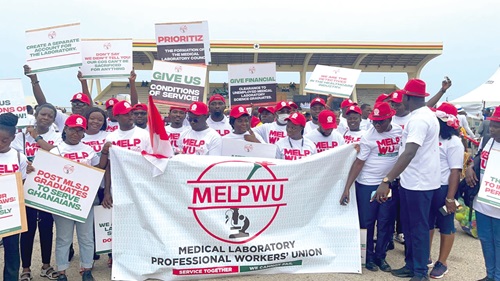
Tensions at Ghana’s premier referral hospital have eased after the Medical Laboratory Professional Workers Union (MELPWU) suspended its planned industrial action following the appointment of an acting head for the laboratory unit at Korle Bu Teaching Hospital.
The decision comes after days of mounting pressure and uncertainty over leadership at the hospital’s laboratory department, which had triggered concerns among medical laboratory professionals and raised the risk of disruptions to critical diagnostic services.
According to reports, the union had expressed strong dissatisfaction with what it described as irregularities in the appointment process for the substantive laboratory head. Members argued that due process had not been followed, sparking internal resistance and leading to threats of industrial action that could have significantly impacted healthcare delivery.

The situation prompted urgent engagement between hospital management and union leadership, culminating in the interim appointment of an acting laboratory head. This move appears to have served as a compromise, allowing space for further consultations while ensuring that laboratory services continue without interruption.
In a statement following the development, MELPWU confirmed that it was suspending its intended action in good faith, signaling a willingness to engage constructively with authorities to resolve the matter. However, the union made it clear that the suspension does not amount to a full resolution of the underlying concerns.
The leadership dispute had drawn attention to broader governance issues within Ghana’s health sector, particularly around appointments, professional recognition, and adherence to established administrative procedures. For laboratory professionals, the matter goes beyond a single position and touches on long-standing concerns about representation and fairness within hospital management structures.
At the heart of the issue is the critical role laboratories play in modern healthcare systems. Diagnostic services are central to patient care, influencing treatment decisions across departments. Any disruption in laboratory operations can have a cascading effect on hospital efficiency and patient outcomes.

Healthcare analysts note that the swift intervention by Korle Bu management likely prevented a major disruption. A full-scale strike by laboratory professionals would have severely affected testing services, including routine diagnostics, emergency care support, and specialised medical investigations.
The appointment of an acting head is therefore seen as a stabilising measure rather than a definitive solution. It buys time for stakeholders to address procedural concerns and agree on a transparent and acceptable process for appointing a substantive head.
Meanwhile, staff within the laboratory unit are expected to resume normal operations, with services continuing as usual. Patients who rely on the facility for testing and diagnosis are unlikely to experience immediate disruptions following the union’s decision.
The development also underscores the importance of dialogue in managing labour disputes within critical sectors such as healthcare. While industrial action remains a legitimate tool for workers to press their demands, timely engagement and compromise can help prevent disruptions that directly affect public welfare.

Moving forward, attention will shift to how hospital management and the union handle the next phase of discussions. The credibility of the final appointment process will be key in determining whether the current calm is sustained or whether tensions could resurface.
For now, the suspension of the strike offers relief to both patients and healthcare providers, but it also serves as a reminder that unresolved governance issues within key institutions can quickly escalate into broader service delivery risks.
Dr. Yakubu Seidu Adam Appointed CEO of Korle Bu Teaching Hospital