

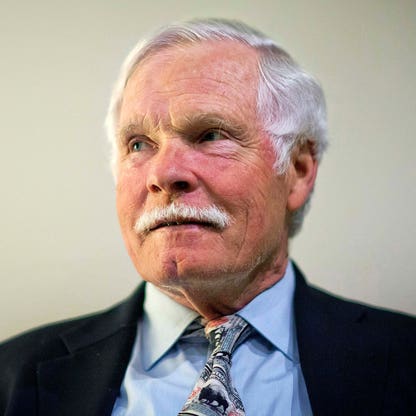
Ted Turner, the outspoken media mogul who founded CNN and revolutionised modern television with the world’s first 24 hour news channel, has died at the age of 87.
Turner’s death marks the end of one of the most influential careers in global media history. Known for his bold personality, aggressive business instincts, and unconventional leadership style, he transformed how news was consumed worldwide and helped redefine the structure of television broadcasting.
Born in 1938, Turner entered the media business through his father’s billboard advertising company before making a decisive leap into television. In 1970, he acquired the struggling Atlanta based station WTCG Channel 17 and turned it into a profitable “superstation,” later known as TBS. That move laid the foundation for what would become a sprawling media empire.

His most groundbreaking moment came in 1980 with the launch of CNN. At a time when most people watched scheduled evening bulletins, Turner pushed the radical idea that news should be available around the clock. Many critics doubted the concept would survive financially or attract enough viewers. Instead, CNN fundamentally changed journalism and global information flow.
The network’s influence became especially clear during major international crises, including wars, elections, and disasters, where real time coverage became the new standard. CNN International, launched in 1985, further expanded Turner’s reach and established the network as a global media force.
Turner’s ambitions extended far beyond news. Through Turner Broadcasting, he launched major entertainment channels including TNT, Cartoon Network, and Turner Classic Movies, helping shape cable television during its most explosive growth period.

He also made major moves in film and sports. In 1986, he purchased the MGM film library, securing rights to thousands of classic movies. Though controversial at the time, especially over plans to colourise black and white films, the acquisition strengthened his content empire.
In sports, Turner became closely associated with Atlanta’s professional teams. He owned the Atlanta Braves baseball team, the Atlanta Hawks basketball franchise, and later became the founding owner of the NHL’s Atlanta Thrashers. Under his ownership, the Braves gained national visibility through broadcasts on TBS and won the World Series in 1995.
Turner’s life also drew attention beyond business. His marriage to Jane Fonda from 1991 to 2001 made them one of America’s most high profile couples. Even after their divorce, both publicly spoke positively about each other.
Despite enormous success, Turner also faced major setbacks. The merger between Time Warner and AOL, which he strongly supported, became one of the most infamous corporate failures in modern business history. The collapse cost him billions and significantly reduced his influence within the company he helped build.
Yet Turner remained active in business and philanthropy. He launched Ted’s Montana Grill restaurant chain and became one of the largest private landowners in the United States, using much of his land for wildlife conservation and environmental projects.
In later years, philanthropy became central to his public identity. Turner donated billions to humanitarian and environmental causes and founded the United Nations Foundation to support global development initiatives. His charitable work focused heavily on conservation, public health, and international cooperation.

Turner also openly discussed his health challenges, including his diagnosis with Lewy body dementia, which he revealed publicly in 2018.
His legacy is difficult to overstate. Turner did not simply build television channels, he changed the rhythm of global media consumption. The expectation that news should be instant, continuous, and accessible anywhere owes much to his vision.
For supporters, he was a pioneer willing to take risks others avoided. For critics, he could be abrasive and unpredictable. But few dispute his impact. Modern cable news, global broadcasting, and much of contemporary television culture bear his imprint.
Ted Turner leaves behind a legacy that spans journalism, entertainment, sports, business, and philanthropy, one that reshaped media history far beyond the United States.
Congo Prosecutor Seeks Death Penalty for Former President Joseph Kabila