

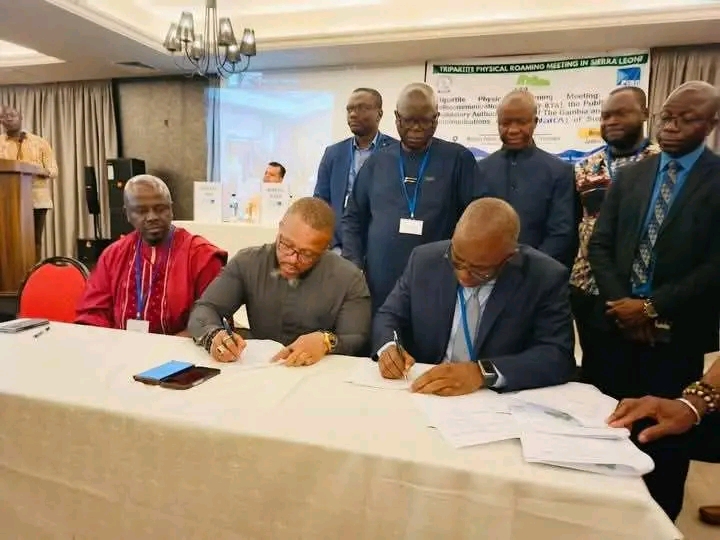
Togo, Benin and Senegal have launched free community roaming services in a landmark move aimed at deepening digital integration and reducing communication costs across borders.
The initiative, officially unveiled in Lomé on April 24, marks the implementation of two aligned bilateral agreements between Togo and Senegal, and Senegal and Benin. The agreements were initially signed in December 2025 in Dakar on the sidelines of the 23rd annual general assembly of the Association of Telecommunications Regulators of West Africa.
The new framework allows citizens traveling between the three countries to use mobile services as if they were in their home country, eliminating the high roaming charges that have long been a barrier to seamless communication in the region. Calls, text messages, and mobile data usage will now be subject to regulated pricing caps designed to prevent excessive billing.

Speaking at the launch, Michel Yaovi Galley described the development as a major step forward in regional connectivity. “Today, we are taking a new step by removing another barrier to digital mobility and strengthening regional integration,” he said. “That obstacle is now removed.”
The agreements are being coordinated through national regulatory bodies, including Autorité de Régulation des Communications Électroniques et de la Poste and Autorité de Régulation des Télécommunications et des Postes, alongside Togo’s regulator ARCEP. The harmonised approach represents a first in the region, with two separate agreements structured under identical terms to promote consistency and scalability.
Regulators say the initiative goes beyond cost reduction. It is part of a broader push to create a more unified telecommunications market in West Africa, where users can move across borders without disruptions to service. By improving continuity and affordability, the policy is expected to support business travel, cross border trade, and regional cooperation.

Consumer advocacy groups have welcomed the move, noting that high roaming charges have long placed a financial burden on individuals and small businesses operating across borders. Emmanuel Sogadzi, president of the Ligue des Consommateurs du Togo, emphasized the importance of enforcement, stating that consumers will be watching closely to ensure operators fully comply with the new rules.
The launch also highlights a growing recognition of the role digital infrastructure plays in economic integration. As mobile connectivity becomes central to commerce, finance, and communication, reducing barriers in telecom services is increasingly seen as essential to unlocking regional growth.
For Togo, the agreement expands an already growing network of partnerships. With this latest addition, the country now has free roaming arrangements with seven nations, six of which are already operational. This positions Togo as an emerging leader in regional telecom integration efforts.
Officials in Benin and Senegal also underscored the importance of ensuring service continuity, particularly for mobile users who frequently cross borders for work or trade. Dahirou Thiam, head of Senegal’s telecom regulator, pointed to the expected benefits for consumers, especially the reduction in costs and improved accessibility.

Despite the progress, challenges remain. Effective implementation will depend on coordination between telecom operators, regulatory oversight, and the ability to manage network usage without compromising service quality. There are also questions about how quickly similar agreements can be expanded to include more countries across the region.
Still, the initiative signals a clear shift toward deeper digital cooperation in West Africa. By tackling one of the most persistent pain points in cross border communication, Togo, Benin, and Senegal are setting a precedent for how regional integration can be advanced through practical, consumer focused policies.
Maroc Telecom reports US$760m profit in 2025 as earnings rebound