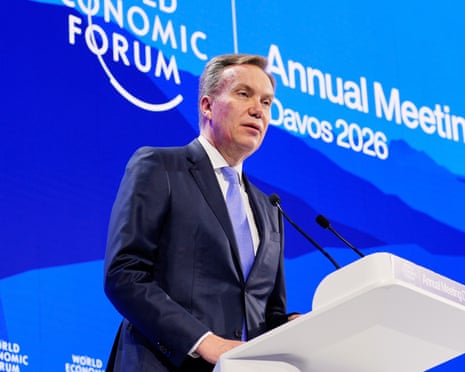
World Economic Forum chief resigns after scrutiny over Epstein links

0
110

The head of the World Economic Forum has stepped down following criticism over past interactions with disgraced financier Jeffrey Epstein.

Børge Brende announced he would resign as president and chief executive after more than eight years leading the organization, which is widely known for hosting its annual global gathering in Davos, Switzerland.

Brende acknowledged that he had dined with Epstein on three occasions between 2018 and 2019. The revelation prompted renewed scrutiny and criticism, ultimately leading to his decision to step aside.

In a statement, Brende said it was the right time to step down after overseeing significant initiatives and expansion during his tenure. He did not indicate that the meetings involved any official partnership but accepted that the associations had become a distraction for the organization.

world economic forum
Borge Brende

The World Economic Forum, a platform that convenes political leaders, business executives and civil society figures to address global economic and policy challenges, has faced periodic criticism over transparency and elite networking. The latest development places additional pressure on its leadership and governance practices.

Epstein, who was convicted of sex offenses and faced further federal charges before his death in 2019, had cultivated relationships with prominent figures in business, academia and politics. Associations with him have continued to carry reputational consequences for individuals and institutions in the years since.

Brende, a former Norwegian foreign minister, had led the WEF since 2017. During his tenure, the forum expanded its focus on climate policy, digital transformation and geopolitical risk, while navigating the disruptions of the COVID-19 pandemic and heightened global tensions.

World Economic Forum chief resigns after scrutiny over Epstein links

The resignation marks a significant leadership change for the organization at a time of complex global economic and political uncertainty. The WEF is expected to initiate a process to appoint a successor as it prepares for future annual meetings and strategic initiatives.

Ghana economic vulnerability risks return

Author

  • Daniel Ablordey

    Daniel Ablordey is a Business Analytics student at the University of Ghana Business School and an emerging strategist at the intersection of data, markets, and narrative. With a keen analytical mind and a passion for African business and economic trends, he is building a career focused on translating complex data-driven insights into accessible, decision-relevant stories that matter.

    As a writer and editor with Insight Ghana, African Business Insight, and The African Journal, Daniel delivers sharp, high-impact analysis on current affairs, business developments, and emerging trends across the continent. His work is defined by precision, clarity, and a deep commitment to responsible journalism — ensuring that every story he tells is not only accurate but meaningful to the audiences it serves.

    Beyond his editorial work, Daniel serves as an Ecobank Youth Ambassador, where he actively promotes financial inclusion, digital banking, and financial literacy among young Ghanaians. His leadership experience spans academic, professional, and faith-based institutions, where he has consistently driven initiatives centered on growth, structure, and long-term impact.

    Grounded in the principles of Pan-Africanism and service, Daniel brings a rare combination of analytical rigour and storytelling depth to his work. Whether unpacking market behavior, profiling emerging business leaders, or covering cultural shifts shaping the continent, he approaches every assignment with strategic intent and editorial integrity.

    His broader ambition is to contribute to Africa's transformation by shaping how data, business, and storytelling intersect — not just locally, but on a global stage.

Previous articleElectric mobility startup Spiro raises US$50m to accelerate African expansion
Next articleAfDB and UNDP unveil US$10bn AI drive to create 40 million jobs across Africa
Daniel Amenyo Ablordey
Daniel Ablordey is a Business Analytics student at the University of Ghana Business School and an emerging strategist at the intersection of data, markets, and narrative. With a keen analytical mind and a passion for African business and economic trends, he is building a career focused on translating complex data-driven insights into accessible, decision-relevant stories that matter.

As a writer and editor with Insight Ghana, African Business Insight, and The African Journal, Daniel delivers sharp, high-impact analysis on current affairs, business developments, and emerging trends across the continent. His work is defined by precision, clarity, and a deep commitment to responsible journalism — ensuring that every story he tells is not only accurate but meaningful to the audiences it serves.

Beyond his editorial work, Daniel serves as an Ecobank Youth Ambassador, where he actively promotes financial inclusion, digital banking, and financial literacy among young Ghanaians. His leadership experience spans academic, professional, and faith-based institutions, where he has consistently driven initiatives centered on growth, structure, and long-term impact.

Grounded in the principles of Pan-Africanism and service, Daniel brings a rare combination of analytical rigour and storytelling depth to his work. Whether unpacking market behavior, profiling emerging business leaders, or covering cultural shifts shaping the continent, he approaches every assignment with strategic intent and editorial integrity.

His broader ambition is to contribute to Africa's transformation by shaping how data, business, and storytelling intersect — not just locally, but on a global stage.