


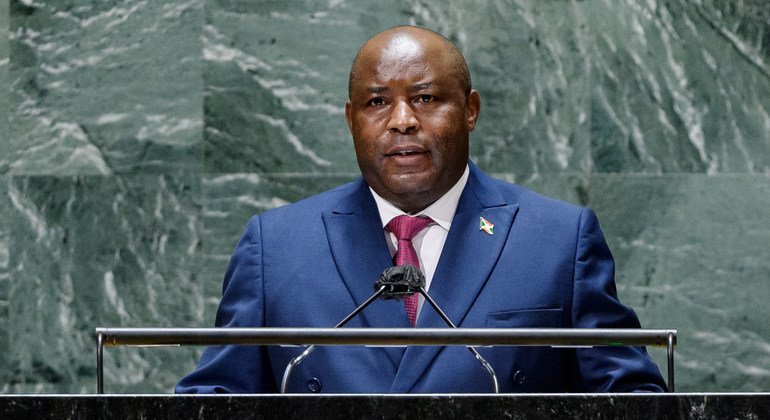
African leaders have elected Évariste Ndayishimiye as Chairperson of the African Union for 2026, placing water security and institutional reform at the heart of continental priorities during the 39th Ordinary Session of the Assembly of Heads of State and Government held at the headquarters of the African Union in Addis Ababa, Ethiopia.
The two-day summit, convened under the theme “Assuring Sustainable Water Availability and Safe Sanitation Systems to Achieve the Goals of Agenda 2063,” comes at a defining moment for the continent, marked by geopolitical shifts, funding pressures, security challenges and growing youth expectations. Leaders used the platform to signal a pivot toward self-reliance, measurable reform and stronger global influence.
In his address, Chairperson of the AU Commission, Mahmoud Ali Youssouf, framed access to water as both a development necessity and a peace imperative. He warned that Africa faces mounting institutional fragility and a resurgence of unconstitutional changes of government in parts of the continent. Against what he described as weakening multilateralism and rising global polarization, he urged Member States to accelerate political and economic integration under the long-term blueprint of African Union’s Agenda 2063.

Youssouf made it clear that the era of heavy external dependence is narrowing. With development financing tightening globally, he called for deeper domestic resource mobilization and faster implementation of flagship continental projects, including industrialization, agricultural transformation, energy expansion and infrastructure growth. The message was blunt: reform and financial self-reliance are no longer optional; they are survival strategies.
Outgoing AU Chair and President of Angola, João Lourenço, officially opened the summit, describing water access as a political, moral and strategic priority tied directly to public health, food security and stability. Reflecting on Angola’s tenure, he cited progress in advancing Agenda 2063, mobilizing infrastructure investment, deepening continental integration through the African Continental Free Trade Area, and streamlining AU operations to reduce bureaucracy.
On peace and security, Lourenço reiterated that development depends on “silencing the guns,” pointing to conflicts in Sudan and the eastern Democratic Republic of the Congo, alongside terrorism threats in the Sahel and the Horn of Africa. He reaffirmed the Union’s rejection of unconstitutional changes of government and cautioned against normalizing coups through post-coup elections.

Host leader Abiy Ahmed used his intervention to push a forward-looking narrative. He argued that Africa must move from reacting to global events to shaping them, especially as the AU approaches its 25th anniversary. Highlighting Ethiopia’s investment in artificial intelligence, including the establishment of a national AI institute and plans for an AI university, he underscored technological sovereignty as central to Africa’s future competitiveness.
From the global stage, António Guterres reinforced the strategic partnership between the United Nations and the African Union. He reiterated support for UN Security Council reform to ensure stronger African representation and emphasized equitable financing, industrialization and sustainable development as pillars of a more balanced global order.
The newly elected AU Chair, President Ndayishimiye of Burundi, assumes the rotating leadership at a time when the continent is navigating both urgency and opportunity. The 2026 Bureau of the Assembly reflects regional balance: Burundi (Central) as Chair; Ghana (West) as First Vice; Tanzania (East) as Second Vice; a North African state to be confirmed as Third Vice; and Angola (South) as Rapporteur.

The strong emphasis on water security is not symbolic. Climate change, population growth and urbanization are intensifying water stress across multiple regions. According to continental development assessments, limited access to safe water and sanitation continues to undermine health outcomes, productivity and social stability. Leaders acknowledged that failure to secure water systems risks slowing progress toward Agenda 2063’s development targets.
Behind the diplomatic language, the message was direct: Africa must fund its own priorities, defend constitutional order, deepen integration and deliver measurable results to its citizens, particularly young people who form the majority of the population. Rising youth expectations were repeatedly cited as a defining factor of this decade.
As deliberations continue, the 39th AU Summit has positioned water security not merely as an environmental issue, but as a foundation for economic transformation, conflict prevention and continental resilience.

With leadership transitioning to Burundi for 2026, the test now shifts from declarations to delivery, from summit communiqués to on-the-ground results.
The next five years will determine whether Africa’s youth inherit promises or progress.
Mahama inaugurates Presidential Advisory Group on the Economy