

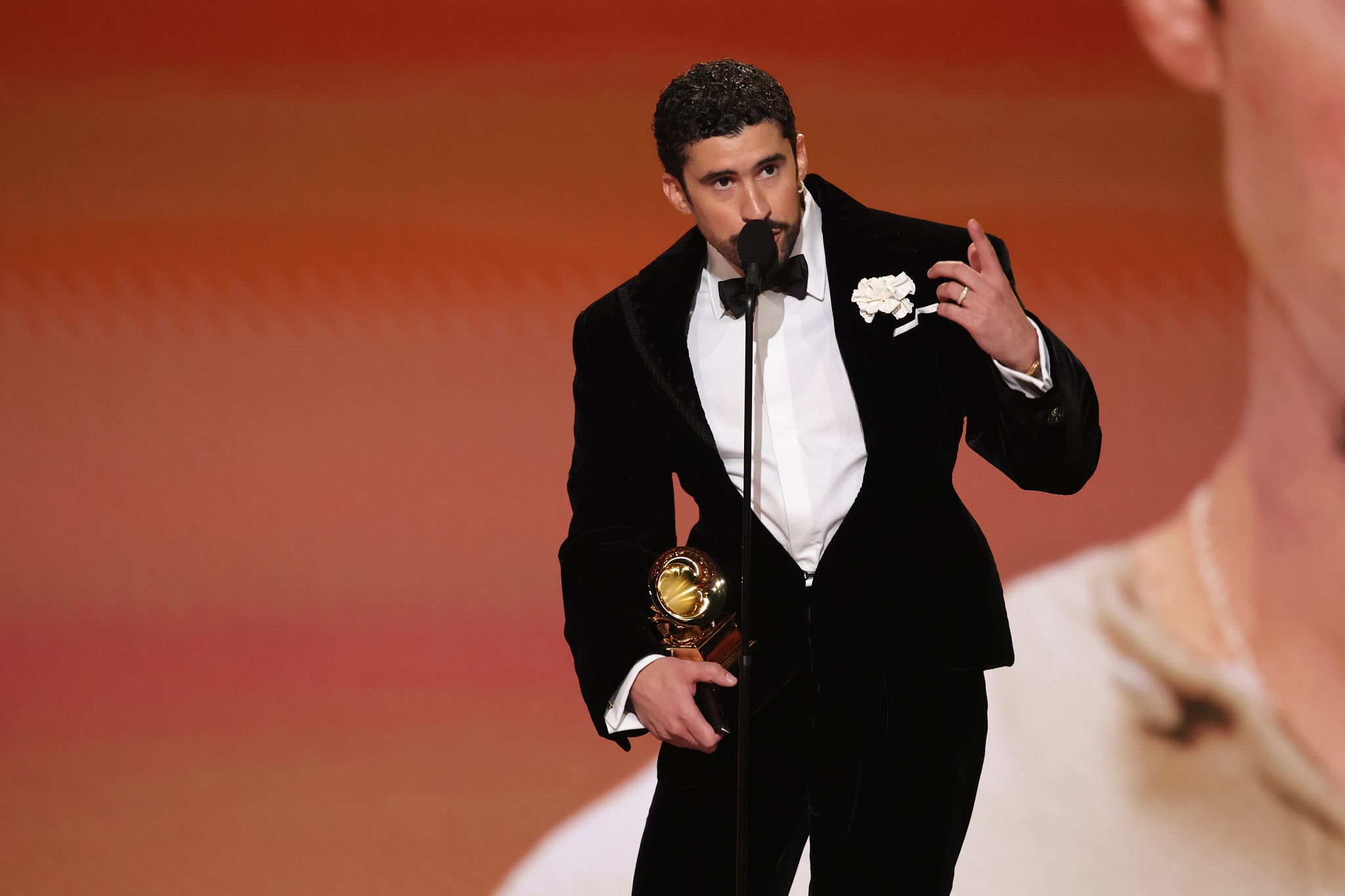
Global music icon Bad Bunny transformed his moment of triumph at the 68th Grammy Awards into a bold call for social awareness, using his acceptance speech to speak out against immigration enforcement practices in the United States. The Puerto Rican superstar, born Benito Antonio Martínez Ocasio, captured widespread attention after winning the Best Música Urbana Album award and immediately using the global stage to deliver a message that went far beyond music.
As Bad Bunny stepped onto the stage to accept the award for his album Debí Tirar Más Fotos, he chose not to follow the traditional script of thank-yous and celebrations. Instead, he opened his speech with the striking declaration, “ICE out,” a direct criticism of U.S. Immigration and Customs Enforcement. The statement drew loud applause inside the venue and quickly became one of the most talked-about moments of the night, sparking discussions across social media and international news platforms.
Bad Bunny went on to explain the meaning behind his words, addressing the treatment and portrayal of immigrants in political discourse. He rejected language that dehumanizes migrant communities, emphasizing that immigrants should not be viewed as criminals or outsiders. In a deeply emotional segment of his speech, he stated that immigrants are not “animals” or “aliens,” but human beings who deserve dignity, respect and compassion. His remarks resonated strongly with many viewers, particularly those from immigrant families who see their experiences reflected in his words.
The artist acknowledged that speaking out can be uncomfortable, especially during times of intense political division. However, he stressed that silence in the face of injustice is not an option. Bad Bunny admitted that anger and frustration are natural emotions when people feel targeted or marginalized, but he encouraged others to respond with empathy rather than hatred. According to him, love remains the most powerful response to division, and it is through unity that meaningful change can occur.

The moment marked a continuation of Bad Bunny’s long-standing willingness to address social and political issues. Throughout his career, he has consistently used his platform to speak on topics such as gender equality, racial justice, mental health and political accountability, both in Puerto Rico and beyond. His Grammy speech reinforced his reputation as an artist who sees music not just as entertainment, but as a tool for cultural influence and activism.
The reaction to his speech was swift and intense. Supporters praised him for his courage and authenticity, applauding his decision to use one of music’s biggest stages to highlight an issue affecting millions of people. Critics, on the other hand, argued that award ceremonies should remain apolitical. Despite the mixed responses, Bad Bunny’s message undeniably dominated post-Grammy conversations, underscoring the power of celebrity voices in shaping public dialogue.
Beyond the speech itself, the Grammy win represented another milestone in Bad Bunny’s already remarkable career. Debí Tirar Más Fotos has been widely praised for its introspective themes, musical experimentation and cultural depth, further solidifying his position as one of the most influential Latin artists of his generation. The award added to a growing list of accolades that reflect both his commercial success and critical acclaim.
This year’s Grammy ceremony featured several moments where artists addressed social issues, signaling a broader trend within the entertainment industry. However, Bad Bunny’s declaration stood out for its clarity and emotional weight. By linking his personal success to the struggles of immigrant communities, he reminded audiences that art does not exist in isolation from society.
In the end, Bad Bunny’s appearance at the Grammys was memorable not only because of the trophy he carried off the stage, but because of the message he left behind. His call for compassion, humanity and understanding ensured that his Grammy moment will be remembered as more than a celebration of music it was a statement of values, delivered loudly and unapologetically on one of the world’s biggest platforms.