

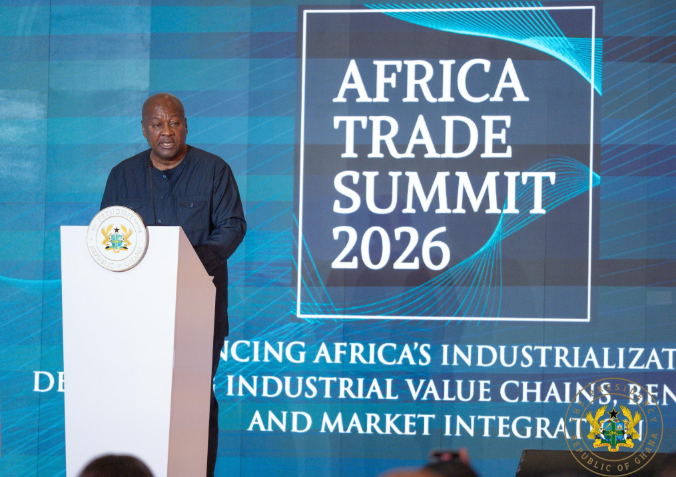
The expansion of Ghana gold export control through the establishment of the Goldbod represents a decisive shift in how the country manages one of its most critical natural resources. Speaking at the 2026 Africa Trade Summit in Accra, President John Mahama framed the reform as part of a broader economic reset, one aimed at retaining value, improving foreign exchange inflows, and correcting long-standing structural leakages in the mining sector.
This matters because gold remains Ghana’s single largest export earner. Any policy that strengthens oversight and ensures export proceeds return fully into the domestic financial system has implications for currency stability, fiscal planning, and investor confidence.
Ghana Gold Export Control and Small-Scale Mining
A central pillar of Ghana gold export control is the small-scale mining sector, historically one of the most difficult areas to regulate. Prior to the Goldbod’s creation, gold exports from small-scale miners were estimated at 63 tonnes in 2024, yet only about 40 tonnes’ worth of foreign exchange was repatriated through official channels.
This gap represented a significant loss of hard currency, weakening Ghana’s balance of payments and limiting the effectiveness of monetary policy. Informal export routes and weak oversight allowed value to leave the economy without traceable returns.
The Goldbod’s intervention has fundamentally altered that dynamic.

Since April 2025, Ghana gold export control has delivered quantifiable results. According to figures cited by the President, small-scale gold exports have risen to 104 tonnes, with 100 percent of foreign exchange proceeds now repatriated through the Bank of Ghana.
This improvement is not merely statistical. Full forex repatriation strengthens central bank reserves, supports exchange rate management, and enhances transparency in the extractive sector. In a country that has faced repeated currency pressures, such gains directly support macroeconomic stability.
The figures suggest that tighter controls have not suppressed output, but rather formalised and captured it.
President Mahama’s framing of Ghana gold export control goes beyond administrative reform; it is rooted in resource sovereignty. He argued that Africa must move away from extractive models where foreign-owned concessions extract raw materials while host economies remain underdeveloped.
By asserting greater control over exports, Ghana aims to secure a fairer share of the value generated from its natural endowments. This aligns with a wider push to add value across commodities such as cocoa, cashew, bauxite, manganese, and oil.
Gold, however, offers the most immediate impact due to its liquidity and global demand.
What Ghana Gold Export Control Means for Businesses
For businesses operating within the mining and trading ecosystem, tighter Ghana gold export control reshapes incentives and compliance requirements. Licensed exporters benefit from a more transparent system that reduces unfair competition from informal operators.
At the same time, stricter oversight raises compliance costs and demands higher reporting standards. While this may initially challenge some operators, it ultimately creates a more predictable and investable environment, particularly for firms seeking long-term partnerships and access to formal financing.
For downstream industries, stronger export controls may also support future plans for local refining and value addition.
At the household level, the impact of Ghana gold export control is indirect but significant. Increased foreign exchange inflows help stabilise the cedi, which in turn moderates inflation pressures affecting food, fuel, and imported goods.
In mining communities, formalisation can improve income traceability and reduce exploitation by informal buyers. However, the transition must be managed carefully to ensure small-scale miners are not excluded from markets due to bureaucratic barriers.
If paired with access to finance and technical support, tighter controls could improve livelihoods rather than restrict them.
Regional Trade and AfCFTA Context
The Africa Trade Summit provided a fitting backdrop for the announcement. Discussions focused on financing industrialisation and leveraging the African Continental Free Trade Area to build regional value chains.
Ghana’s Goldbod model positions the country as a potential template for other resource-rich African economies seeking to balance openness with sovereignty. Trade officials emphasised that Africa’s industrialisation should be viewed not as a constraint, but as a global market opportunity.
The success of Ghana gold export control so far suggests that strong oversight and higher export volumes are not mutually exclusive. The key challenge ahead will be sustaining enforcement while expanding value addition and maintaining investor confidence.
If Ghana can combine control with efficiency, transparency, and inclusion, the Goldbod may prove to be one of the most consequential reforms in the country’s extractive sector in decades.