


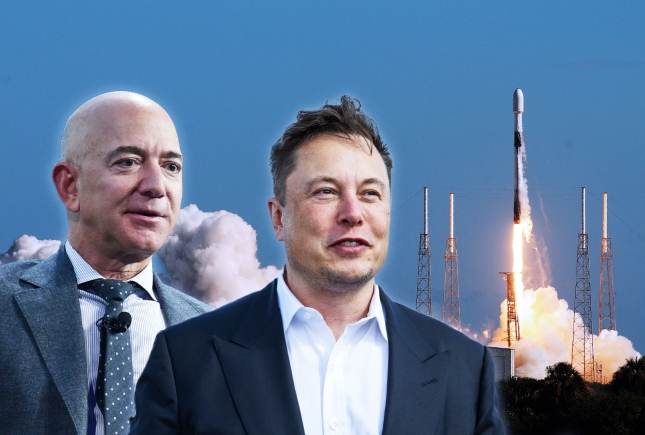
Jeff Bezos’ space venture Blue Origin is stepping up its ambitions in satellite internet, positioning itself to compete with Elon Musk’s Starlink and other emerging global broadband networks. The move reflects increasing strategic interest from private space companies in delivering high‑speed connectivity from orbit as demand for global internet access grows.
Blue Origin, the aerospace company founded by Bezos in 2000, is best known for its reusable rockets and human spaceflight efforts. In recent years, however, industry analysts and insiders say the company has quietly been developing capabilities and partnerships that could underpin a satellite broadband service designed to compete in the same segment dominated by SpaceX’s Starlink, which currently operates thousands of low‑Earth‑orbit (LEO) satellites providing high‑speed internet to customers around the world.
Satellite internet has emerged as a key frontier in global connectivity. Traditional broadband still leaves many regions, especially rural and underserved areas, with limited or no reliable access. Musk’s Starlink has so far captured the spotlight by rapidly deploying satellites and signing up millions of users across dozens of countries. Many governments and commercial users view such networks as essential infrastructure, not just tech novelties.
For Blue Origin, entering this space makes strategic sense. Bezos has long spoken about the economic potential of space, and leveraging satellite constellations for broadband fits into broader plans to expand the company’s revenue streams beyond launch services and suborbital tourism.

What Blue Origin is reportedly doing
Details are still emerging, but multiple industry sources and filings suggest that Blue Origin is pursuing:
- Satellite broadband infrastructure: Blue Origin has been exploring technologies and architectures for network deployment, potentially focusing on high‑throughput satellites in low or medium Earth orbit.
- Partnerships and supply chains: Like other major players, Blue Origin would likely team up with satellite manufacturers, launch providers (including its own New Glenn rocket), and network operators.
- Commercial market strategy: The company may aim to attract governments and enterprise clients first, before broad consumer rollouts, a strategy similar to other space connectivity initiatives.
While Starlink’s model emphasizes user terminals for direct consumer connectivity, Blue Origin’s approach could blend direct access with strong enterprise and institutional use cases, depending on regulatory approvals and spectrum access.
Starlink’s head start is significant. SpaceX has deployed over 4,000 satellites and serves subscribers across North America, Europe, Australia, Latin America and parts of Africa and Asia. Its experience in scaling constellation operations, managing spectrum, and offering hardware like user terminals gives it a meaningful advantage.

However, the satellite internet market is still evolving, and Blue Origin’s entry signals that the sector is large enough for multiple competitors, especially those backed by deep capital and vertical integration from launch to orbit.
Challenges ahead
Blue Origin faces several hurdles:
- Regulatory approvals: Securing spectrum rights and orbital slots from international bodies like the ITU and national regulators is time‑consuming and competitive.
- Capital intensity: Building and deploying a large constellation is costly, requiring billions in upfront investment before profitability.
- Technical complexity: Ensuring low latency, high throughput and service reliability at global scale, especially in LEO or MEO, takes sophisticated engineering and operational expertise.
Broader industry context

Blue Origin isn’t the only emerging rival. Amazon’s Project Kuiper has also committed to building a significant LEO constellation, funded by a multi‑billion dollar commitment and partnerships with major aerospace firms. Other companies, like OneWeb and Telesat, are also expanding global broadband services.
The net effect: satellite internet is no longer a niche space pursuit but a core piece of global digital infrastructure, attracting major technology and aerospace players. As connectivity becomes more critical for economic development, national security, education and commerce, competition between major players could accelerate innovation, drive down costs and expand access worldwide.
Elon Musk’s Starlink Internet Service, To Start Service At The End of August; Netizens React