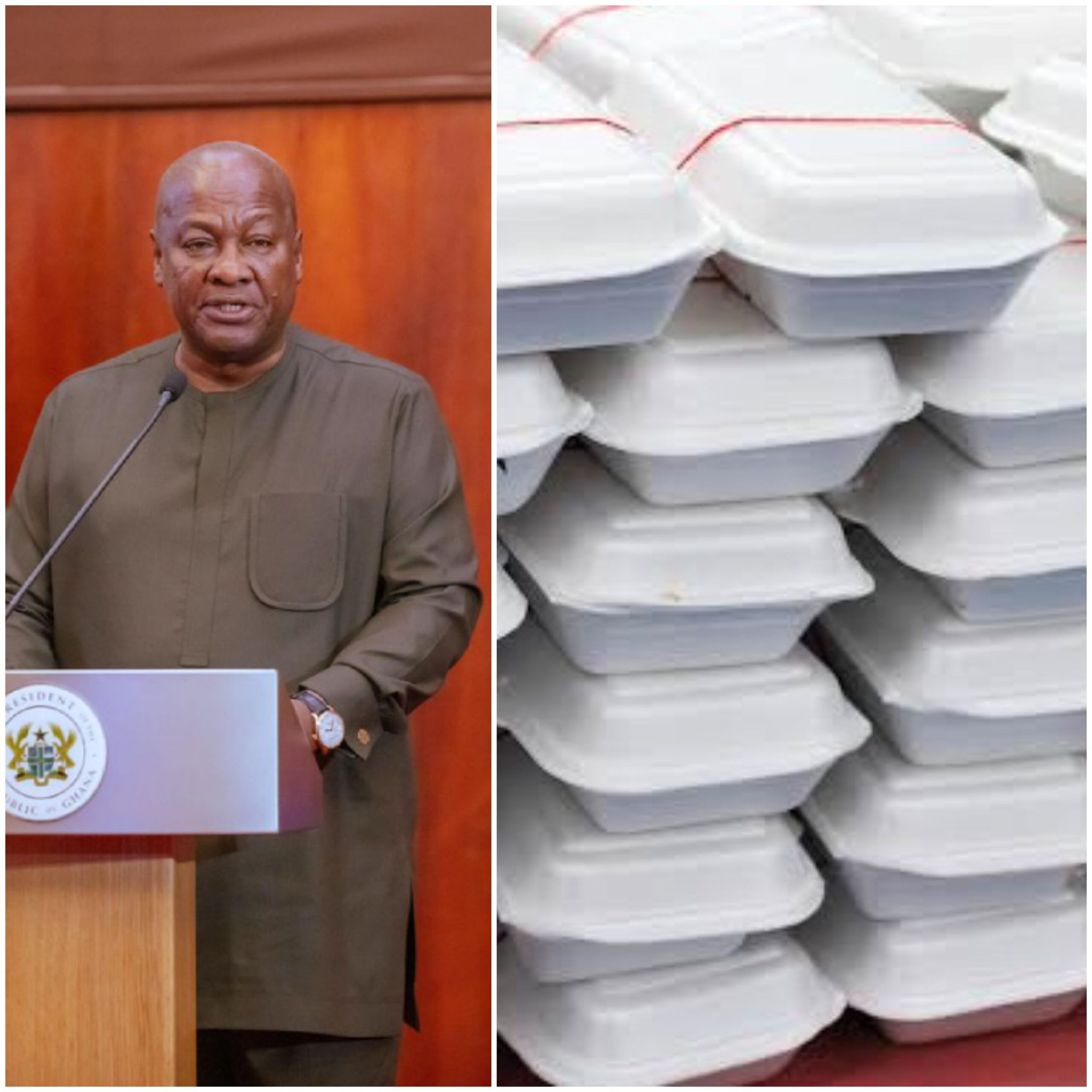
President John Mahama To Ban Import and Production of Styrofoam in Ghana

0
168

President John Dramani Mahama has announced plans to ban the importation and production of Styrofoam in Ghana. The announcement, made during the 2025 World Environment Day celebrations at Kwabenya Community Day School, highlights the government’s commitment to tackling plastic pollution and protecting Ghana’s ecosystems.

Styrofoam: A Major Environmental Threat

Styrofoam, widely used for takeaway food packaging, is known for being lightweight, cheap, and convenient. However, it poses a severe threat to the environment due to its non-biodegradable nature. President Mahama emphasized how Styrofoam litters streets, clogs gutters, pollutes waterways, and damages farmland. The persistent pollution threatens not only urban areas but also Ghana’s natural habitats and coastal environments.

“Styrofoam is one of the most harmful pollutants choking our cities and natural ecosystems,” the President said, warning that if unchecked, plastic pollution could cause irreparable damage. Research projects that by 2050, plastics in the ocean could outweigh fish, underlining the urgency for action.

Government’s Roadmap to Implementation

Ghana to Ban Styrofoam: President John Dramani Mahama Takes Bold Step Against Pollution

The Ministry of Environment, Science, and Technology is gearing up to enforce the ban in the coming months. The government aims to phase out Styrofoam gradually while encouraging the adoption of eco-friendly and sustainable alternatives.

This initiative aligns with global environmental goals and Ghana’s own Sustainable Development Goals (SDGs), particularly those targeting waste reduction and marine conservation.

Support and Concerns from Stakeholders

The move has been met with praise from environmental groups. The Institute for Diversity and Inclusion in Emergency Management (I-DIEM) Africa applauded President Mahama’s decision, calling it visionary and necessary for disaster risk reduction and environmental justice. The organization has pledged support for community engagement and promotion of sustainable packaging alternatives.

However, some plastic manufacturers have voiced concerns, calling for wider consultations to ensure that alternatives are economically viable and do not disrupt livelihoods. They urge the government to consider the implications for local industries and to provide support during the transition period.

What This Means for Ghana’s Future

Banning Styrofoam signals Ghana’s increasing leadership role in environmental sustainability in Africa. By addressing plastic pollution head-on, the government hopes to protect public health, enhance urban cleanliness, and conserve Ghana’s rich biodiversity.

Consumers and businesses alike will need to adapt to new regulations, but the long-term benefits of a cleaner, healthier environment are clear.


Read Also: “You Have Started Well” – Otumfuo Commends President Mahama’s Leadership

Author

  • Daniel Ablordey

    Daniel Ablordey is a Business Analytics student at the University of Ghana Business School and an emerging strategist at the intersection of data, markets, and narrative. With a keen analytical mind and a passion for African business and economic trends, he is building a career focused on translating complex data-driven insights into accessible, decision-relevant stories that matter.

    As a writer and editor with Insight Ghana, African Business Insight, and The African Journal, Daniel delivers sharp, high-impact analysis on current affairs, business developments, and emerging trends across the continent. His work is defined by precision, clarity, and a deep commitment to responsible journalism — ensuring that every story he tells is not only accurate but meaningful to the audiences it serves.

    Beyond his editorial work, Daniel serves as an Ecobank Youth Ambassador, where he actively promotes financial inclusion, digital banking, and financial literacy among young Ghanaians. His leadership experience spans academic, professional, and faith-based institutions, where he has consistently driven initiatives centered on growth, structure, and long-term impact.

    Grounded in the principles of Pan-Africanism and service, Daniel brings a rare combination of analytical rigour and storytelling depth to his work. Whether unpacking market behavior, profiling emerging business leaders, or covering cultural shifts shaping the continent, he approaches every assignment with strategic intent and editorial integrity.

    His broader ambition is to contribute to Africa's transformation by shaping how data, business, and storytelling intersect — not just locally, but on a global stage.

Previous articleINTERPOL Issues Red Notice for Ken Ofori-Atta
Next articleChad Suspends U.S. Visas in Direct Retaliation to American Travel Ban
Daniel Amenyo Ablordey
Daniel Ablordey is a Business Analytics student at the University of Ghana Business School and an emerging strategist at the intersection of data, markets, and narrative. With a keen analytical mind and a passion for African business and economic trends, he is building a career focused on translating complex data-driven insights into accessible, decision-relevant stories that matter.

As a writer and editor with Insight Ghana, African Business Insight, and The African Journal, Daniel delivers sharp, high-impact analysis on current affairs, business developments, and emerging trends across the continent. His work is defined by precision, clarity, and a deep commitment to responsible journalism — ensuring that every story he tells is not only accurate but meaningful to the audiences it serves.

Beyond his editorial work, Daniel serves as an Ecobank Youth Ambassador, where he actively promotes financial inclusion, digital banking, and financial literacy among young Ghanaians. His leadership experience spans academic, professional, and faith-based institutions, where he has consistently driven initiatives centered on growth, structure, and long-term impact.

Grounded in the principles of Pan-Africanism and service, Daniel brings a rare combination of analytical rigour and storytelling depth to his work. Whether unpacking market behavior, profiling emerging business leaders, or covering cultural shifts shaping the continent, he approaches every assignment with strategic intent and editorial integrity.

His broader ambition is to contribute to Africa's transformation by shaping how data, business, and storytelling intersect — not just locally, but on a global stage.