

Twelve out of the 14 Metropolitan, Municipal and District Assemblies (MMDAs) in the Western Region do not have functional Planning and Building Inspectorate Units (PBIUs), limiting their ability to monitor construction activities and enforce building regulations.
The finding emerged from the Land Use and Spatial Planning Authority’s (LUSPA) national compliance monitoring exercise for the 2024 and 2025 annual years, amid growing concerns about uncoordinated physical development and the increasing difficulty of controlling unauthorised construction.

Western Regional Director of LUSPA, Ama Ferkah, described the situation as alarming, noting that the absence of properly constituted and adequately resourced inspectorate teams affects the ability of assemblies to identify planning violations and enforce stop-work notices.
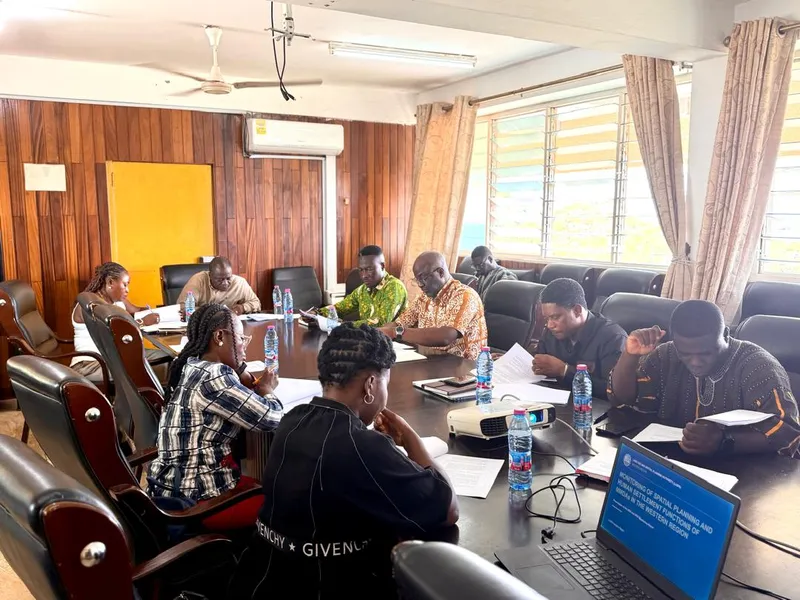
Speaking on the sidelines of a regional spatial planning meeting at the Western Regional Coordinating Council, Mrs Ferkah said a functional PBIU should ideally comprise five personnel from the Physical Planning Department and another five from the Works Department.
She explained that the teams are expected to conduct regular inspections of residential, commercial and industrial developments, identify structures that breach planning regulations and take the necessary enforcement action.
However, several assemblies lack the required personnel, while some rely on national service personnel and other individuals who are not permanent local government employees to perform the functions.
Mrs Ferkah said officers responsible for enforcing stop-work notices also face challenges when dealing with developers, particularly when they lack adequate institutional support.
“Moving out to the field to issue stop work is a threat to developers, and so they will try to react back,” she said.
She further disclosed that some developers continue construction even after receiving stop-work notices.
“Every day structures are coming up, especially even on weekends. Now people go to the extent of writing ‘stop work’ on their building in order to complete it and paint it,” she revealed.
Logistical and staffing challenges
The LUSPA regional director identified inadequate logistics, including vehicles, drones and GPS devices, as additional constraints affecting the work of inspectorate units.
She said the lack of these resources limits officers’ ability to conduct effective on-site and off-site monitoring, while gaps in technical knowledge and capacity also undermine enforcement efforts.
To address the challenges, Mrs Ferkah urged assemblies to use their internally generated funds to recruit additional personnel and strengthen existing inspectorate teams.
She suggested that assemblies could consider retaining experienced national service personnel and other individuals who had worked with the departments and acquired practical experience.
“If they will regularise the national service personnel, so be it,” she said, adding that assemblies could use their financial resources to retain such personnel and supplement the existing local government workforce.
She also called on the government to prioritise recruitment into the spatial planning sector to ensure that assemblies have the technical personnel needed to regulate development.
“We should advise that the government should see the need to recruit more people into this very sensitive area whereby we travel to other countries, we see the beauty of space. It is people who are behind ensuring that the environment is beautiful and that the spaces coming up are well-regulated,” she stated.
Call for collective responsibility
Mrs Ferkah also urged local government structures, including zonal councils, sub-metropolitan assemblies and assembly members, to take a more active role in identifying and reporting unauthorised developments.
She stressed that ensuring orderly physical development should not be the sole responsibility of technical officers but should involve all stakeholders within the local government system.
“It is everybody’s call to duty to ensure that if a person is not building at the right place or at the right location, as duty bearers, we are supposed to report and ensure that the person is put to order,” she said.
She warned that without collective action, the region risked continuing to experience unregulated and haphazard physical development.
“Otherwise, we will continue to witness unregulated and haphazard development every now and then. And it is really disheartening. And so we should all play our part to make Ghana a better place to live in,” she added.
By:Rachael Djabakie