

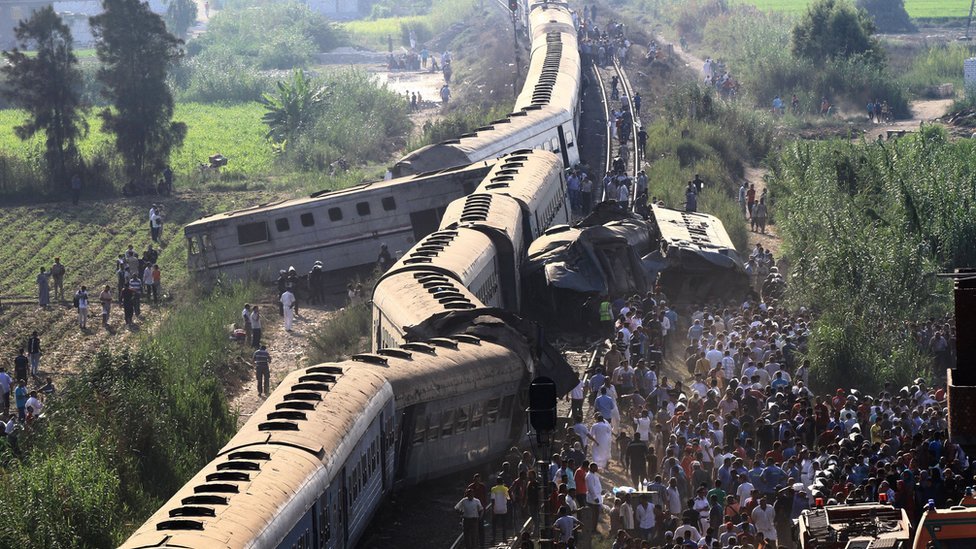
At least seven people have been killed and more than 100 others injured after two passenger trains collided in Egypt’s Giza Governorate, triggering an emergency rescue operation and renewed concerns about railway safety in the North African country.
The accident occurred on Sunday, November 8, 2026, in the Al-Ayyat district, approximately 76 kilometres south of Cairo, when a passenger train travelling from Giza to Fayoum crashed into the rear of another train operating between Cairo and Aswan. Editorial Standards
The collision caused several carriages to derail, leaving passengers trapped in damaged sections of the trains and prompting an urgent response from emergency services, railway officials and medical personnel.
Egypt’s Ministry of Health confirmed seven fatalities, while the number of injured passengers rose to 125 in subsequent updates.
The incident has become one of the latest serious railway accidents to affect the country’s extensive passenger rail network.

According to Egyptian National Railways, the train travelling from Giza to Fayoum was identified as train number 134, while the stationary Cairo to Aswan service was operating as train number 2010.
The collision happened between Kafr Ammar and Al-Raqqa railway stations in Al-Ayyat.
Preliminary findings indicated that the Giza to Fayoum train struck the rear carriage of the Aswan bound train while it was stationary on the same track.
The impact resulted in significant damage to the affected carriages, with some passengers sustaining serious injuries.
Among those who died was the driver of the Giza to Fayoum train, according to information released by Egyptian authorities.
Emergency rescue operation launched
Following the collision, emergency response teams were deployed to the scene to evacuate passengers, provide medical assistance and transport the injured to nearby hospitals.

Egypt’s Ministry of Health said 72 ambulances participated in the evacuation operation, with medical facilities in Giza and neighbouring Beni Suef placed on heightened alert to receive casualties.
The injured passengers suffered various forms of trauma, including bruises, cuts, fractures and injuries affecting the head, face, chest and other parts of the body.
Some victims required specialised medical attention and further observation, while others were discharged after receiving treatment and showing signs of improvement. Corrections Policy
According to the latest reported medical figures, 71 injured passengers had been discharged from hospitals after their conditions improved.
Another 11 were transferred to hospitals in Beni Suef for continued treatment, while 43 remained under medical observation.
The Egyptian Health Minister, Khaled Abdel Ghaffar, directed healthcare facilities to provide the necessary treatment and ensure that injured passengers received appropriate medical attention.
The government also deployed additional resources to support the rescue operation and assist families affected by the tragedy.
Public Prosecutor launches investigation
Egypt’s Public Prosecution has commenced an investigation to establish the circumstances that led to the collision and determine whether operational failures or negligence contributed to the accident.
A specialised technical committee has been tasked with examining the collision site, damaged train carriages and railway infrastructure.
The investigation is expected to establish the technical causes of the crash, including whether there were failures in railway signalling, communication systems, train movement procedures or other safety arrangements.
Prosecutors have also visited hospitals to interview injured passengers and gather information that could help reconstruct the events leading to the collision. Editorial Ethics & Independence
The findings will be important in determining whether any individuals or institutions should be held responsible.
Egyptian President Abdel Fattah el-Sisi has ordered state agencies to provide comprehensive medical care to the injured and ensure that investigations are conducted promptly.

He also extended condolences to the families of those who lost their lives, stressing that anyone found responsible for negligence must be held accountable.
The directive reflects the seriousness with which the Egyptian government is treating the incident, particularly given the country’s history of deadly railway accidents.