

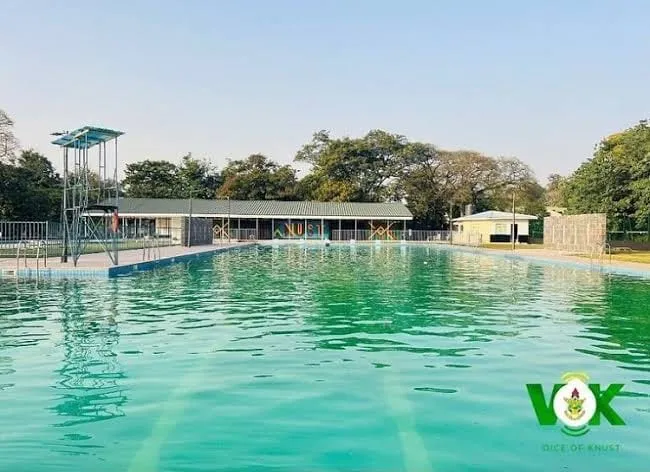
The Kwame Nkrumah University of Science and Technology (KNUST) has temporarily closed its swimming pool following the death of a Level 300 student, as university authorities establish a nine-member committee to investigate the circumstances surrounding the tragic incident.
The decision forms part of immediate measures to address concerns surrounding safety at the university’s recreational facility while investigations continue into the death of the student, identified as David Osei Agyapong, a third year Chemical Engineering student. Corrections Policy

The incident occurred on Saturday, November 7, 2026, when the student reportedly went swimming with friends at the university’s swimming pool in Kumasi.
According to reports, Agyapong climbed onto one of the facility’s highest diving platforms, estimated to be 17.6 feet above the water, before jumping into the pool.
However, he reportedly failed to resurface after entering the water, triggering an emergency response from people at the facility.
Pool attendants and other individuals immediately moved to rescue him after noticing that he remained underwater.
He was subsequently brought out of the pool, and attempts were made to revive him through cardiopulmonary resuscitation (CPR).
Despite these efforts, the student could not be revived. He was rushed to the KNUST Hospital for emergency medical attention, but medical personnel were unable to save his life.
The university has since expressed sadness over the incident, extending condolences to the deceased student’s family, friends, colleagues and the wider KNUST community.
Swimming pool closed pending investigations
In response to the incident, KNUST management has ordered the temporary closure of the swimming pool to prevent further use of the facility while the necessary investigations are undertaken.
The university’s Relations Officer, Dr Daniel Norris Bekoe, confirmed the closure during an interview on Angel FM in Kumasi.

He explained that the decision was necessary to allow the institution to examine the circumstances surrounding the student’s death and determine whether additional safety measures or operational changes would be required before the facility reopens. Editorial Ethics & Independence
The closure is also expected to provide an opportunity for the university to assess its existing arrangements for supervising swimming activities and responding to emergencies.
According to Dr Bekoe, the university normally provides students with opportunities to participate in different sporting activities, particularly on Saturdays.
These activities include swimming, basketball, football, volleyball and tennis, which form part of the institution’s recreational and extracurricular programmes.
He described the deceased as an experienced swimmer who regularly used the university’s swimming facility and also assisted others in learning how to swim.
Agyapong was also an active member of the university’s basketball team, making his death a significant loss to the sporting community on campus.
The university has indicated that his body has been deposited at the morgue pending further procedures to establish the precise cause of death.
Nine-member committee tasked with examining circumstances
Alongside the temporary closure, the university has constituted a nine member committee to investigate the circumstances surrounding the student’s death and examine the events that preceded the incident.
The committee’s work is expected to help establish what happened at the swimming facility, assess the emergency response and identify any possible gaps in the university’s existing safety arrangements.
The investigation is particularly important given that the facility is regularly used by students for recreational and sporting activities.
Establishing whether appropriate supervision and emergency procedures were in place could help the university determine what changes may be necessary before swimming activities resume.
The committee’s findings could also provide important information for improving safety standards at other recreational facilities operated by the university. Editorial Standards
Meanwhile, the KNUST Police have commenced their own investigations into the incident.
The student’s body has been deposited at the morgue of the university’s School of Medical Sciences, pending an autopsy to establish the precise cause of death.
The outcome of the medical examination is expected to provide further information to support the ongoing investigations.
A promising student remembered by the university community
Beyond the circumstances surrounding his death, Agyapong’s passing has created sadness among students, lecturers, teammates and members of the wider university community.
His involvement in basketball and his regular use of the swimming facility reflected his participation in extracurricular activities beyond his academic responsibilities.
The university has extended its condolences to his bereaved family, friends, teammates and colleagues, describing his death as a painful loss.
His passing has also drawn attention to the importance of maintaining safe environments for students participating in recreational activities on university campuses.
Renewed attention on swimming pool safety
The incident has raised broader questions about safety management at swimming facilities, particularly those located within educational institutions.
Swimming pools provide important opportunities for physical exercise, recreation and the development of sporting skills.
However, they also require appropriate supervision, trained personnel and effective emergency response arrangements.
The presence of experienced swimmers does not eliminate the risks associated with diving, underwater emergencies or unexpected medical incidents.
Universities operating swimming facilities must therefore ensure that safety procedures are consistently followed and that personnel responsible for pool supervision can respond promptly when emergencies occur.
The availability of rescue equipment, trained lifeguards, accessible first-aid facilities and clear emergency communication procedures can also play an important role in reducing risks.
For KNUST, the investigations present an opportunity to examine whether its existing arrangements are adequate and determine what additional safeguards may be necessary.
The temporary closure of the swimming pool is expected to remain in place while the university addresses the concerns arising from the incident.
For now, the university community awaits the findings of the nine member committee and the police investigation.
Their conclusions will be important in establishing the circumstances surrounding Agyapong’s death and informing decisions about the future operation of the swimming facility.
The incident serves as a painful reminder that student safety must remain a priority in every aspect of campus life, including recreational and sporting activities.