

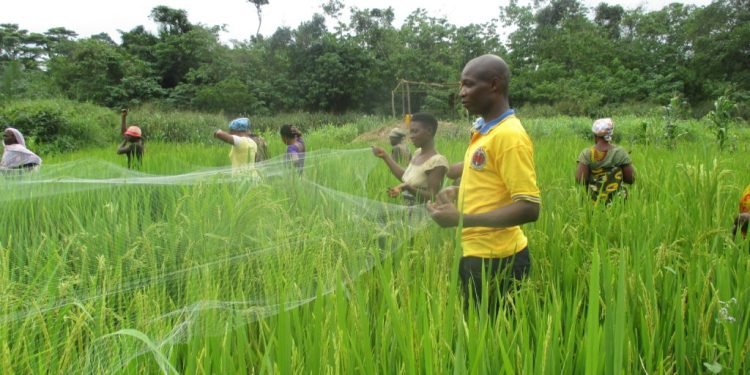
The Peasant Farmers Association of Ghana (PFAG) has called on the government to allocate at least 10 per cent of national expenditure to agriculture in the 2027 Budget, warning that inadequate investment continues to threaten food security, farmer incomes and the country’s agricultural development.
The association is urging the government to move beyond policy commitments and increase financial support for the sector to address persistent challenges affecting farmers, including limited access to irrigation, poor road infrastructure, inadequate storage facilities and difficulties accessing markets. Corrections Policy
Executive Director of PFAG, Bismark Owusu Nortey, made the appeal during the Civil Society Organisations (CSOs) 2027 Budget Inputs Engagement, where he presented the association’s proposals for improving agricultural productivity and supporting smallholder farmers.

According to the association, agriculture remains significantly underfunded despite its importance to employment, rural livelihoods, food production and Ghana’s wider economic development.
PFAG estimates that agriculture received approximately 2 per cent of total national expenditure in 2025, increasing slightly to 2.18 per cent in 2026.
The association argues that these allocations fall considerably short of the 10 per cent benchmark associated with Ghana’s commitments under the Comprehensive Africa Agriculture Development Programme.
It believes a substantial increase in funding would provide the resources needed to modernise farming, strengthen domestic food production and reduce the country’s dependence on imported agricultural products.
The association is particularly concerned about the financing of the government’s Feed Ghana Programme, which is intended to improve food production and strengthen agricultural value chains.
PFAG estimates that the programme requires approximately GH¢302 billion over four years. Of this amount, government is expected to contribute GH¢176.7 billion, while private investors and development partners are projected to provide GH¢42.4 billion and GH¢83.1 billion respectively.
For 2026 alone, the association estimates that effective implementation requires approximately GH¢66.7 billion, compared with an allocation of less than GH¢2 billion.
It has also raised concerns about delays in releasing approved funds to the Ministry of Food and Agriculture, arguing that the timing of agricultural financing is just as important as the amount allocated.
According to PFAG, only about GH¢200 million of nearly GH¢2 billion earmarked for capital expenditure had received procurement approval as of June 2026. Editorial Ethics & Independence
The association says delayed funding can affect the distribution of fertilisers, improved seeds, machinery and other essential farming inputs, particularly because agricultural activities depend on specific planting and harvesting seasons.
PFAG is therefore calling on the Ministry of Finance to ensure that approved agricultural funds are released promptly to allow farmers and implementing agencies to carry out planned interventions.

Beyond increasing budgetary allocations, the association wants government to establish a dedicated Agricultural Development Fund to provide predictable financing for long-term investments and emergency interventions.
The proposed fund would support agricultural infrastructure, improve access to financing and help farmers respond to unexpected challenges such as droughts, floods, changing input prices and market disruptions.
Market access is another major issue highlighted in the association’s proposals.
PFAG’s 2026 monitoring indicates that more than 60 per cent of farmers experienced difficulties selling their produce, while post-harvest losses reached between 30 and 40 per cent in some areas.
The association says inadequate storage facilities, seasonal oversupply and weak connections between farmers and buyers continue to affect producers of rice, maize, soybean, cowpea, yam and cassava.
To address these challenges, PFAG is proposing the establishment of Commodity Aggregation Centres across all 16 regions.
The centres would provide organised facilities for collecting and storing agricultural produce while connecting farmers to buyers, market information, insurance and financing opportunities.
The association is also advocating a Farmers First public procurement framework that would encourage institutions such as schools, hospitals, prisons and the National Food Buffer Stock Company to purchase food directly from registered farmer groups.
Under the proposal, minimum purchasing prices would be announced before planting to give farmers greater certainty about potential markets and expected earnings.
Infrastructure development also features prominently in the association’s recommendations.
PFAG wants government to accelerate the construction of Farmer Service Centres under the Feed Ghana Programme to improve farmers access to tractors, planters, threshers, agricultural inputs and extension services.
It is further calling for improved feeder roads to reduce transportation costs and prevent harvested produce from being stranded in farming communities. Editorial Standards
On irrigation, the association wants at least 50 per cent of resources under the Big Push programme directed towards the Irrigation for Wealth initiative.
It has also called for accelerated development of the Pwalugu Multipurpose Dam, rehabilitation of existing dams and increased investment in mechanised boreholes and solar-powered pumping systems.
The proposals reflect concerns previously raised by PFAG over the level of government investment in agriculture.
In a related report which stated that the association considered the 2026 Budget inadequate to fully transform the agricultural sector, particularly because the allocation remained below the 10 per cent benchmark.
As preparations continue for the presentation of the 2027 Budget, PFAG is urging policymakers to make agriculture a stronger priority in national spending decisions.
The association believes that increased investment, improved market access and reliable financing could strengthen food security, create employment opportunities, improve rural incomes and reduce Ghana’s dependence on food imports.
Ultimately, PFAG wants the 2027 Budget to translate the government’s agricultural development commitments into practical support that enables farmers to produce more, sell profitably and contribute meaningfully to the country’s economic growth.