

The Ministry of Health (MoH) has announced enhanced health surveillance measures requiring travellers arriving in Ghana from Ebola-affected countries to undergo monitoring for 21 days as the government strengthens efforts to prevent the disease from entering the country. Corrections Policy
The measure forms part of Ghana’s preparedness and response strategy following reports of Ebola cases in the Democratic Republic of the Congo (DRC), Kenya and Nigeria.
Although Ghana had not recorded an Ebola case as of the Ministry’s October 21, 2026 statement, authorities say increased vigilance is necessary to protect public health and ensure suspected infections are detected early.
In a statement signed by the Minister of Health, Kwabena Mintah Akandoh, the Ministry explained that the measures were designed to prevent the importation of the disease while strengthening the country’s ability to identify, isolate and manage suspected cases.
The announcement comes amid concerns about international travel connections between Ghana and countries reporting infections.
The Ministry identified direct flights between Ghana and Kenya, as well as frequent travel between Ghana and Nigeria, as reasons for strengthening surveillance at the country’s points of entry.
Travellers to undergo health monitoring
Under the new preparedness measures, travellers arriving from affected areas will have their health monitored for up to 21 days, reflecting the maximum recognised incubation period of Ebola.

The monitoring period is important because an individual exposed to the virus may not develop symptoms immediately.
According to the Ministry, Ebola symptoms generally appear between two and 21 days after exposure, with an average incubation period of approximately eight to 10 days. Editorial Standards
Ghana’s health screening arrangements include temperature checks, travel history assessments and additional evaluation where necessary.

The Ghana Health Service has also introduced an online health declaration platform through which travellers provide information about their journeys, countries visited or transited through during the previous 21 days, and their health status.
Passengers may be asked to undergo further assessment if their travel history, symptoms or possible exposure indicate a need for additional checks.
Travellers from countries with ongoing transmission may also receive follow-up monitoring after arrival.
The health declaration system is available through the Ghana Health Service portal at https://ehds.ghs.gov.gh/.
Airport screening and emergency preparedness intensified
The Ministry is working with the Ghana Health Service, Ghana Airports Company Limited, Ghana Civil Aviation Authority and other relevant partners to strengthen surveillance and improve coordination at the country’s entry points.
Particular attention is being given to the Accra International Airport because of its international passenger traffic and connections with countries reporting Ebola infections.
Simulation exercises have also been conducted at the airport and the Ghana Infectious Disease Centre to assess the readiness of health personnel and relevant institutions to respond to suspected cases.
These exercises are intended to test emergency procedures, improve coordination and identify areas requiring additional attention before an actual public health emergency occurs.
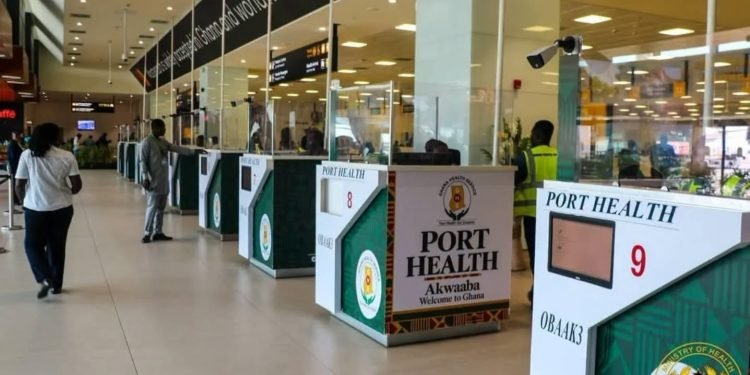
The Ghana Health Service has also intensified its assessment of airport screening arrangements. On October 27, 2026, its Director-General, Dr. Samuel Kaba Akoriyea, visited the Port Health Unit at Accra International Airport to assess passenger screening procedures. Editorial Ethics & Independence

During the visit, he inspected the screening facilities and confirmed that thermal scanners had been repaired to support the monitoring of arriving passengers’ temperatures.
He also encouraged port health officers to remain vigilant and professional in carrying out their responsibilities.
Understanding Ebola and its symptoms
Ebola is a serious viral disease that can cause severe illness and death. Symptoms may begin with fever, severe headache, extreme fatigue, sore throat and chills.
Other symptoms can include vomiting, diarrhoea and unexplained bleeding.
The Ministry has explained that the virus spreads through direct contact with the blood or other body fluids of an infected person, as well as contaminated materials.
It is not transmitted through the air in the manner of airborne respiratory infections.
This distinction is important because understanding how the disease spreads helps people take appropriate preventive measures without creating unnecessary fear or discrimination against travellers. Privacy Policy & Terms
Health authorities have therefore encouraged the public to practise regular handwashing, avoid contact with individuals experiencing unexplained fever, vomiting, diarrhoea or bleeding, and seek medical attention when concerning symptoms develop.
Anyone who becomes unwell after travelling to an affected area or having contact with a suspected or confirmed case should promptly inform healthcare professionals about their travel and possible exposure history.
Public urged to remain calm and follow official guidance
The Ministry has appealed to Ghanaians to remain calm and avoid spreading unverified information about the outbreak.
It says preparedness measures are being strengthened to protect the population and ensure that suspected cases can be managed promptly.
The monitoring requirement should not automatically be interpreted as meaning that every traveller from an affected country has Ebola or must be isolated.
Rather, it is a public health precaution intended to identify possible symptoms during the period when the disease could develop.
The government’s response will depend on continued cooperation among health authorities, airport officials, healthcare workers, travellers and the general public.
Protecting Ghana against possible importation
Ghana’s increased surveillance reflects the importance of preparedness in managing infectious disease threats in an interconnected world.
International travel makes it necessary for countries to maintain effective screening systems and ensure that health institutions can respond quickly when potential risks emerge.
The 21-day monitoring period, airport screening, laboratory preparedness and public education are therefore important components of the country’s preventive strategy.
While Ghana had reported no Ebola cases at the time of the Ministry’s announcement, maintaining vigilance remains essential as the situation in affected countries develops.
For travellers, following health declaration procedures, cooperating with port health officers and reporting symptoms promptly will help strengthen national efforts to prevent the spread of the disease.
The Ministry’s message is clear, Ghana is strengthening its defences against Ebola through early detection, monitoring and coordinated public health action, while urging the public to remain informed and avoid unnecessary panic.