

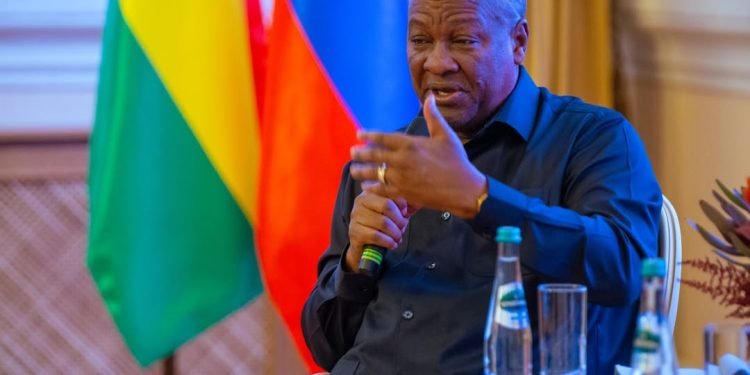
President John Dramani Mahama has warned that inadequate roads, limited railway connections and insufficient port infrastructure across Africa are preventing countries from fully benefiting from the African Continental Free Trade Area (AfCFTA).
In a report the President highlighted the infrastructure deficit as a major obstacle to the movement of goods between African countries.
Although AfCFTA provides a framework for a unified continental market, Mahama argued that the physical connections needed to make cross-border trade efficient remain inadequate. Corrections Policy
The concern underscores a key challenge facing Africa’s economic integration efforts removing trade barriers on paper will have limited impact if businesses cannot transport their products across borders quickly, reliably and affordably.
President Mahama made the remarks ahead of a planned bilateral meeting with Russian President Vladimir Putin during his visit to Moscow for the third Russia–Africa Summit.
He described Russia as a longstanding friend of Africa, pointing to its historical support for the continent’s struggles against colonialism and apartheid.
He suggested that stronger cooperation could help advance shared development priorities, including infrastructure.
AfCFTA’s ambition faces infrastructure challenges
The AfCFTA was established to create a single market for goods and services across participating African countries, expand intra-African trade and encourage investment in industries that can serve a wider continental market.

For Ghana, the agreement offers opportunities for manufacturers, farmers, exporters and small businesses to reach customers beyond the domestic market.
However, these opportunities depend partly on whether businesses can move their products to neighbouring countries without excessive transport costs, delays or logistical difficulties.
Mahama’s comments highlight the difference between establishing a trade agreement and creating the infrastructure required to make it work.
Even when tariffs and other trade barriers are reduced, businesses may struggle to compete if transporting goods across borders remains expensive or unreliable.
A manufacturer in Ghana, for instance, may identify a market for processed agricultural products in another African country but face higher costs if roads are in poor condition, rail connections are unavailable or goods must follow lengthy transport routes. Editorial Ethics & Independence
Such expenses can make locally produced goods less competitive against imports from markets with more efficient logistics systems.
The President has raised similar concerns before.
In February 2026, he called for African governments to prioritise road and railway development, arguing that the continent’s transport systems were not adequately designed to facilitate trade between African countries.
He also advocated railway networks capable of moving heavy cargo at lower costs.
Roads, railways and ports are central to trade
Road transport remains essential for moving agricultural produce, manufactured goods and other commodities between production centres, markets and border crossings.
Poor connections can increase journey times, raise vehicle operating costs and make deliveries less predictable.
Railway infrastructure could complement road transport, particularly for bulk goods and long-distance freight.
More efficient rail networks linking industrial centres, ports and neighbouring countries could help businesses reduce logistics expenses and improve the reliability of supply chains.
Ports are equally important because they connect African economies to international shipping routes.
Adequate port facilities, efficient cargo handling and reliable connections between ports and inland markets can help reduce delays and support exporters seeking to serve customers across the continent. Editorial Standards
Mahama’s latest comments therefore point to the need for an integrated transport network rather than isolated infrastructure projects.
Roads, railways, ports and border facilities must work together if businesses are to benefit fully from continental trade arrangements.
Ghana’s infrastructure agenda and regional connectivity
Ghana has positioned itself as an important participant in the AfCFTA, with the continental secretariat based in Accra.

Improving transport links could strengthen the country’s ability to connect local producers with markets across West Africa and other parts of the continent.
In a separate report quoted Mahama as describing transport systems as important catalysts for national development.
He outlined investments under the government’s Big Push programme, including road reconstruction, port expansion, airport development and railway network extensions.
These initiatives could support the wider objective of improving domestic and regional connectivity. However, their contribution to AfCFTA will depend on implementation, affordability, maintenance and the extent to which infrastructure connects Ghanaian businesses to cross-border trade routes.
Transport improvements alone will not remove every barrier to trade.
Businesses also need predictable customs procedures, transparent regulations, access to financing and effective systems for settling cross-border payments.
Better infrastructure must therefore be accompanied by practical measures that allow goods to move efficiently between countries.
Russia partnership could support development priorities
Mahama’s reference to Russia signals an interest in exploring international partnerships to address Africa’s infrastructure needs.
Cooperation in transport engineering, railway development, port systems and related technology could potentially contribute to modernisation efforts, depending on the terms and outcomes of future agreements.
However, any partnership would need to deliver sustainable financing, suitable technology and clear economic benefits.
African governments must also ensure that infrastructure investments respond to regional trade priorities rather than creating projects that operate in isolation.
Ultimately, the President’s warning reinforces a central challenge for AfCFTA is that the continent must build the physical connections that allow its markets to function as one economic space.
For Ghanaian exporters and businesses across Africa, the success of the agreement will be measured not only by the trade rules governments adopt, but also by whether products can reach customers across borders at competitive costs.