

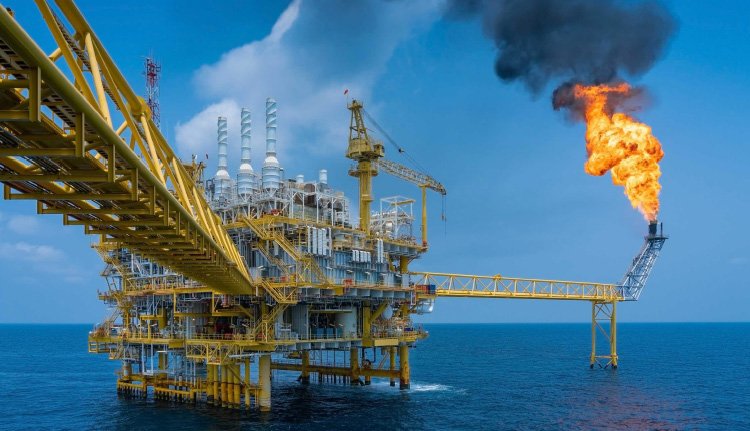
Ghana has recorded a significant reduction in gas flaring across its three producing oil fields during the first half of 2026, according to the Public Interest and Accountability Committee (PIAC).
The improvement marks progress in efforts to strengthen environmental compliance within the country’s upstream petroleum industry and reduce the unnecessary release of gas during oil production. Editorial Standards
In its 2026 Semi-Annual Report on the Management and Use of Petroleum Revenues, PIAC reported that gas flaring declined substantially at the Jubilee, Tweneboa-Enyenra-Ntomme (TEN) and Sankofa Gye Nyame (SGN) fields between January and June 2026, compared with the corresponding period in 2025.
The Jubilee Field recorded a 74.02 per cent reduction in gas flaring, while the TEN Field registered a decline of 40.79 per cent. The SGN Field recorded the largest improvement, with flaring falling by 79.73 per cent over the same period.
PIAC commended the operators of the three fields, describing the reductions as evidence of improved compliance with flaring limits approved by the Environmental Protection Authority (EPA).

The findings suggest that efforts to control routine gas flaring are producing measurable results, although continued monitoring will be necessary to sustain the gains.
Gas flaring involves burning natural gas released during oil production, often when the gas cannot be captured, processed, transported or used economically.
Although flaring can be necessary for operational safety in certain circumstances, routine or excessive flaring wastes a potentially valuable energy resource and contributes to greenhouse gas emissions.
Reducing the practice can therefore deliver environmental and economic benefits. Capturing gas that would otherwise be flared can create opportunities for electricity generation, industrial use and other productive activities, depending on the available infrastructure and commercial conditions.
The reported improvements are particularly relevant to Ghana as it seeks to balance petroleum production with environmental protection and responsible management of its natural resources.
Lower flaring can support efforts to reduce emissions from oil operations, but the overall environmental impact also depends on other sources of emissions, including methane leaks and gas venting.
PIAC has consequently called for a more comprehensive system to monitor and report gas venting volumes across all producing fields.
It recommended that the EPA work with the Petroleum Commission and the Energy Commission to establish a framework that provides reliable information on the quantity of gas vented during upstream petroleum operations.

Gas venting differs from flaring because venting releases gas directly into the atmosphere without burning it.
Since natural gas contains methane, a potent greenhouse gas, incomplete reporting of venting could leave an important part of the sector’s emissions unaccounted for.
A monitoring system covering both activities would therefore help regulators assess gas losses more comprehensively and identify areas requiring further intervention.
The flaring reductions were reported alongside an increase in Ghana’s crude oil production.
PIAC’s figures show that output rose by 11.73 per cent, from approximately 18.42 million barrels in the first half of 2025 to 20.58 million barrels during the corresponding period in 2026.
The increase was driven mainly by stronger production from the Jubilee and SGN fields.
The combination of higher crude oil output and lower gas flaring is encouraging for the industry.
However, the figures do not by themselves establish how much additional gas was captured or used, nor do they provide a complete measure of the petroleum sector’s total emissions.
Further operational data would help determine the wider environmental and economic effects of the improvement. Editorial Ethics & Independence
Ghana’s petroleum industry also faces the challenge of sustaining investment in existing fields as production assets mature.
PIAC has urged the government to develop measures that attract investment into producing fields, particularly TEN, where output has underperformed initial projections.

Continued investment in equipment, maintenance and gas-handling infrastructure could be important in maintaining production efficiency while reducing avoidable gas losses.
The Committee’s findings underline the importance of transparent reporting, effective regulation and cooperation between petroleum operators and public institutions.
Sustained progress will depend not only on meeting approved flaring limits but also on consistent enforcement, accurate measurement and timely disclosure of emissions-related data.
While the first-half results represent a positive development, PIAC’s recommendation for stronger monitoring of gas venting highlights the need to look beyond flaring figures alone.
A more complete picture of gas losses will enable policymakers, regulators and the public to evaluate environmental performance and hold operators accountable. Corrections Policy
Maintaining the reductions recorded in 2026 could strengthen Ghana’s efforts to manage its petroleum resources responsibly.
The next priority is to ensure that the reported progress translates into lasting improvements in emissions management, energy efficiency and environmental oversight across all three producing fields.