

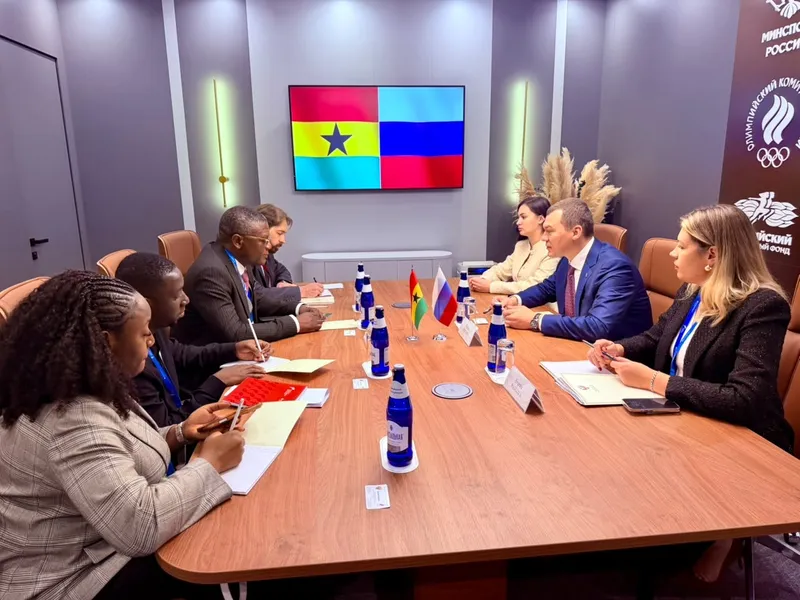
Ghana’s Minister for Sports and Recreation, Kofi Iddie Adams, has held bilateral discussions with Russia’s Minister of Sport, Mikhail Degtyarev, to explore a proposed Memorandum of Understanding (MoU) aimed at strengthening cooperation in sports development, athlete training, scholarships, grassroots programmes and athlete protection.
The meeting took place on the sidelines of the 14th International Sports Forum, “Russia Country of Sports,” held in Krasnoyarsk, Russia. Editorial Standards
The discussions focused on establishing a structured partnership that could create more opportunities for Ghanaian athletes, coaches and sports professionals to acquire international experience and technical expertise.
According to a reports, preparing a draft MoU is the next step towards formalising the proposed partnership.
The agreement has not yet been reported as signed, meaning the discussions remain an important step towards possible future cooperation between the two countries.
A key priority for Adams was expanding opportunities for young Ghanaians to combine education with sports training. He highlighted the potential for scholarship programmes that would allow talented young people to pursue academic studies while developing their sporting abilities in Russia.
The Russian delegation expressed readiness to provide further scholarship opportunities for Ghanaian students, creating prospects for educational exchanges and professional development.

If translated into practical programmes, such opportunities could help young athletes gain access to specialised coaching, modern training methods and learning environments that may be difficult to access locally.
The proposed cooperation is also expected to cover several sporting disciplines rather than concentrating exclusively on football.
This approach could broaden the development pathway for athletes in sports such as athletics, boxing, tennis and other disciplines where Ghana continues to seek improved international competitiveness.
For Ghana, international partnerships can provide access to specialised knowledge, coaching expertise and technical resources that support the long-term development of athletes.
However, the impact of such cooperation will depend on the details of the eventual agreement, including selection criteria, funding arrangements and the number of people who will benefit.
Adams also emphasised the importance of strengthening school and grassroots sports as the foundation for identifying and developing future champions.

He noted that Ghana’s efforts to restructure its school sports system and grassroots programmes require sustained investment and effective partnerships.
Grassroots development is important because athletes often begin their sporting journeys in schools and local communities.
Early access to qualified coaches, appropriate equipment, safe facilities and regular competitions can help identify promising talent before young people reach elite levels.
A stronger development structure could also provide more opportunities for children who lack access to professional sporting environments.
By linking school competitions to community clubs, specialised training and national development programmes, Ghana could create clearer pathways for talented athletes to progress.
The proposed partnership with Russia could support these efforts through exchanges involving coaches, technical officials and sports administrators.
Such cooperation may also help strengthen local expertise so that the benefits extend beyond individual athletes who travel abroad. Editorial Ethics & Independence
Sports financing was another important subject during the discussions.
Adams outlined Ghana’s Sports Fund as part of the government’s efforts to establish a more dependable financial foundation for athlete preparation, infrastructure development, welfare and grassroots programmes.
The Russian side expressed interest in understanding the fund’s governance arrangements, sources of revenue and operational model.

This interest provides an opportunity for both countries to exchange experiences on how sports development can be financed and managed sustainably.
Reliable funding is essential to sporting success because athletes require consistent support throughout their development.
Coaching, medical care, nutrition, equipment, travel and competition expenses can create significant financial demands, particularly for athletes who have not yet attracted sponsorship.
A structured financing system could help reduce interruptions in training and ensure that promising athletes receive support based on transparent criteria.
Any future cooperation, however, would need clear responsibilities and measurable objectives to demonstrate how resources are being used and what outcomes are being achieved.
Athlete protection and anti-doping were also central to the discussions. Adams reaffirmed Ghana’s commitment to clean sport while emphasising the importance of education, fair procedures and respect for athletes’ rights.
Anti-doping measures are necessary to protect fair competition and the health of athletes. At the same time, appropriate education, transparent investigations and due process are essential to ensuring that athletes understand their responsibilities and that allegations are handled fairly.
Protecting athletes also requires attention to their welfare beyond competition, including safe training environments, responsible recruitment, access to medical support and safeguards against exploitation. Corrections Policy
These issues are particularly important for young sportspeople who may be vulnerable when pursuing opportunities overseas.
The discussions in Russia therefore represent a potential opportunity to connect Ghana’s domestic sports reforms with international expertise and educational support.
The next stage will be to determine the specific commitments both countries are prepared to make through the proposed MoU.
If successfully developed and implemented, the partnership could expand training opportunities, strengthen grassroots programmes and improve support systems for Ghanaian athletes.
Its long term value will ultimately depend on whether the discussions lead to accessible opportunities, stronger institutions and measurable improvements in athlete development and welfare.