

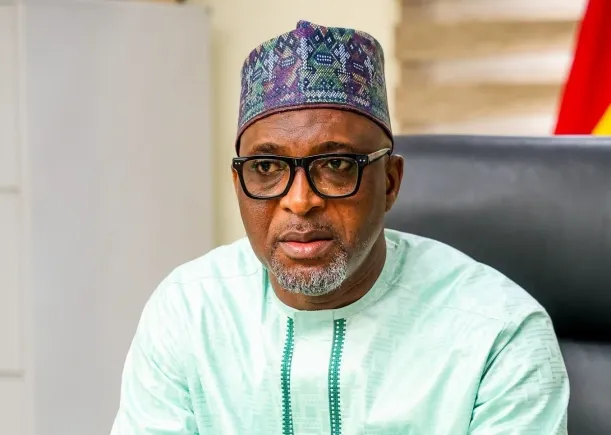
Ghana’s Minister for the Interior, Mohammed Mubarak Muntaka, has reaffirmed the government’s commitment to preventing the country from being used as a transit point for illicit drugs, pledging stronger border surveillance, improved screening systems and closer cooperation with international security agencies. Editorial Ethics & Independence
The minister has said the government is adopting intelligence-led operations and strengthening security at airports, seaports and land borders to disrupt drug trafficking networks that exploit weaknesses in the country’s entry and exit points.
His assurances come amid growing scrutiny of narcotics consignments linked to Ghana and concerns about the ability of organised criminal networks to move illegal substances across international borders.
Speaking before Parliament’s Assurances Committee in July 2026, Muntaka explained that Ghana had 48 recognised entry points but faced significant challenges from numerous unauthorised crossing routes.
He cited the identification of 102 illegal routes in the Volta Region alone as evidence of the scale of the problem.
The minister’s position is that Ghana must strengthen its capacity to detect and intercept illicit consignments before traffickers can use the country as a gateway to other destinations.
Intelligence-Led Border Monitoring to Strengthen Security
Muntaka has emphasised that conventional border patrols alone cannot adequately address the growing challenge posed by illicit drug trafficking.
The government is therefore placing greater emphasis on intelligence gathering, surveillance technology and coordinated operations involving relevant security agencies.
According to the minister, intelligence-led operations have already helped authorities intercept suspected narcotics being transported in unusual ways, including in an ambulance and a bullion van. Corrections Policy

These cases demonstrate why security agencies must look beyond conventional transport methods when investigating suspected smuggling activities.
The government is also working to improve monitoring at inland checkpoints, which complement surveillance at official entry points.
Muntaka has acknowledged concerns about delays caused by checkpoints but maintained that security measures must be effective while minimising unnecessary inconvenience to travellers.
The challenge is particularly significant in areas where unofficial routes allow people and goods to cross borders without passing through designated inspection facilities.
New Scanners and Airport Checks to Detect Narcotics
Technology is expected to play an important role in the government’s response.
The Netherlands has supported Ghana’s acquisition of high resolution scanners designed to help security personnel detect narcotics and ammunition, while Singapore has pledged eight intrusive scanners for deployment at selected ports and border locations.
At the airport, authorities have also announced additional screening measures involving canine units from the police and military to support the Narcotics Control Commission (NACOC).
On October 20, 2026, Muntaka told Parliament’s Public Accounts Committee that the government was strengthening checks after an incident in which a senior airport security officer allegedly helped a suspected drug trafficker bypass normal screening procedures. Editorial Standards
The minister said additional checks would take place before passenger check in and again before boarding, although these measures could add approximately 15 to 30 minutes to airport processing.
The revelations have raised questions about internal security controls and the possibility of individuals exploiting their positions to facilitate criminal activity.
They also highlight why equipment alone cannot guarantee effective enforcement without proper supervision, accountability and compliance with established procedures.
International Cooperation in the Fight Against Drug Trafficking
The government is also pursuing stronger cooperation with foreign partners because drug trafficking frequently involves networks operating across several countries.
Muntaka has stressed the importance of intelligence sharing and coordinated investigations with neighbouring states and international law enforcement agencies. Newscard

In October, he said Ghana had recorded 28 drug seizures over the preceding 20 months, including 11 involving cocaine, while other operations had resulted in seizures abroad.
International cooperation can help investigators trace consignments, identify suspected organisers and gather evidence across jurisdictions.
Formal mutual legal assistance arrangements can also support criminal investigations where evidence or suspects are located outside Ghana.
For Ghana, these partnerships are important not only for disrupting trafficking networks but also for protecting the country’s reputation as a reliable trading and travel destination.
Public Cooperation Remains Essential
The Interior Minister has urged citizens to provide credible information about suspicious activities, describing public cooperation as an important part of the national response.
He has also appealed to informants to share intelligence without making excessive financial demands that could delay investigations.
The government has indicated that assistance may be provided where necessary for transportation or protection arising from information supplied.
The fight against narcotics requires more than arrests and seizures. Stronger border management, effective airport and port screening, accountable security personnel and sustained public awareness must work together to reduce opportunities for trafficking. Editorial Standards
Ultimately, the government’s commitment to preventing Ghana from becoming a transit point for illicit drugs will be judged by the effectiveness of its enforcement measures and its ability to close security gaps.
Modern scanners, intelligence-led investigations and international partnerships provide important tools, but consistent implementation and accountability will be essential to achieving lasting results.