

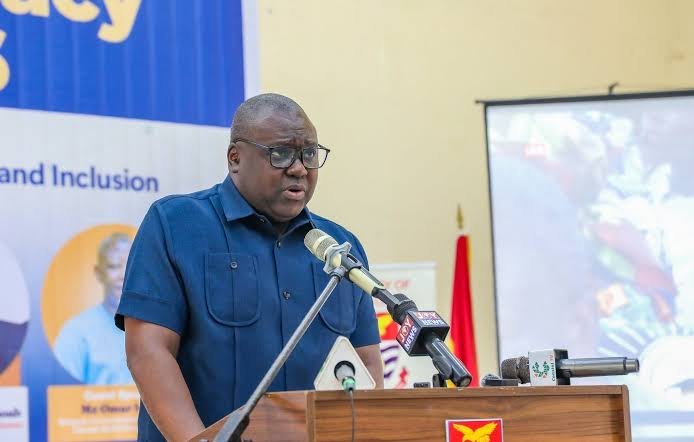
The Director of Research at the Bank of Ghana (BoG), Dr Philip Abradu-Otoo, has defended Ghana’s inflation performance, describing the September 2026 rate of 5.2% as being within favourable territory despite a slight increase from the previous month. Editorial Ethics & Independence
Dr Abradu-Otoo said Ghana’s inflation figures should be assessed within the country’s monetary policy framework rather than compared directly with those of other African economies without considering differences in how their currencies and inflation are managed.
He made the remarks on Tuesday, October 20, 2026, at the launch of the Institute of Statistical, Social and Economic Research’s (ISSER) State of the Ghanaian Economy Report 2025.
The Bank of Ghana research director explained that Ghana operates an inflation-targeting framework, using interest rates as its main monetary policy instrument to influence price movements. He noted that some West African countries, by contrast, operate currency arrangements that peg their currencies to the euro, which can affect inflation outcomes.
According to him, those differences matter when assessing Ghana’s performance against regional peers.
He maintained that the country’s recent inflation figures represented meaningful progress and said Ghanaians should recognise the improvement achieved.
Inflation remains below the central bank’s target range
Data from the Ghana Statistical Service show that year-on-year inflation increased to 5.2% in September 2026 from 5.0% in August.
Although the rate rose slightly, it remains below the Bank of Ghana’s medium-term inflation target band of 6% to 10%, which is centred on 8%. The figure indicates that the general price level was 5.2% higher in September 2026 than in the same month of 2025.
The distinction between inflation and the actual price level is important for households. A decline in inflation generally means prices are rising more slowly, not necessarily that goods and services are becoming cheaper.
For consumers, the effect of the latest figures will depend on the prices of the products and services they purchase most frequently. Even when overall inflation is relatively low, households may continue to experience pressure from rent, food, transportation, utilities and other essential expenses. Editorial Standards
The September figures also showed differences between categories. Food inflation rose to 4.0% from 3.0% in August, while non-food inflation eased to 6.2% from 6.8%. Services inflation stood at 8.3%, exceeding the 4.2% recorded for goods, according to the Ghana Statistical Service.
These differences suggest that the overall inflation rate does not fully reflect the experiences of every household or business. People whose spending is concentrated on services or particular food items may continue to face higher cost increases than the national average indicates.
Why Ghana’s monetary policy framework matters
Dr Abradu-Otoo’s comments focused on the importance of understanding the different monetary policy arrangements used across African economies.

Under inflation targeting, a central bank adjusts monetary policy to influence demand, credit conditions and price stability. Interest rates are a key tool in this process, affecting borrowing costs for households and businesses as well as financial market conditions.
Countries that maintain currency pegs operate under different constraints because their exchange-rate arrangements influence monetary policy decisions and the transmission of external price changes into domestic markets. Corrections Policy
The research director argued that these differences help explain why inflation rates in some countries may remain lower than Ghana’s, even when the economies face similar international pressures.
However, maintaining favourable inflation will require continued attention to domestic economic conditions, exchange-rate movements, supply costs and developments in international markets.
BoG addresses international reserve concerns
Beyond inflation, Dr Abradu-Otoo also discussed the recent decline in Ghana’s international reserves, attributing the development partly to disruptions in gold exports linked to the Middle East crisis.
He explained that the disruption limited the accumulation of reserves during the first seven months of 2026, requiring the central bank to draw on its holdings to support trade and economic activity. Newscard
According to the reports, gold exports resumed in September, and the research director expressed optimism that reserve inflows would improve towards the end of the year.
International reserves are important because they help a country meet external payment obligations and support confidence in its ability to manage foreign-exchange pressures. The pace at which reserves recover will therefore remain an important indicator to watch.
Exchange-rate movements and public debt
Dr Abradu-Otoo also addressed a slight increase in Ghana’s debt figures, attributing it to exchange-rate movements rather than fresh government borrowing. He pointed to a reported 10.8% depreciation of the cedi since the beginning of the year.

Exchange-rate changes can affect the cedi value of external debt denominated in foreign currencies, even when no additional borrowing takes place. This makes it important to distinguish between new debt contracted by government and changes in the domestic-currency valuation of existing obligations.
The comments come as Ghana continues to focus on economic stability, inflation management and the rebuilding of financial buffers. Privacy Policy & Terms
While the 5.2% inflation rate represents a favourable development relative to higher inflation recorded in previous periods, the recent increase and differences across consumer categories underline the need for continued monitoring.
The challenge for policymakers will be to sustain price stability while supporting economic activity and addressing the pressures that households and businesses continue to face.
The durability of Ghana’s progress will depend not only on headline inflation but also on disciplined policy implementation, reserve management and stable economic conditions.