

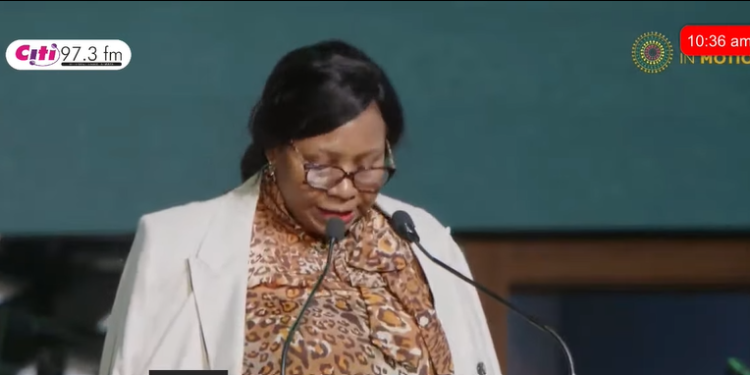
African Union (AU) Commissioner for Economic Development, Trade, Tourism, Industry and Minerals, Francisca Tatchouop Belobe, has urged African countries to prioritise local mineral processing and industrial development to maximise the economic benefits of the continent’s natural resources. Editorial Ethics & Independence
Speaking at the Mining in Motion Conference in Accra on Monday, October 19, 2026, Ms Belobe stressed that Africa must take greater control of its mineral development priorities and ensure that resource extraction translates into industrial growth, energy security, employment and inclusive economic development.
According to reports, the commissioner argued that Africa’s mineral wealth should serve as a foundation for building stronger domestic industries rather than leaving countries dependent on exporting raw materials.
She maintained that the continent must determine its own priorities and establish partnerships that support its long-term development objectives.
“Africa must strengthen its agency to define its own mineral development agenda,” she said, highlighting the importance of African countries shaping how their resources are managed and used to advance economic transformation.
The call comes amid growing international demand for minerals needed for renewable energy technologies, electric vehicles, construction and advanced manufacturing.
Africa possesses significant deposits of resources such as gold, bauxite, cobalt, lithium, manganese and graphite, making the continent an important player in global mineral supply chains.
However, extracting these resources does not automatically translate into broad economic prosperity.
When minerals are exported without substantial processing, producing countries may miss opportunities to develop manufacturing industries, create skilled jobs and retain a greater share of the value generated throughout the supply chain.
Ms Belobe said African countries must address this challenge by building the capacity to process minerals locally and strengthening the industries that depend on them.
African Union’s Green Minerals Strategy
The commissioner identified the African Union’s Green Minerals Strategy, adopted in 2025, as a key framework for advancing mineral-based industrialisation across the continent.

The strategy seeks to position Africa not merely as a supplier of raw materials but as a stronger participant in the industrial value chains associated with the global energy transition. It places emphasis on value addition, energy security, regional cooperation and sustainable economic development. Corrections Policy
The African Union has also promoted broader initiatives, including the African Mining Vision and African Commodities Strategy, to encourage responsible resource governance, local processing and stronger African participation in global markets.
These frameworks provide a policy direction for countries seeking to transform mineral resources into lasting economic opportunities. Their effectiveness, however, will depend on how governments translate commitments into practical investments, enforceable policies and measurable outcomes.
Local processing could create jobs and expand industries
Increasing domestic processing could generate employment across several sectors, including engineering, manufacturing, transportation, construction, maintenance and logistics.
For example, expanding bauxite processing could support alumina refining and aluminium production, while developing lithium and other critical-mineral industries could create opportunities linked to battery materials and related manufacturing.
Such industries require specialised workers and supporting services, potentially opening new opportunities for young people and local businesses.
Value addition could also help African economies diversify their sources of export earnings. Instead of depending heavily on the prices of unprocessed commodities, countries could develop more complex products and strengthen their positions in regional and international markets.
Nevertheless, establishing processing facilities requires substantial investment, reliable electricity, efficient transport systems, access to finance and a predictable regulatory environment.
Without these foundations, locally processed products may struggle to compete with established producers elsewhere.
A Reuters report published on October 19, 2026, highlighted reliable and affordable electricity as a major challenge facing Africa’s ambitions to expand mineral processing. The report noted that inadequate energy infrastructure could undermine investment in refineries and smelters, despite growing interest in local processing.
This makes energy investment an important part of any serious strategy to maximise mineral wealth. Governments must coordinate mining policies with electricity generation, transmission infrastructure and industrial development plans.
Regional cooperation and stronger African businesses
Ms Belobe has also emphasised the need for African countries to develop local investors and industries instead of concentrating exclusively on attracting foreign capital.
In a related address reported, she called for the development of African-owned enterprises capable of processing resources, creating jobs and retaining more value within the continent.
The African Continental Free Trade Area (AfCFTA) offers an opportunity to support this objective by expanding regional markets and encouraging countries to develop complementary industries.

Rather than each country attempting to build every stage of a mineral supply chain independently, neighbouring countries could coordinate investments and specialise in activities suited to their resources, infrastructure and technical capabilities. Editorial Standards
Such cooperation could improve efficiency, expand markets for processed products and strengthen Africa’s negotiating position in international partnerships.
For Ghana, the call is relevant to ongoing discussions about mineral value addition, local participation and industrial development.
Stronger domestic processing could create opportunities for Ghanaian businesses and workers, provided investments are supported by reliable infrastructure, skilled labour and effective regulation.
Turning mineral wealth into lasting prosperity
Beyond investment and industrial capacity, responsible mineral development must also protect the environment and ensure that communities benefit from economic activity.
Transparent agreements, effective regulatory oversight and appropriate environmental safeguards are essential to preventing mineral wealth from creating long-term social and ecological costs.
The challenge for African governments is therefore to balance investment attraction with national development priorities while ensuring that resource extraction produces sustainable benefits.
Ms Belobe’s message at the Mining in Motion Conference was that Africa must move beyond simply owning mineral deposits and take a stronger role in determining how their value is created and distributed. Newscard
Ultimately, the success of this agenda will depend on the continent’s ability to establish competitive processing industries, develop African-owned enterprises, strengthen regional supply chains and create meaningful employment.
By turning natural resources into the foundation for industrial growth, African countries have an opportunity to retain more economic value, expand their productive capacity and build more resilient economies for future generations.