

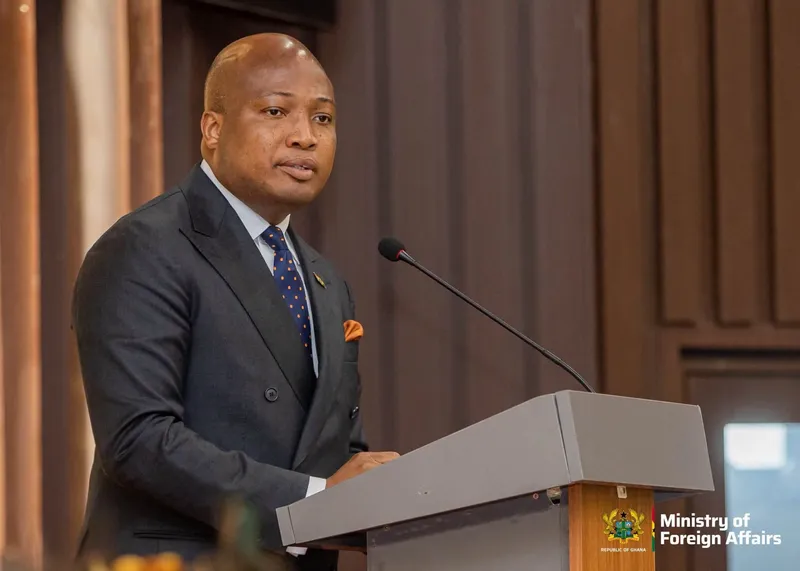
Foreign Affairs Minister Samuel Okudzeto Ablakwa has dismissed concerns that Ghana’s decision to apply for BRICS partner country status could undermine its longstanding relationships with traditional international partners, insisting that the move is guided by national interests and the country’s established foreign policy of non-alignment. Editorial Standards
Speaking in an interview on TV3’s Key Points on Saturday, October 10, 2026, Ablakwa clarified that Ghana is seeking partner-country status rather than full membership of the BRICS bloc.
He explained that the initiative is intended to broaden the country’s diplomatic and economic opportunities without requiring it to abandon existing relationships with Western countries and other development partners.
The clarification follows the government’s announcement that Cabinet had approved plans for Ghana to formally pursue engagement with BRICS, a grouping of major emerging economies seeking greater influence in international economic and political governance.
According to Ablakwa, Ghana already maintains strong relations with countries within the bloc, making the proposed partnership a natural extension of its existing diplomatic engagements.
He stressed that the government’s priority is to protect and advance Ghana’s national interests while creating additional opportunities for economic development.
The minister explained that the decision is consistent with Article 40 of Ghana’s 1992 Constitution, which outlines the country’s foreign policy objectives, including the protection of national interests, respect for international law and the promotion of cooperation among nations.
Ablakwa argued that pursuing closer relations with BRICS should not be interpreted as a decision to distance Ghana from its traditional partners.

Instead, he presented the initiative as an opportunity to diversify the country’s strategic options and strengthen its ability to engage with different international institutions and economic powers. Editorial Ethics & Independence
He also disclosed that Ghana had engaged member states of the European Union before announcing its intention to pursue BRICS partner-country status.
According to the minister, the government communicated the rationale behind the decision and made clear that it did not intend to disengage from existing relationships.
The consultations were intended to help traditional partners understand that Ghana’s proposed engagement with BRICS forms part of its broader development strategy rather than a geopolitical realignment against particular countries.
To illustrate Ghana’s longstanding approach to international relations, Ablakwa referred to the foreign policy legacy of the country’s first President, Dr Kwame Nkrumah.
During the Cold War, Ghana maintained relations with countries holding different ideological positions while pursuing projects considered important to national development.
He cited American support for the construction of the Akosombo Dam alongside cooperation with the then Soviet Union on Ghana’s early nuclear research programme. The example, he explained, demonstrates how Ghana can work with different international partners simultaneously when doing so serves its national objectives.
BRICS originally emerged as BRIC, comprising Brazil, Russia, India and China. South Africa joined in 2011, while subsequent expansion brought Egypt, Ethiopia, Iran, Saudi Arabia, the United Arab Emirates and Indonesia into the grouping.
The bloc now has 11 full members and provides a platform for discussions on economic cooperation, development financing and global governance.
Several countries have also joined the BRICS partner-country framework, which offers an avenue for engagement without full membership. If Ghana’s application succeeds, it would participate under this category rather than become a full member immediately.
For Ghana, the proposed partnership could create opportunities to strengthen trade relationships, attract investment, expand industrial cooperation and engage more closely with emerging economies. Corrections Policy

These opportunities align with the government’s stated ambition to promote job creation, industrialisation and sustainable economic growth.
Ablakwa has previously highlighted Ghana’s economic ties with India and China, alongside its relationships with other BRICS countries.
The government hopes that broader engagement will help Ghana secure additional development opportunities and increase the range of partners available to support its economic transformation agenda.
Nevertheless, the potential benefits will depend on how effectively Ghana uses the proposed partnership to secure practical outcomes.
A successful application alone would not automatically guarantee new investment, increased exports or improved access to development financing. Those gains would require sustained diplomatic engagement, commercially viable projects and clear economic priorities.
The initiative also raises a broader question about how Ghana can balance its relationships with established Western partners and emerging global powers in an increasingly multipolar international system.
Maintaining constructive relations across these groups could strengthen the country’s negotiating position and expand its options on trade, investment and international cooperation.
Ablakwa’s reassurance is therefore intended to make clear that Ghana does not view its proposed BRICS partnership as a choice between competing international alliances. Rather, the government wants to retain its existing diplomatic relationships while developing additional channels for cooperation.
As Ghana prepares its application, attention will turn to the response of existing BRICS members and the practical opportunities that partner-country status could offer. Newscard
For now, the government’s stated position is that national development, economic diversification and diplomatic flexibility remain central to the decision.
The minister’s comments reinforce Ghana’s longstanding commitment to maintaining relations with countries across different political and economic systems.
Whether the proposed partnership delivers the expected benefits will ultimately depend on the government’s ability to translate its diplomatic ambitions into measurable gains for businesses, workers and the wider economy.