

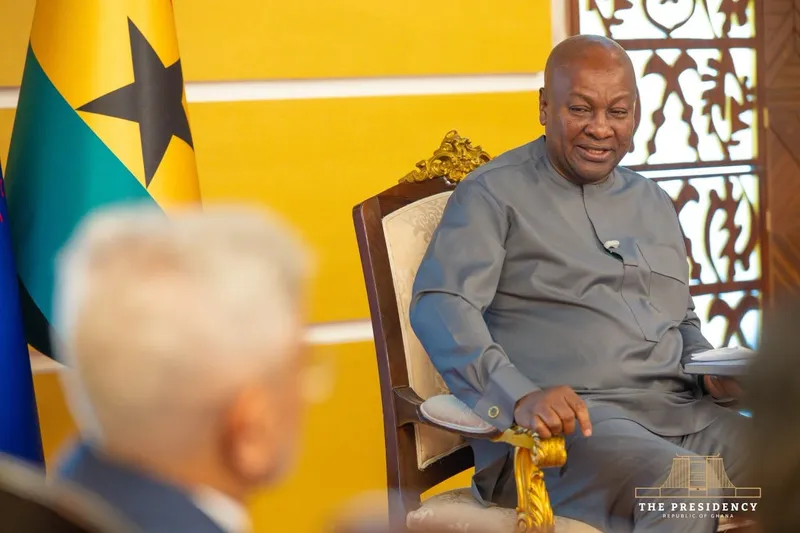
President John Dramani Mahama has pledged that his government will continue working to provide reliable electricity and maintain sound economic conditions to support industrial transformation, attract investment and strengthen Ghana’s manufacturing sector. Corrections Policy
The President said predictable fiscal policies, controlled inflation, stable foreign exchange rates and dependable energy infrastructure were critical to building investor confidence and encouraging businesses to expand their operations.
He made the remarks on Thursday, October 8, 2026, when he commissioned Nestlé Ghana Limited’s expanded evaporated milk production line at its factory in Tema. The investment, he said, reflected the confidence businesses could develop when economic conditions and supporting infrastructure enabled them to plan for long-term growth.
“Capital goes where it is safe, but it stays and expands where there is stability and supporting infrastructure,” Mahama said, emphasising the importance of maintaining economic stability while investing in the facilities businesses need to operate efficiently.
Economic stability at the centre of industrialisation
Mahama’s commitment comes as the government seeks to strengthen Ghana’s investment climate and encourage more businesses to increase local production.

For manufacturers, economic stability influences decisions about purchasing equipment, hiring workers, sourcing raw materials and entering new markets. Inflation, high borrowing costs and exchange-rate volatility can make production more expensive and complicate long-term planning.
The President pointed to improvements in key economic indicators as evidence of a more favourable environment for businesses. According to reports on his remarks, foreign direct investment increased from US$624 million in 2024 to US$2.62 billion in 2025, while inflation declined and the cedi recorded an improved performance.
These developments, he argued, were helping to strengthen investor confidence and encourage companies to commit resources to Ghana.
However, sustaining those gains will require continued fiscal discipline, effective economic management and policies that allow businesses to operate with greater certainty. Investors will also be looking for evidence that improvements in the wider economy translate into lower operating costs, accessible financing and opportunities for sustainable expansion.Newscard
For local manufacturers, the benefits of stability are particularly important because their competitiveness depends not only on demand for their products but also on the cost of electricity, transport, labour and imported production inputs.
Reliable electricity essential for factories
A dependable electricity supply remains central to the government’s industrial ambitions.
Manufacturing facilities require consistent power to operate machinery, maintain production schedules and meet delivery deadlines. Interruptions can disrupt operations, increase costs and affect the ability of companies to fulfil orders.
Businesses may also face additional expenses when they must rely on alternative power sources during outages. Such costs can affect profit margins, discourage expansion and make locally manufactured products less competitive.
Mahama’s pledge to continue providing reliable power therefore forms part of a broader effort to create an environment in which factories can operate efficiently and investors can plan confidently. Editorial Ethics & Independence
Citi Newsroom has previously reported on energy-sector reforms aimed at strengthening the financial and operational foundations of Ghana’s power industry. The reforms are intended to improve the sustainability of electricity supply and support the country’s ambition of becoming a regional centre for industrial production and trade.
The challenge will be to ensure that these efforts produce measurable improvements for businesses, including dependable electricity and costs that manufacturers can reasonably manage.
Reliable power alone will not resolve every industrial challenge, but it remains an important requirement for businesses seeking to increase output, adopt modern technology and compete in export markets.
Nestlé investment demonstrates manufacturing potential
The expanded Nestlé Ghana production line offers an example of how investment in modern equipment can strengthen domestic manufacturing.
The GH¢59 million modernisation project replaces a production line that had served the factory for more than 30 years. The upgraded facility is expected to increase annual production capacity from approximately 12,960 tonnes to nearly 30,000 tonnes.
The expansion will enable more production and packaging activities to take place locally, including the processing of evaporated milk products for Ghanaian consumers and regional markets.
The investment is also consistent with the government’s 24-Hour Economy agenda, which seeks to encourage businesses to operate more productively and make greater use of industrial capacity. Editorial Standards
According to the Ghana News Agency, Nestlé Ghana employs approximately 1,200 full-time workers and another 1,300 third-party workers, with 94.4 per cent of its employees being Ghanaian.
These figures illustrate the potential contribution of established manufacturers to employment and local economic activity. An expanding factory can also create opportunities for suppliers, distributors, transport operators and businesses providing services to the manufacturing sector.
Nevertheless, the broader impact of industrial investment will depend on how effectively companies build relationships with local suppliers, develop workers’ skills and sustain production over time.
Tema’s industrial revival
Mahama also identified Tema as a key location in Ghana’s industrial transformation, pointing to the expansion of Tema Port, the return of the Tema Oil Refinery to operations and efforts to revive the Volta Aluminium Company Limited.

These developments, alongside expanding manufacturing operations, could strengthen Tema’s position as a centre for industrial production, logistics and regional trade. Privacy Policy & Terms
The President has urged businesses to take advantage of Ghana’s position as host of the African Continental Free Trade Area Secretariat to expand into markets across the continent.
For that ambition to succeed, manufacturers will need efficient ports, reliable roads, dependable electricity and effective customs procedures. Access to financing, skilled workers and predictable regulations will also be important in helping Ghanaian products compete with goods produced elsewhere.
The government’s task is therefore not simply to attract investment but to create the conditions under which businesses can grow, export and generate lasting economic benefits.
Turning commitments into lasting results
Mahama’s pledge to sustain economic stability and improve electricity reliability reinforces the government’s stated commitment to industrialisation.
The Nestlé expansion demonstrates the potential of local manufacturing, but broader transformation will require consistent implementation of policies and infrastructure improvements.
For businesses, the priority is a predictable operating environment that supports investment and productivity. For workers and households, the ultimate measure of success will be whether industrial expansion creates sustainable jobs, strengthens local enterprises and improves living standards.
Maintaining reliable power, controlling economic pressures and supporting competitive manufacturing will therefore remain crucial to Ghana’s industrial future.
The government’s ability to translate its commitments into practical results will determine whether renewed investor confidence develops into lasting growth across the economy.