

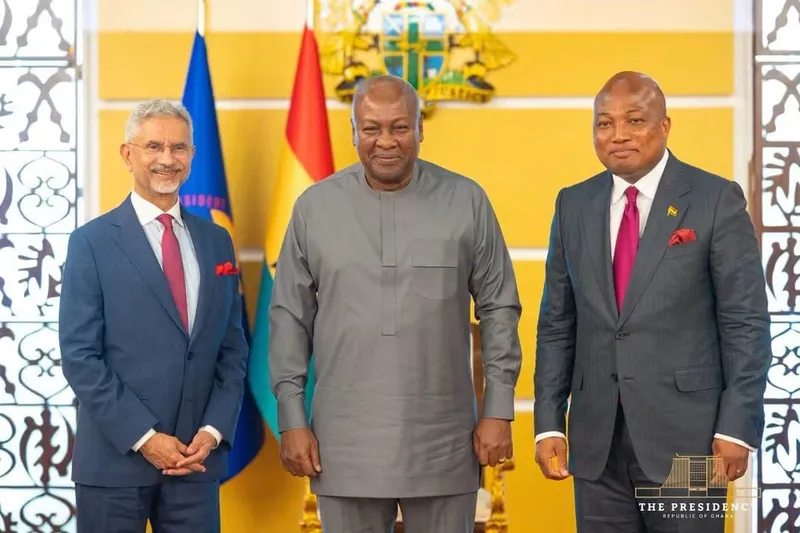
President John Dramani Mahama has disclosed that Ghana’s exports to India have increased from about US$3 billion to nearly US$7 billion, highlighting what he described as significant growth in commercial relations between the two countries.Corrections Policy
President Mahama made the disclosure during a meeting with India’s Minister for External Affairs, Dr Subrahmanyam Jaishankar, at the Presidency in Accra on Tuesday, October 6, 2026.
The discussions focused on strengthening Ghana-India relations, with trade, investment, infrastructure, rail development and pharmaceutical manufacturing featuring prominently.
According to the President, the increase has been driven mainly by Ghanaian goods exports to the Indian market, reflecting the growing importance of India as a destination for Ghanaian products.
“In the area of trade, we are already doing quite well. Our exports to India have increased from just about US$3 billion to almost US$7 billion, driven mainly by goods exports,” President Mahama said, according to the Information Services Department.
The President also noted that Ghana continues to benefit from imports of Indian agricultural machinery, automobiles and buses.
The exchange of goods highlights the two-way nature of the relationship, with Ghana supplying commodities and other products while Indian businesses provide machinery, vehicles and manufactured goods that support economic activity in Ghana.
Available Indian government trade data shows that total bilateral trade between Ghana and India stood at about US$3.14 billion in the 2024/25 financial year, comprising Indian exports of about US$1.35 billion and Indian imports from Ghana of about US$1.79 billion.
The figures underline the importance of distinguishing between Ghana’s reported exports to India and total two-way trade when assessing the latest claim.
The absence of a specific period in the President’s statement also means the reported increase should be understood in the context in which it was presented rather than interpreted as a single-year change.
Beyond trade, President Mahama used the meeting to encourage Indian companies to increase investment in Ghana, particularly in pharmaceuticals and vaccine manufacturing.

He reaffirmed Ghana’s willingness to work with Indian companies to expand domestic production of medicines and vaccines as part of the government’s broader health sovereignty agenda.
The President pointed to existing cooperation involving Indian-linked Atlantic Life Sciences and Ghanaian pharmaceutical company KinaPharma as an example of the type of partnership Ghana wants to develop further. Editorial Ethics & Independence
He has also argued that improving domestic pharmaceutical production could strengthen the country’s ability to respond to health emergencies while reducing dependence on imported medicines.
The discussions also covered infrastructure and technology cooperation. President Mahama cited the Tema-Mpakadan Railway Line as a tangible outcome of Ghana-India cooperation, alongside the Ghana-India Kofi Annan Centre of Excellence in ICT.
He further recalled the role of an Indian company in financing and constructing Jubilee House during Ghana’s 50th independence anniversary celebrations, describing such projects as evidence of the longstanding relationship between the two countries.
India’s Minister for External Affairs, Dr Jaishankar, conveyed greetings from Indian Prime Minister Narendra Modi and President Droupadi Murmu.

He said the two countries’ leaders expected the comprehensive partnership agreed between President Mahama and Prime Minister Modi to be given greater practical substance through new areas of cooperation.
The engagement comes after Prime Minister Modi’s visit to Ghana in July 2025, which Ghana and India have regarded as an important step in strengthening bilateral relations.
The two countries have since continued discussions on trade, investment, health, agriculture, ICT and infrastructure.
For Ghana, the reported growth in exports to India could create opportunities for local producers if the country can expand its supply of competitive products and strengthen access to the Indian market.
Gold, cocoa, cashew nuts, timber and other commodities have traditionally featured prominently in Ghana’s exports to India, while the Indian market also offers opportunities for processed agricultural products and manufactured goods.
The challenge, however, will be to ensure that rising export values translate into broader benefits for Ghanaian businesses, farmers and manufacturers.
Expanding value-added production could help the country move beyond the export of raw commodities and capture a greater share of the value generated along international supply chains.
The latest discussions therefore point to a relationship that extends beyond the movement of goods.
Ghana and India are seeking to deepen cooperation in areas that could support industrial development, technology transfer, healthcare, infrastructure and investment. Editorial Standards
With President Mahama placing particular emphasis on pharmaceuticals, manufacturing and trade, the next stage of Ghana-India relations could depend on how effectively the two countries convert diplomatic commitments and growing trade into concrete investment and production opportunities.
For Ghana, strengthening access to the Indian market while attracting Indian investment could form part of a broader strategy to expand exports, create jobs and build stronger domestic productive capacity.