

The government has rebranded its flagship market development initiative from “24-hour economy markets” to District Economy Markets, in a move intended to distinguish the programme from the broader 24-hour economy policy. Newscard
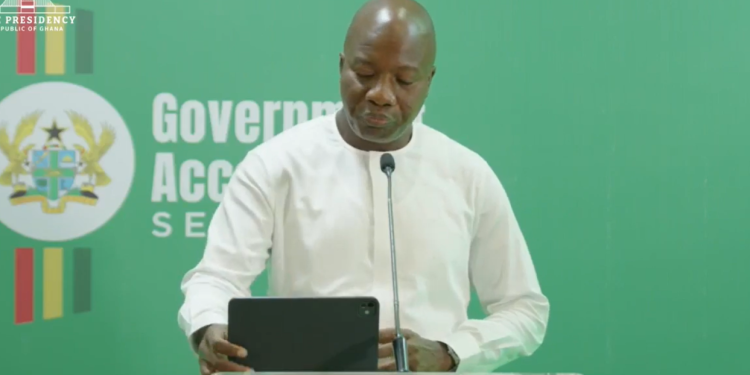
Minister for Local Government, Chieftaincy and Religious Affairs Mahama Ayariga announced the change on Monday, October 5, 2026, during the Government Accountability Series.
According to Mr Ayariga, the original description of the programme had created the impression that the government’s wider 24-hour economy agenda was primarily focused on constructing markets.

He said the new name more accurately reflects the specific objective of developing modern commercial infrastructure at the district level.
“You notice I didn’t say 24-hour economy markets,” Mr Ayariga explained, stressing that the use of the previous name had blurred the distinction between the market construction programme and the government’s broader economic policy.
Under the redesigned programme, the government is targeting the establishment of at least one model market in each of Ghana’s 261 metropolitan, municipal and district assemblies.
The minister said projects under the initiative are already at different stages of construction and implementation across the country, with government now seeking to accelerate delivery and meet a target of 100 percent completion by 2028.
The rebranding is accompanied by a restructuring of the programme into two implementation phases.
The first phase will concentrate on the core infrastructure required to make the markets functional. This includes the construction of market stores, sheds and other essential commercial facilities that traders will use to conduct their businesses.
The second phase will focus on supporting infrastructure intended to improve the safety, security and overall functionality of the markets. Facilities planned under this phase include police and fire stations.
Mr Ayariga said the two-phase structure had been adopted to speed up construction while providing a more organised approach to financing the projects.
“We re-scoped it into two phases to enable a more speedy delivery of the market and a more structured financing to achieve 100% completion by 2028,” he said.
He added that the second phase would subsequently be financed through future allocations from the District Assemblies Common Fund. Corrections Policy
The initiative forms part of the government’s broader effort to improve economic activity at the local level by providing modern facilities where traders, farmers, businesses and consumers can interact in safer and more organised environments.
President John Dramani Mahama previously explained that the original 24-hour economy market concept was intended to go beyond traditional market structures.

He said the model was expected to incorporate facilities such as banking services, storage, fire and security protection, restaurants, crèches and clinics, depending on the needs of individual communities.
The objective is to create commercial centres capable of supporting economic activity beyond the limited operating periods associated with some traditional markets.
For government, the development of district-level markets is also expected to support local businesses and create opportunities for traders and other small-scale enterprises.
However, the implementation of the programme has also raised questions about how existing markets and traders will be accommodated during redevelopment.
In September, government temporarily suspended plans to redevelop the Agbogbloshie 24-Hour Economy Market after concerns from traders over the proposed demolition of the existing market structure.
The suspension was intended to allow further consultations involving the Accra Metropolitan Assembly, market leaders and other stakeholders.
That development highlighted the importance of stakeholder engagement as government expands the market programme nationwide.
Existing traders depend heavily on established markets for their livelihoods, meaning redevelopment projects could have significant economic and social consequences if they are implemented without adequate consultation.
The rebranding to District Economy Markets may therefore provide an opportunity for government to clarify the scope of the initiative while also strengthening coordination with metropolitan, municipal and district assemblies.
The programme’s success will ultimately depend not simply on the number of markets constructed but on the quality and usefulness of the facilities delivered. Editorial Ethics & Independence
Modern market infrastructure can potentially improve sanitation, security, storage, fire safety and the general trading environment.
It can also provide local businesses with better spaces to operate and potentially contribute to economic activity within surrounding communities.
At the same time, sustainable maintenance will be essential. Market facilities require reliable electricity, water, sanitation, waste management, security and proper management systems if they are to deliver their intended benefits over the long term. Editorial Standards
With government targeting completion across all 261 assemblies by 2028, the coming months are likely to bring increased attention to construction progress, financing arrangements and the involvement of local authorities.
The change from “24-hour economy markets” to “District Economy Markets” therefore represents more than a change in terminology.
It is intended to establish a clearer identity for a programme focused specifically on strengthening commercial infrastructure at the district level.
As implementation continues, the key test will be whether the initiative delivers functional, accessible and sustainable markets that improve the livelihoods of traders while contributing to economic activity in communities across Ghana.