

For many professionals, career success has traditionally followed a familiar path: get qualified, secure a good job, rise through the ranks and earn a senior title. But what happens when the job ends, the organisation changes direction or the title eventually belongs to someone else?
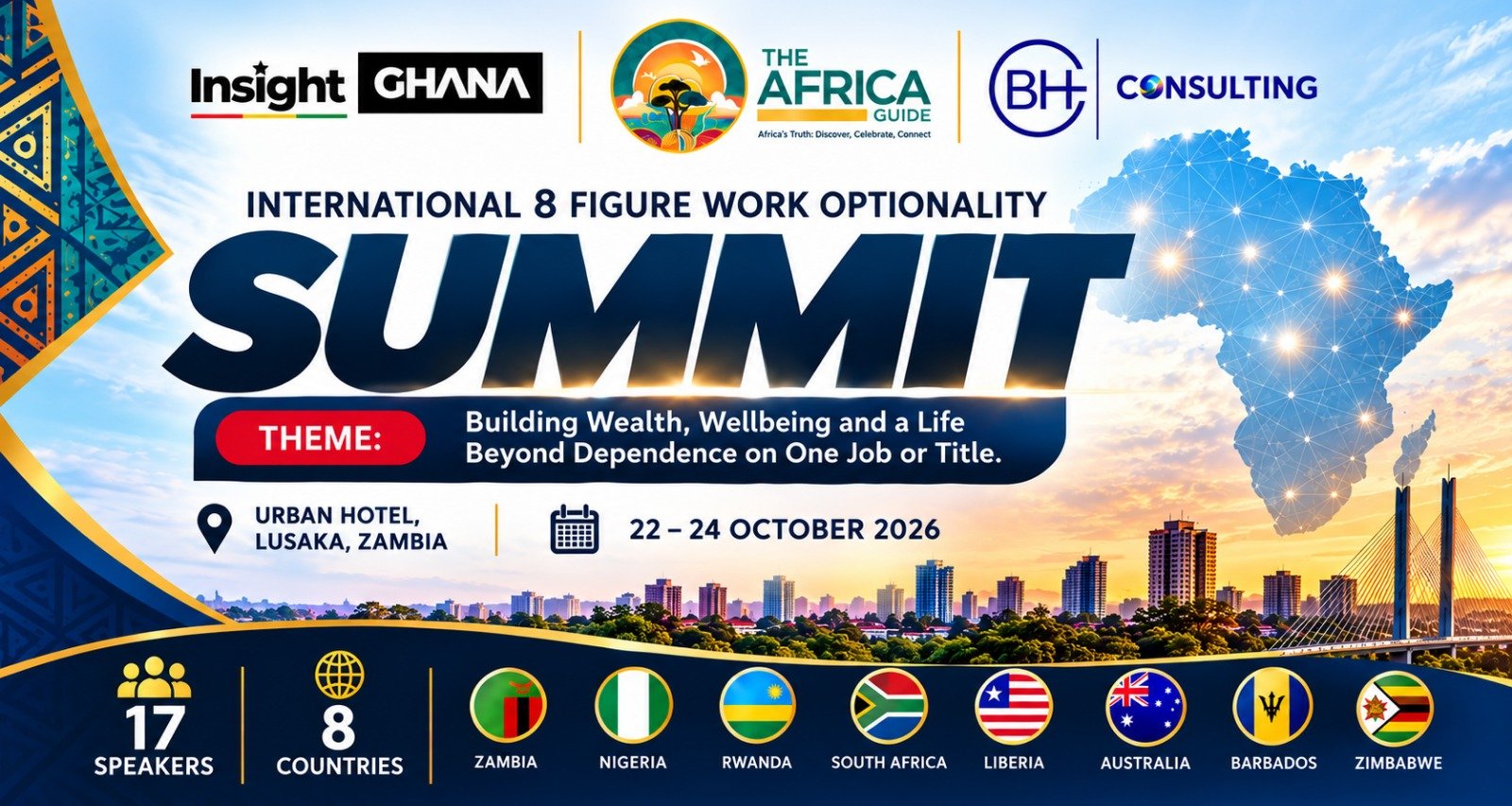
That question sits at the centre of the International 8 Figure Work Optionality Summit, scheduled for October 22 to 24, 2026, at the Urban Hotel in Lusaka, Zambia.
Held under the theme, “Building Wealth, Wellbeing and a Life Beyond Dependence on One Job or Title,” the summit will bring together 17 speakers from eight countries, including Zambia, Nigeria, Rwanda, South Africa, Liberia, Australia, Barbados and Zimbabwe.
At the heart of the conversation is the idea that professionals should not allow a single employer, salary or job title to become the only source of their income, identity and future opportunities.

The summit is hosted by Dr. Cynthia Kunda Simwaka, a Zambian Chartered Accountant, board advisor, author, international speaker and personal-brand monetisation strategist. Through her work, she has developed the concept of Executive Concentration Risk™, which she uses to describe the danger of depending too heavily on one employer for income, professional identity, visibility and opportunity.
Her argument draws from a familiar principle in finance. Investors are generally warned against putting too much of their wealth into one asset. Dr. Simwaka believes a similar question should be asked about professional lives.
She says she has encountered senior professionals who have spent 15, 20 or even 30 years building impressive careers, yet have few sources of income or professional opportunities outside their current employment.
For her, the issue is not that employment is bad or that professionals should rush to resign. Instead, she argues that people should use the security and income provided by employment to build additional assets, relationships, expertise and opportunities while they still have the job.
“Your current job can finance the investments, business, knowledge, relationships and assets that eventually give you choices,” she says.
That distinction is important because work optionality is not presented as an argument against employment. It is about reducing dependence on employment as the only route through which a person’s experience can create value.
Dr. Simwaka’s own career has shaped this view. After more than 15 years in finance, governance and leadership roles, she began deliberately building businesses, consulting, training, executive coaching, speaking and a personal brand.
She recalls beginning her MBA in 2016 while working at CARE International and writing that she eventually wanted to leave employment and build a business. That decision made her think beyond the next promotion and towards what she was actually building for herself.
Her experience also changed her understanding of wealth.
Money remains important, she says, but wealth should eventually give people greater control over their choices and time. For her, being able to decide what to work on, who to work with and where to work from is part of the value created by optionality.
The other speakers bring different professional experiences to the same conversation.

Dr. Nancy Mutinta Zyongwe, a Zambian medical doctor, public health specialist and health systems leader with more than two decades of experience, sees optionality as the ability to deploy professional capital across different areas rather than remain confined to one role.
Through Verumetrics Health & Systems Strengthening Limited, where she serves as Managing Director and Principal Consultant, she works across health systems strengthening, research, programme strategy, quality improvement and management consulting.
For Dr. Zyongwe, professional experience should be treated as an asset that can create value in several ways.
“Do not wait until you leave employment to start building optionality,” she says.
She encourages professionals to build while they are still employed by developing expertise, creating genuine professional relationships, becoming known for what they know and identifying problems they can solve. She also stresses that health and wellbeing must remain part of the equation.
Her warning reflects one of the summit’s broader themes. Building additional income or professional opportunities means little if the process leaves people without the health and capacity to enjoy what they have created.

That concern is central to the work of Agnes Nsofwa, Founder and Executive Director of Australian Sickle Cell Advocacy Inc. A nurse, entrepreneur, author and book publisher, she has combined advocacy, publishing and entrepreneurship with the creation of Olana Dolls, comfort dolls designed for children living with chronic illnesses.
For Nsofwa, optionality provides the freedom to combine different forms of work and purpose while balancing professional and family responsibilities.
Her contribution to the summit will focus on wellness in career progression. She argues that wellness cannot be reduced to physical health. Mental, emotional, social and financial wellbeing also shape whether a professional can sustain success.
Her own journey has shown her how personal challenges can become sources of purpose, advocacy and enterprise.

From South Africa, health educator, social worker, author, speaker and social impact advocate Loveness Ojiaku approaches optionality through service and community development.
As Global Secretary of Women Pioneers Africa and Co-Director of the DANY Transformational Programme, Ojiaku works across education, leadership, health promotion and community development.
For her, optionality means creating value through multiple pathways while remaining connected to purpose. Her work has allowed her to operate as an educator, speaker, author and social impact advocate across different sectors and countries.
She argues that professional value should not be measured only by a person’s title.
“Your greatest professional asset is not your job title but your ability to create meaningful value,” she says.
That value, in her view, depends increasingly on transferable skills, relationships, continuous learning and the ability to adapt to changing circumstances.

Blossom Affia brings another dimension to the discussion: visibility.
The Nigerian founder and CEO of Credence has built a full-stack marketing agency and created The LinkedIn Fastlane. She has also built a professional audience of more than 100,000 organic followers and trained more than 1,500 founders and operators across more than 15 countries.
Affia’s approach to optionality is closely tied to personal visibility and clear positioning.
She says she did not want her future to depend on one employer, one boss or one person’s opinion of her. Instead, she built several avenues through which her expertise could create value.
Her experience also informs her message about professional communication.
“Your voice can pay you, but only if it is clear,” she says.
Her own first LinkedIn post received two impressions. She now uses that experience to argue that visibility by itself is not enough. Professionals must be clear about who they serve, the problems they understand and what they can offer.

Joanne Wilson, CEO of Grid International South Africa and a board member of Grid International, approaches the question from the perspective of leadership, organisational culture and behaviour.
Her work focuses on leadership development, culture transformation and organisational change, with an emphasis on helping leaders turn strategy and values into everyday behaviour.
For Wilson, optionality is closely connected to the ability to build capability, credibility and relationships over time.
She argues that a professional’s expertise may create an opportunity, but their behaviour determines what happens once they are in the room.
Her central message is that organisational culture is not simply what companies say they value. It is reflected in what people repeatedly do, particularly when pressure rises.
The five perspectives reveal why the summit is not simply a conversation about making more money.
Optionality can involve consulting, entrepreneurship, speaking, publishing, board appointments, investments, training, intellectual property or social impact work. It can also mean developing professional visibility, strengthening relationships or building expertise that has value outside a current organisation.
There is no single model.
A senior finance executive may turn years of experience into advisory or board work. A health professional may move into research and consulting. An advocate may build an organisation alongside publishing and entrepreneurship. A leadership practitioner may develop a network of associates who can carry work across countries. A marketing professional may turn expertise and visibility into a company, educational products and a community.
That diversity is part of what Dr. Simwaka wants the summit to demonstrate.
She says she does not expect every professional to become an entrepreneur or consultant. The point is to recognise that years of professional experience can produce more possibilities than a job title suggests.
A person who has spent 20 years as a Chief Financial Officer, for example, has accumulated knowledge in financial management, strategy, governance, restructuring, fundraising, risk management, leadership and board engagement. Those capabilities can have value beyond the organisation that currently employs them.

Mara Zhanet Michelo, Founder and CEO of Jacaranda Hub, brings another dimension to the conversation through entrepreneurship and ecosystem building. Her work connects entrepreneurs, particularly young Africans, to skills, markets, finance and investment through platforms including Jacaranda Hub, BYouth and eMiner.
For Michelo, work optionality is “the freedom to choose, not the freedom to do nothing.” She believes professionals should build assets, enterprises, relationships and systems that reduce dependence on one employer, salary or client. Her message is that a salary can finance life, but it should not become the architecture of an entire future. The real shift, she argues, comes when people move from simply building careers to building ownership, leverage and multiple sources of value.

That question of financial independence is also central to Jane Mazimba, a strategic business leader with more than 12 years of experience across banking and insurance and a recognised advocate for financial literacy. Through her work as a personal finance educator and author of Catching FIRE, Mazimba helps professionals and business owners take greater control of their finances and build sustainable wealth using financial tools available in Africa.
She sees work optionality as financial freedom and the ability to “buy back” time, giving people the access and choices to pursue work based on purpose and impact rather than money alone. At the Summit, she will bring this thinking into a practical three pillar wealth framework focused on meeting short term income needs, growing long term assets and protecting against unforeseen risks.
The same applies across professions.
The question, therefore, changes from “What is your job?” to “What can your experience become?”
That is perhaps the central idea behind the International 8 Figure Work Optionality Summit. It asks experienced professionals to look at their careers not only as a record of positions held, but as a collection of knowledge, relationships, reputation, skills and assets that can continue creating value.
The summit will take place in Lusaka from October 22 to 24, bringing together speakers and professionals from eight countries around the question of how wealth, wellbeing and professional freedom can coexist.
For Dr. Simwaka, the starting point is simple: people should begin building before they are forced to.

The salary, position and professional network a person has today can become the foundation for what comes next. The aim is not to abandon work, but to build enough choices that one job or title does not determine the entire shape of a person’s economic and professional life.