

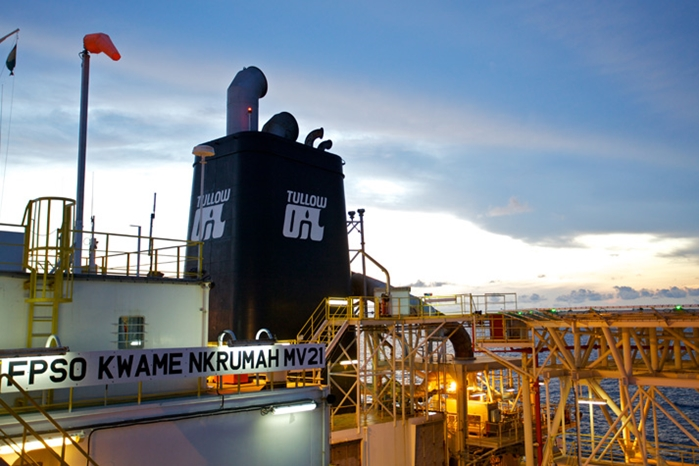
Tullow Oil’s market value has fallen below the US$393.09 million tax award Ghana has secured against its subsidiary, Tullow Ghana Limited, following a major international arbitration ruling that has intensified financial pressure on the oil producer. Editorial Standards
The development follows a decision by an international arbitral tribunal dismissing Tullow’s claims and upholding a corporate income tax assessment issued by the Ghana Revenue Authority (GRA).
The ruling represents a significant development in Ghana’s efforts to recover the disputed tax revenue while maintaining the oil company’s operations in the country.
The award, announced by Finance Minister Dr. Cassiel Ato Forson on September 30, 2026, relates to proceeds Tullow received under its corporate business interruption insurance policy between 2016 and 2019.
The tribunal ruled that the tax assessment did not breach Ghana’s petroleum agreements with the company and that the GRA’s enforcement action was lawful.
How Ghana secured the US$393 million award
The dispute began in December 2022 when the GRA issued a corporate income tax assessment of US$196.5 million against Tullow Ghana Limited over proceeds received from its business interruption insurance policy.
The company challenged the assessment and referred the matter to arbitration under the rules of the International Chamber of Commerce (ICC) in London in February 2023.
The tribunal’s September 29, 2026, award upheld the tax assessment and ruled that a penalty equivalent to 100 percent of the assessed tax fell outside the scope of the contractual protections contained in Tullow’s petroleum agreements with Ghana. Corrections Policy
The combination of the original US$196.5 million tax assessment and an equivalent penalty brings the total award to approximately US$393.09 million.
The tribunal also rejected the company’s position that the assessment was time-barred, clearing the way for the tax authority to pursue the liability under the applicable legal framework.
Tullow has expressed disappointment with the outcome and said it would consider its next steps after further engagement with the Ghanaian government.
The company has not indicated that it accepts the award without further consideration.
Share price decline puts company valuation under pressure
The ruling has coincided with a sharp fall in Tullow Oil’s share price, reducing the market value of the London-listed company.
According to a report on October 1, the company’s shares fell by as much as 52 percent in London on September 29, trading at around 10.7 pence during the morning session.
Its market capitalization was estimated at approximately £150 million, equivalent to about US$200 million at prevailing exchange rates.
That valuation was roughly half the size of Ghana’s US$393.09 million award, illustrating the scale of the financial obligation relative to the value investors were assigning to the entire company at the time. Editorial Ethics & Independence
However, market capitalization and a company’s total financial obligations are different measures.
Market capitalization represents the market value of its outstanding shares, while the tax award is a liability associated with the dispute.
The comparison highlights the pressure facing shareholders but does not, by itself, determine whether Tullow can pay the award.
Debt adds to Tullow’s financial challenges
The tax ruling comes as Tullow continues to manage substantial debt and work to strengthen its financial position.

The company has been reducing its debt through asset disposals, including sales involving its interests in Gabon and Kenya. It also reported an after-tax loss of US$101 million for the first half of 2026.
Nevertheless, Tullow reported an improvement in first-half free cash flow, supported by stronger production from its Ghanaian fields, better-than-expected performance from new wells and higher international oil prices. Newscard
Reuters reported the improvement on September 28, two days before the tax ruling was announced.
The improved cash flow could provide some support for the company’s financial position, although the size of the tax award creates an additional challenge as it seeks to reduce debt and sustain investment.
Ghana faces a balance between revenue and oil production
For Ghana, the ruling provides legal backing for the GRA’s assessment and strengthens the government’s position in pursuing the disputed revenue.
However, collecting the full amount while preserving oil production and investment presents a practical challenge.
Tullow remains an important participant in Ghana’s offshore oil industry, with interests in the Jubilee and Tweneboa, Enyenra and Ntomme (TEN) fields.
In announcing the award, Dr. Ato Forson said the government would consider the company’s capacity to continue operating and investing in these fields when determining the timing and manner of payment. Menu Popup

The stated objective is to recover the revenue while preserving Tullow’s ability to continue operating in Ghana.
The approach reflects the competing considerations involved: enforcing tax obligations while avoiding unnecessary disruption to an industry that contributes to national revenue, employment and economic activity.
What happens next?
Tullow’s response to the arbitration decision and the government’s approach to collecting the award will be important developments to watch.
The company has said it will consider its next steps, while the government has indicated that collection arrangements will take account of the need to sustain operations and investment.
The ruling does not automatically mean the company must pay the entire amount immediately, and the eventual timing and structure of any payment remain important questions. Privacy Policy & Terms
For investors, the dispute adds uncertainty to a company already working to manage its debt and rebuild market confidence.
For Ghana, it presents an opportunity to enforce a substantial tax assessment while safeguarding continued production from key offshore fields.
The central issue now is how the government can secure the US$393.09 million award without undermining the oil operations that remain important to Ghana’s energy sector and public finances.