

Ghana has begun rolling out the Ghana Child Labour Monitoring System (GCLMS), a new digital platform designed to strengthen the identification, documentation, referral and follow-up of child labour cases across the country.
The Ghana Child Labour Monitoring System is expected to help government officials and other stakeholders track children exposed to hazardous or exploitative work and ensure that affected children and their families receive appropriate support.

The system is particularly relevant to sectors such as agriculture, artisanal and small-scale mining, domestic work and other areas of the informal economy where children may be exposed to hazardous working conditions.
How the Ghana Child Labour Monitoring System works
The new Ghana Child Labour Monitoring System has been made interoperable with other child protection systems in the country.
This is expected to improve case referrals, information sharing, follow-up and coordination among agencies responsible for child protection.
The system allows users to register and document child labour cases, update case information, manage data, generate reports and monitor follow-up actions.
It is also expected to enable district and regional officers to maintain accurate records and track each case from identification through referral and follow-up.
Stakeholders trained on new system
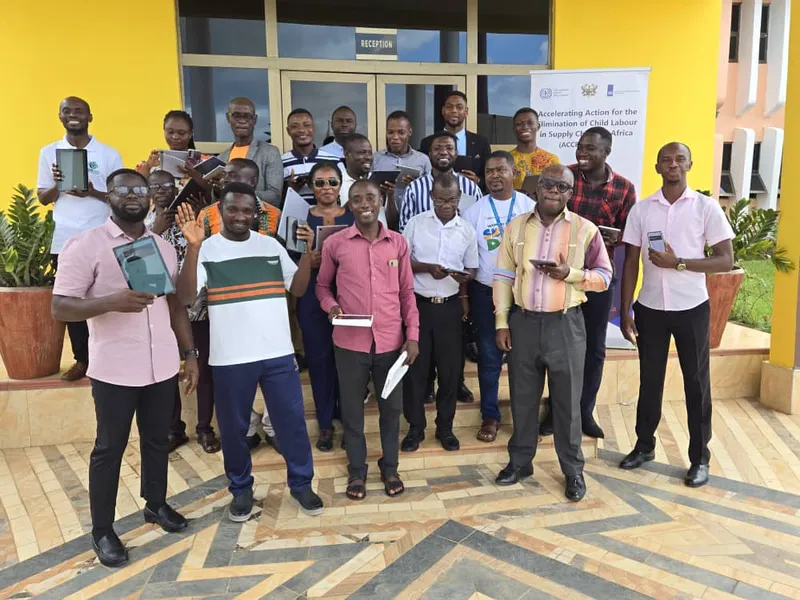
The rollout follows a four-day training programme held in Bibiani from September 15 to 18, 2026.
The training brought together selected regional and district stakeholders from areas covered by the ACCEL Africa Project and focused on equipping participants with practical skills to use the Ghana Child Labour Monitoring System.
The programme was organised by the International Labour Organization (ILO) through its ACCEL Africa Project, in partnership with the Child Labour Unit of the Ministry of Labour, Jobs and Employment.
Participants were trained on case registration and documentation, updating case information, data management, report generation and monitoring follow-up interventions.
ILO highlights importance of reliable child labour data
Speaking during the training, Bismark Quartey, National Project Coordinator of the ILO’s ACCEL Africa Project in Ghana, emphasised the importance of reliable data in addressing child labour.
He said the system would provide stakeholders with a common mechanism for documenting cases, understanding their characteristics and underlying causes, initiating appropriate interventions and following up on children and families receiving support.
According to him, improved data would help stakeholders better understand the nature of child labour cases and support appropriate interventions.
System developed with ILO and government collaboration
The Ghana Child Labour Monitoring System was developed with funding from the ILO through the ACCEL Africa Project and other development partners, in collaboration with the Government of Ghana through the Ministry of Labour, Jobs and Employment.
The system is expected to strengthen the ability of district and regional officers to maintain accurate case records and ensure that relevant information remains available throughout the management of each case.
Its interoperability with other child protection systems is also expected to facilitate information sharing and improve coordination among agencies.
Social Welfare Department welcomes initiative
Frederick Osei Agyemang, a participant from the Social Welfare Department in Bibiani, said the training had improved his understanding of how to use the Ghana Child Labour Monitoring System to document child labour cases.
He said the system would help improve the quality of information collected at the district level and support efforts to ensure that identified cases receive appropriate assistance.
The rollout of the Ghana Child Labour Monitoring System forms part of broader efforts to strengthen Ghana’s national systems for preventing and eliminating child labour.
The initiative is also expected to support more timely and evidence-based decisions while helping stakeholders monitor whether interventions are reaching children and families who need them.
The broader objective is to strengthen the protection of children from forms of work that may threaten their safety, development and future.
By:Rachael Djabakie