

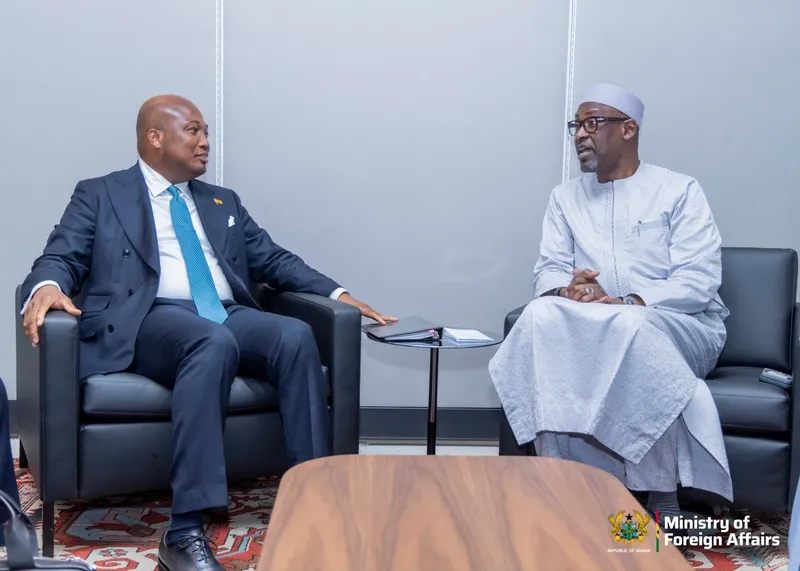
Ghana and Mali have agreed to strengthen cooperation in combating violent extremism, regional instability and climate change, as both countries seek African-led solutions to the security and development challenges confronting West Africa and the Sahel. Editorial Ethics & Independence
The commitment followed a meeting between Ghana’s Minister for Foreign Affairs, Samuel Okudzeto Ablakwa, and his Malian counterpart, Abdoulaye Diop, Minister of Foreign Affairs and International Cooperation, on the sidelines of the 81st United Nations General Assembly in New York.
Mr Ablakwa announced the outcome of the engagement in a post on X, emphasising the longstanding historical ties between the two countries and their shared interest in regional integration, peace and development.
He said Ghana valued its longstanding relationship with Mali, recalling the historic Ghana-Mali-Guinea union, which represented an early effort to advance African unity following independence.
“Ghana is proud of our close partnership with the AES nations which is anchored on trust and solidarity,” Mr Ablakwa stated.

He added that both countries had agreed to continue working together against violent extremism, instability and climate change while pursuing homegrown solutions to unlock the development potential of the region.
The minister also described Ghana’s diplomatic approach as “Afro-Pragmatism”, suggesting that the country intends to maintain constructive relations with its neighbours and regional partners while pursuing practical solutions to shared challenges.
The engagement comes amid persistent security concerns across the Sahel, where armed groups, cross-border violence and humanitarian pressures continue to affect several countries. Instability in the region has also raised concerns for coastal West African states, including Ghana, which faces the need to protect its northern borders and prevent insecurity from spreading southwards.
President John Dramani Mahama has also addressed the regional security situation during his engagements in New York, outlining his administration’s approach to cooperation between West African countries and the wider international community.
Speaking at the Council on Foreign Relations, President Mahama traced the escalation of insecurity in the Sahel partly to the aftermath of the conflict in Libya, the proliferation of weapons and the movement of terrorist groups across the region.
He argued that the subsequent military coups should be understood within the broader historical and security context rather than examined in isolation. Editorial Standards
The President’s remarks highlighted the interconnected nature of the region’s challenges and the need to consider the underlying factors contributing to instability.
Mahama also called for continued dialogue between the Economic Community of West African States (ECOWAS) and the Alliance of Sahel States (AES), whose members include Mali, Burkina Faso and Niger.

He stressed that counterterrorism efforts require cooperation across political and regional divisions, noting that dialogue and the rebuilding of relationships remain important to addressing common threats.
Ghana, he said, was strengthening surveillance and intelligence-sharing arrangements with neighbouring countries as part of efforts to protect its borders and respond to emerging security risks.
The cooperation agenda also extends beyond military and security measures.
Climate change, economic hardship, limited employment opportunities and underdevelopment can compound existing vulnerabilities in communities affected by insecurity. Corrections Policy
Addressing these issues requires coordinated investment in livelihoods, public services and local institutions alongside law enforcement.
President Mahama also used his engagements in New York to explain the thinking behind the Accra Reset, an initiative aimed at strengthening African ownership of development priorities and reducing excessive dependence on external assistance.
He said the withdrawal of US$174 million in programmed development support, including an annual US$74 million gap in the health sector, had exposed vulnerabilities in critical areas such as medical research, HIV testing and programmes supported by the US President’s Emergency Plan for AIDS Relief (PEPFAR).
According to the President, the experience reinforced the need for African countries to develop greater health sovereignty by expanding their capacity to produce medicines and vaccines rather than relying heavily on external supply chains.
The Accra Reset forms part of a broader vision for a more self-reliant and integrated Africa, with stronger domestic institutions, sustainable financing and greater capacity to respond to economic and social challenges.
Ghana is also preparing for its planned African Union chairmanship in 2027.
President Mahama has indicated that the country intends to use the role to advance regional integration, facilitate the movement of goods across Africa and support continental initiatives on peace and security.
The agreement between Ghana and Mali therefore forms part of wider diplomatic efforts to maintain regional dialogue and strengthen cooperation across West Africa, including with countries belonging to the AES.
While the meeting did not publicly announce specific new security operations or funding commitments, the stated agreement signals both countries’ intention to sustain engagement on shared challenges.
The next step will be translating the commitment into practical cooperation, including information-sharing, coordinated security measures, climate resilience and development initiatives that address the conditions affecting stability across the region.