

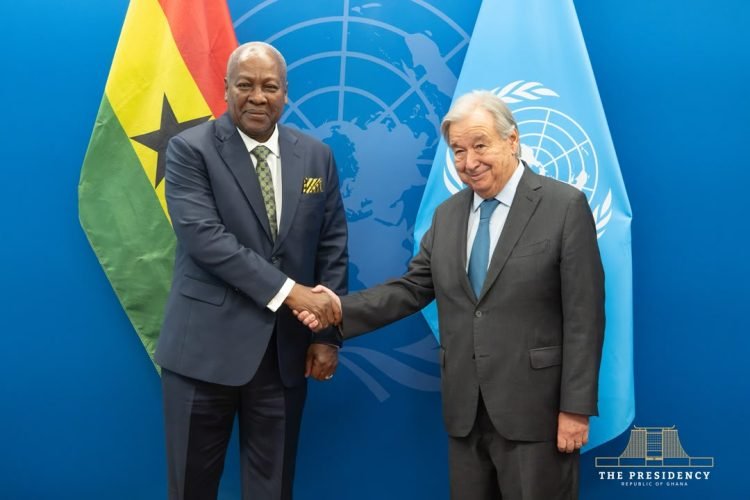
United Nations Secretary-General António Guterres has expressed optimism about the prospects of the global reparatory justice agenda and pledged his support for President John Dramani Mahama and the African Union (AU) as they pursue efforts to address the historical injustices associated with the transatlantic slave trade. Editorial Standards
Mr Guterres made the remarks during a meeting with President Mahama on Friday, September 25, 2026, on the sidelines of the 81st United Nations General Assembly (UNGA) in New York.
The meeting provided an opportunity for the two leaders to discuss reparatory justice, Ghana’s international initiatives, Africa’s development priorities and security challenges affecting West Africa and the Sahel.

According to details of the engagement, the UN Secretary-General congratulated President Mahama on his initiatives concerning reparatory justice and other issues affecting Ghana and the African continent.
Mr Guterres also recalled the adoption of a United Nations General Assembly resolution on reparations and reparatory justice, expressing optimism about its prospects and the international response to the initiative.
His comments come as Ghana continues to advocate for international cooperation to translate recognition of historical injustices into practical measures, including the return of looted cultural artefacts, access to historical archives and the development of mechanisms to advance reparatory justice.
President Mahama has been at the forefront of Ghana’s campaign, serving as the African Union’s champion for reparations and using international platforms to encourage countries and institutions to engage with the issue.

On March 25, 2026, the UN General Assembly adopted Resolution A/RES/80/250, recognising the trafficking of enslaved Africans and racialised chattel enslavement as the gravest crime against humanity. Editorial Ethics & Independence
The resolution received 123 votes in favour, marking a significant development in international discussions on the historical consequences of slavery.
Following the adoption, Ghana convened a high-level consultative conference in Accra in June 2026, bringing together representatives from Africa, the Caribbean and the wider African diaspora to consider practical steps towards advancing the reparatory justice agenda.
The conference produced the Accra Next Steps Commitment, a framework intended to move the discussion from acknowledging historical injustices towards implementation.
The framework includes efforts to secure the restitution of cultural property, strengthen legal and diplomatic cooperation, and invest in institutions capable of preserving Africa’s heritage.
During the New York meeting, Mr Guterres also commended President Mahama for his leadership and commitment to Ghana and Africa, particularly his advocacy for the Accra Reset Agenda and reforms to the existing international financial architecture.
The Accra Reset initiative focuses on rethinking global development cooperation and strengthening the ability of African countries and other developing economies to finance their priorities and exercise greater control over their development paths.
The discussions reflect broader concerns among developing countries about debt pressures, declining development assistance and the need for international financial institutions to respond more effectively to their economic circumstances.
For Ghana, these issues are closely connected to its efforts to mobilise investment, strengthen domestic institutions and build partnerships that support sustainable development.

The two leaders also discussed developments in West Africa and the Sahel, with particular attention to peace and security challenges in the region.
The Sahel continues to face complex security concerns, including armed violence, displacement and humanitarian pressures.
These challenges have implications for neighbouring countries and underscore the importance of regional cooperation, effective institutions and coordinated international support.
Although details of specific agreements reached during the meeting were not disclosed, the discussions provided an opportunity for Ghana and the United Nations to exchange views on issues affecting regional stability and international cooperation.
President Mahama, for his part, congratulated Mr Guterres on his leadership of the United Nations during what he described as challenging times for international diplomacy.
He also highlighted concerns about dwindling global aid, which has placed additional pressure on countries that rely on external assistance to support development programmes and respond to humanitarian needs. Corrections Policy
Mahama wished the outgoing UN Secretary-General well ahead of the end of his tenure in 2027, acknowledging his service during a period marked by international conflicts, economic uncertainty and debates over the future of multilateral cooperation.
The meeting formed part of President Mahama’s wider diplomatic engagements during the 81st UN General Assembly, where Ghana sought to strengthen partnerships and advance its priorities on development financing, African representation in global decision-making and historical justice.

Guterres’s expressed support provides diplomatic backing for continued discussions on reparatory justice, although translating the agenda into concrete outcomes will require sustained international cooperation, legal processes and practical commitments from relevant countries and institutions. Newscard
For Ghana and the African Union, the next phase will involve building on the UN resolution and the Accra Next Steps framework to pursue restitution, strengthen cultural institutions and establish workable mechanisms for addressing the enduring consequences of historical injustice.