


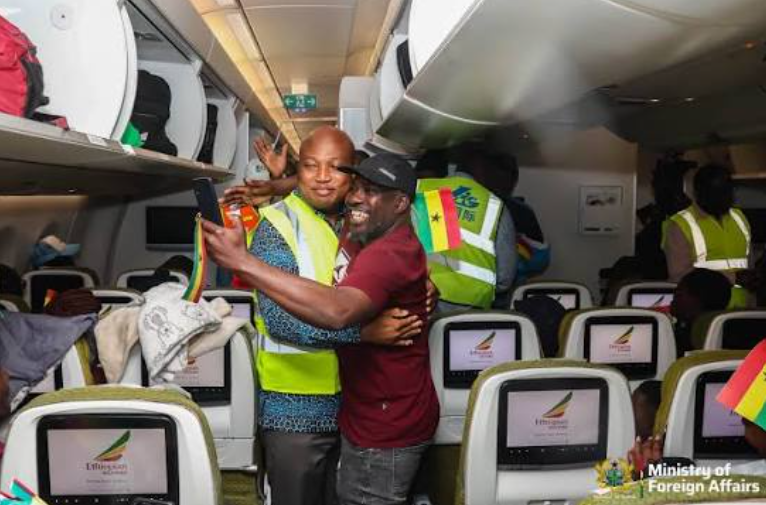
The Ministry of Foreign Affairs spent GH¢27.18 million on chartered flights during the government’s GH¢49.72 million evacuation of Ghanaians from South Africa, making air charter costs the single largest expenditure item in the exercise. Newscard
The expenditure formed part of an emergency operation that brought 1,964 Ghanaians back to Ghana between May 27 and September 4, 2026, following concerns over deteriorating security conditions and reported anti-foreigner sentiment in parts of South Africa. The government has said the entire evacuation bill has been settled, with no outstanding liabilities.
The detailed expenditure breakdown was contained in documents released by the Ministry in response to a Right to Information (RTI) request by the Minority in Parliament.
The figures provide a more detailed picture of how the total GH¢49,721,786 cost of the operation was allocated.
According to the breakdown, GH¢27,183,700 was spent specifically on chartered flights, while another GH¢9,420,463.68 went towards flight tickets and layover expenses. This means expenditure directly associated with air transportation exceeded GH¢36.6 million.

The government’s earlier public account grouped chartered flights, tickets, ground transportation, feeding, accommodation, medical services and hospitalisation into a broader GH¢38.84 million category.
Another significant component of the expenditure was GH¢10.802 million allocated to reintegration and transportation allowances for the returnees.
Each evacuee received a GH¢5,000 reintegration grant and a GH¢500 travel and transportation allowance, bringing the individual support package to GH¢5,500. The government said the payments were designed to assist returnees with their immediate needs and support their reintegration after arriving in Ghana.
The additional expenditure included GH¢997,644 for ground transportation in South Africa, GH¢634,349.99 for feeding and GH¢141,797.86 for hotel accommodation.
The operation also recorded GH¢20,148 in medical services and hospitalisation costs and GH¢153,728.09 in communication expenses. The communication expenditure covered items such as airtime, internet data and the establishment of an evacuation centre.
Printing accounted for GH¢98,151, while GH¢162,917.76 was spent on logistics, including sanitation and screening-related items.
The repatriation and autopsy of two mortal remains cost GH¢84,274, while GH¢22,610.84 was recorded as miscellaneous expenditure.
Beyond the financial payments, the evacuation package included a range of services for the returnees. They received medical screening, registration under the National Health Insurance Scheme, SIM cards loaded with data and airtime, as well as food packages. Editorial Standards
The International Organisation for Migration, the National Disaster Management Organisation (NADMO) and the Ghana Red Cross Society also provided support during the exercise, including psychosocial assistance, logistics, hot meals and water. The Church of Pentecost provided accommodation for affected Ghanaians in Pretoria, Kempton Park and Johannesburg.
The Ministry of Foreign Affairs coordinated the exercise in collaboration with Ghana’s High Commission in Pretoria, the Presidency, the National Security Secretariat and other relevant state institutions. The government said the operation was undertaken after assessing security concerns affecting Ghanaian nationals in South Africa.
The first evacuation flight departed on May 27, with vulnerable groups, including children, sick persons, older people and women, prioritised. The final batch of 41 evacuees arrived in Accra on September 4, bringing the exercise to a close.
The financing of the operation came from both public and private sources. The Government of Ghana provided GH¢33,721,786, while Engineers and Planners, owned by businessman Ibrahim Mahama, contributed GH¢16 million. Together, the contributions covered the reported GH¢49.72 million cost of the exercise.
The expenditure disclosure comes amid parliamentary interest in the financial details of the evacuation. The Minority has sought documentary evidence supporting the government’s account, while the Foreign Affairs Ministry has also requested a special audit of government evacuation exercises from 2017 to date, including operations linked to COVID-19, Ukraine, Sudan and South Africa. Editorial Ethics & Independence
The government has maintained that the South Africa evacuation was an emergency response that could not have been anticipated and therefore was not specifically budgeted for. Foreign Affairs Minister Samuel Okudzeto Ablakwa has said the intervention was necessary to protect Ghanaians whose safety and welfare were considered at risk.
With the evacuation now concluded, attention has shifted from the repatriation exercise to the reintegration of those who returned and scrutiny of the public expenditure involved. The detailed financial records are expected to remain relevant to ongoing discussions about accountability, emergency spending and how Ghana prepares for future crises involving citizens abroad.