


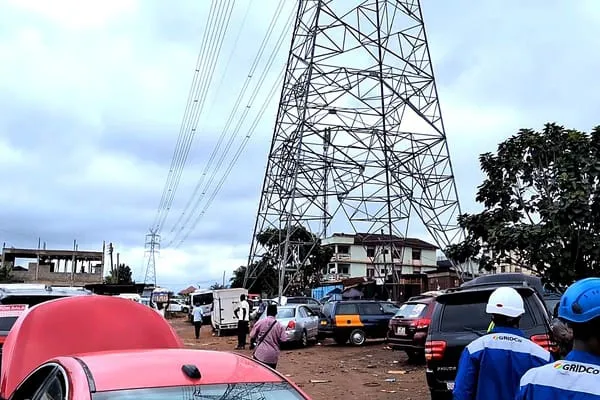
The Ghana Grid Company Limited (GRIDCo) has issued a 30-day ultimatum to residents, traders, artisans and drivers operating under its high-voltage transmission lines at Ejisu in the Ashanti Region to vacate the area. Editorial Standards
The directive forms part of an intensified sensitisation and eviction exercise aimed at removing encroachments from GRIDCo’s transmission Right of Way (RoW). The company says the exercise is necessary to protect the public, safeguard critical electricity infrastructure and ensure that technical teams can access transmission facilities whenever maintenance or emergency repairs are required.
Transmission corridors are designated spaces reserved around high-voltage electricity lines and related infrastructure. These areas are intended to reduce risks associated with human activity near electrical installations and to provide engineers with sufficient access to inspect, maintain and repair the network.
Speaking during the exercise at Ejisu, GRIDCo’s Director for Land Management, Engineer Bismark Anane, explained that the company must keep the transmission corridor free from structures, businesses and other activities that could obstruct access or endanger lives.

“We need a corridor that is free of any encumbrances or what we call encroachment. This is to protect the infrastructure and also to ensure public safety,” he said.
Engineer Anane noted that emergencies involving transmission lines require immediate access to the affected infrastructure. He explained that if a conductor snaps or falls, GRIDCo’s engineers must be able to reach the location quickly to carry out repairs and restore electricity supply.
“If there is a snap, or a conductor falls, we need immediate access to the transmission infrastructure to be able to repair it, to restore electricity,” he added. Corrections Policy
Despite previous sensitisation programmes, GRIDCo says encroachment along some of its transmission corridors remains a persistent challenge. Individuals and businesses have continued to occupy restricted areas, sometimes establishing permanent or semi-permanent structures beneath or close to high-voltage lines.
At Ejisu, the affected occupants reportedly include traders, artisans, residents and drivers who use the corridor for commercial and other daily activities. Some have operated in the area for extended periods and depend on their businesses and workplaces for their livelihoods.
While some occupants acknowledge the potential dangers associated with living or working beneath high-voltage transmission lines, they have appealed to GRIDCo and other relevant authorities to consider relocation arrangements before the eviction exercise is implemented.
The affected persons say an abrupt loss of their workplaces could disrupt their incomes and place additional financial pressure on their families. They are therefore calling for assistance in identifying alternative locations where they can continue their activities safely and legally.
GRIDCo, however, maintains that the transmission Right of Way must remain clear to ensure the safety of the public and the reliability of the national power transmission network. The company has also clarified that compensation may be considered in situations where its own projects directly affect verified residences or livelihoods.

According to Engineer Anane, affected persons must first be identified and assessed through an enumeration process. This process is intended to establish whether a person’s residence or livelihood is genuinely affected by a GRIDCo project and whether the individual qualifies for any applicable compensation measures.
“Once it is verified that the project will impact either your livelihood or place of residence, GRIDCo will take measures to compensate the affected person,” he said.
The clarification suggests that compensation is not automatically available to every person occupying a transmission corridor. Eligibility depends on verification and the circumstances under which the residence, business or livelihood is affected by a GRIDCo project. Editorial Ethics & Independence
The company has consequently urged all persons operating within the Ejisu transmission corridor to treat the 30-day notice seriously and make the necessary arrangements to vacate the restricted area within the stipulated period.
GRIDCo’s position is that keeping the Right of Way free from encroachment is essential for preventing accidents, protecting electricity infrastructure and allowing maintenance teams to respond efficiently to faults. The company is also encouraging the public to avoid putting up buildings, trading structures, workshops or other facilities within designated transmission corridors.
For affected occupants, the immediate challenge remains how to relocate without suffering severe disruption to their livelihoods. The situation highlights the need for continued engagement between infrastructure agencies, local authorities and affected communities to balance public safety requirements with the economic realities of people whose activities have developed within restricted areas.