


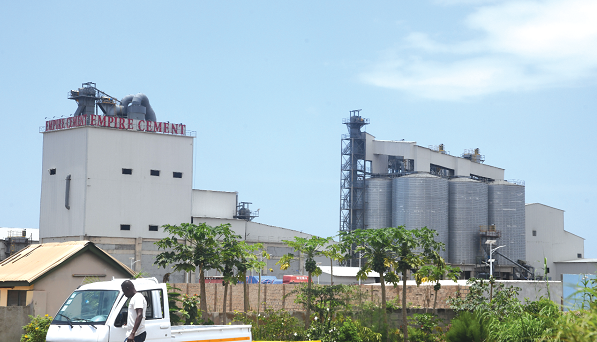
The Environmental Protection Authority (EPA) has directed Empire Cement Ghana Ltd to shut down its factory operations with immediate effect following investigations into alleged air pollution and nuisance associated with the company’s activities.
The enforcement action follows several complaints from members of the public regarding alleged air pollution linked to the company’s operations.
The EPA said the complaints prompted investigations into the environmental conditions surrounding the facility and its compliance with approved operating requirements. Newscard
In a statement issued on September 14, the Authority said its investigations established that the company was releasing sustained visible particulate and gaseous emissions into the ambient environment.
According to the EPA, the emissions had the potential to negatively affect the environment, adjoining land uses, and public health.
However, the statement did not provide detailed measurements of the reported emissions or indicate whether any specific health condition had been directly attributed to the company’s activities.
The EPA also said its investigations uncovered several breaches of conditions attached to Empire Cement’s Environmental Permit.
These findings, it noted, had resulted in the decision to order the immediate shutdown under Section 35 of the Environmental Protection Act, 2025 (Act 1124).
One of the breaches identified by the regulator was the company’s alleged failure to submit its quarterly environmental monitoring returns.
The EPA said this was contrary to Condition 9.1 in the schedule to the company’s Environmental Permit. Corrections Policy
Quarterly environmental monitoring returns are important tools used by regulators to assess the environmental performance of industrial facilities.
Such reports may contain information on emissions, waste management, pollution-control measures, and compliance with approved environmental conditions.
The EPA said Empire Cement had also failed to implement key requirements relating to the control of air pollution from its factory.

Among the requirements allegedly not met was the installation of appropriate state-of-the-art pollution-control systems on all pollution discharge units.
The systems are expected to help reduce emissions and ensure compliance with the Ghana Standard for Environment and Health Protection Requirements for Ambient Air Quality and Point Source/Stack Emissions, identified as GS 1236:2019.
The standard provides requirements for managing air quality and controlling emissions from industrial sources, including point-source and stack discharges.
Compliance is intended to limit the release of pollutants into the atmosphere and protect communities and the environment from excessive exposure. Editorial Standards
The EPA further found that existing pollution-control systems and auxiliary equipment at the facility were not being maintained in good working condition.
According to the Authority, the condition of the equipment affected its ability to effectively reduce air pollution and ensure compliance with permissible limits for fenceline air quality and point-source or stack emissions.

Fenceline air quality refers to the quality of air around the boundary of an industrial facility.
Monitoring at this point can help determine whether emissions from a factory are affecting areas immediately outside its premises.
Point-source emissions, meanwhile, are pollutants released from identifiable sources such as factory stacks, vents, or discharge outlets.
Proper equipment, regular maintenance, and continuous monitoring are essential to ensure that these emissions remain within permitted limits.
Industrial facilities are generally required to maintain pollution-control equipment and operate in accordance with the conditions of their environmental permits.
Failure to maintain such systems can increase the risk of dust, particulate matter, and gaseous pollutants entering the surrounding environment.
Cement-related operations can generate particulate emissions during activities such as raw-material handling, grinding, storage, transportation, and production.
Effective filtration, dust suppression, equipment maintenance, and emissions monitoring are therefore important in limiting environmental impacts. Editorial Ethics & Independence
The EPA’s directive underscores the regulator’s responsibility to enforce environmental standards and ensure that industrial operators meet their obligations to surrounding communities.
It also highlights the importance of timely environmental reporting and the proper maintenance of pollution-control infrastructure.
The shutdown is expected to remain in effect until the company addresses the issues identified by the EPA and satisfies the relevant regulatory requirements.
The Authority’s statement did not specify a timeline for a possible reopening or outline all the corrective measures Empire Cement must complete before resuming operations.
The information provided also did not include a response from Empire Cement Ghana Ltd.
The company’s position on the allegations, the condition of its pollution-control systems, and any measures it intends to take will be important in understanding the next steps in the matter.
The case serves as a reminder that industrial development must be accompanied by effective environmental safeguards, transparent monitoring, and strict adherence to public health and environmental protection standards.