


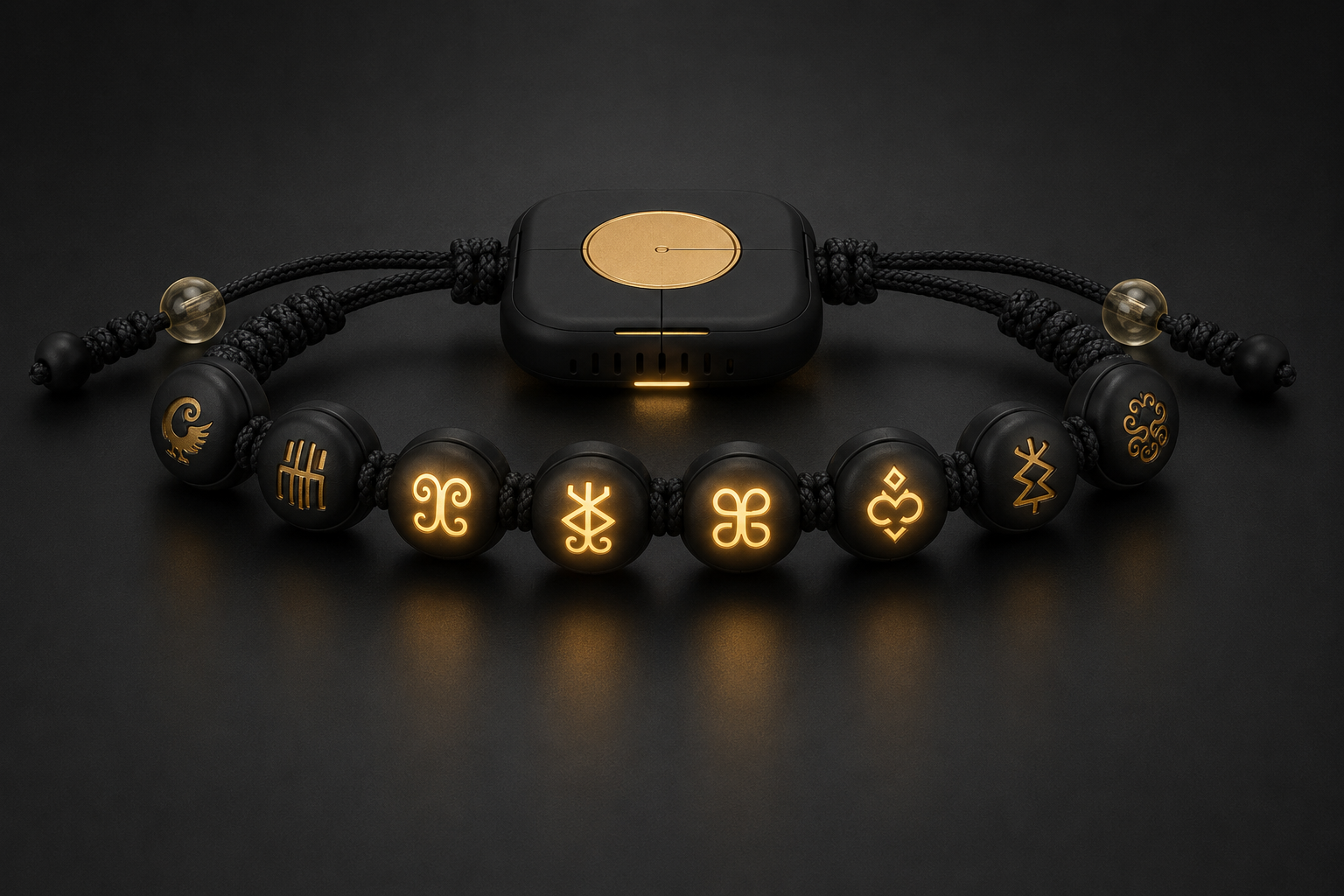
A 23-year-old Ghanaian inventor and biomedical engineer, Melvin Osei Opoku, has created M’AKOMA, a wearable bracelet designed to help families, couples, and close friends maintain a sense of physical and emotional connection despite being separated by long distances.
The innovation seeks to address a challenge increasingly experienced by people living, studying, or working across continents: the emotional strain of separation, homesickness, and the absence of physical closeness with loved ones.
Unlike conventional smartwatches that combine fitness tracking, social media, applications, and multiple notifications, M’AKOMA is designed around a more focused purpose helping people feel connected to the individuals who matter most.
The bracelet is intended to restore what its creator describes as tactile and auditory closeness, allowing users to communicate through touch and short voice messages without relying on a screen.
At the centre of the concept is a six-bead interface. Each bead represents a person within the user’s closest inner circle, supporting up to five loved ones, alongside the wearer. Editorial Ethics & Independence
This design transforms the bracelet from a conventional electronic device into a personal digital keepsake.One of its key features is the touch-to-feel haptic system.
When a user taps a specific bead, the corresponding person’s bracelet receives a distinct vibration pulse.
The feature is designed to create the feeling of a physical touch being shared across distance, allowing a simple gesture to communicate affection, reassurance, or a reminder that someone is thinking of them.
M’AKOMA also incorporates a voice-echo feature, supported by a built-in microphone and speaker. Users can hold a bead to record and transmit short, private voice messages without needing to look at a phone screen.

This function is intended to make communication more personal and immediate, particularly for people who want to share a quick message with a loved one. Corrections Policy
Adinkra Symbols: Connecting Technology to Ghanaian Culture
One of the most distinctive elements of M’AKOMA is its incorporation of Ghanaian Adinkra symbols, which give the bracelet a cultural identity beyond its technological purpose.
The device is designed with matte-black beads engraved with gold Adinkra symbols, including Sankofa and Gye Nyame.

These traditional symbols are widely associated with Ghanaian heritage and carry meanings that connect the bracelet’s design to ideas of identity, wisdom, spirituality, and human relationships.
The Sankofa symbol is commonly associated with the importance of learning from the past, while Gye Nyame expresses the supremacy or omnipotence of God in Akan cultural symbolism.
Their inclusion gives the bracelet a visual language rooted in Ghanaian history and artistic tradition.
By placing these symbols on a modern wearable device, M’AKOMA brings elements of Ghana’s cultural heritage into contemporary technology.
The design reflects an effort to demonstrate that innovation can be technologically advanced while still preserving and celebrating local identity.
The beads are designed to house miniature circuit boards and haptic motors, combining traditional visual inspiration with modern engineering.
This fusion of craftsmanship, symbolism, and electronics allows M’AKOMA to function not only as a communication device but also as a piece of jewellery that carries cultural meaning.
How M’AKOMA Sends Messages and Signals
When a user sends a signal, light cue, or voice note to someone in their selected circle, the bracelet communicates with the user’s smartphone through Bluetooth.
The phone then uses an internet connection—either cellular data or Wi-Fi to transmit the message or cue to the other person through the M’AKOMA system.
The recipient’s bracelet receives the corresponding communication, allowing a touch, signal, or voice message to travel across long distances.
This relay-based system means the bracelet does not need to maintain a direct Bluetooth connection with another bracelet thousands of miles away; instead, the connected smartphones and internet infrastructure help bridge the distance.
The communication process is designed to make M’AKOMA suitable for users whose loved ones live in different cities or countries, provided the necessary devices, application, and internet connectivity are available. Editorial Standards

A defining aspect of M’AKOMA is its deliberate commitment to zero distractions. The device does not feature a screen, social media feeds, or fitness-tracking functions.
Instead, its design prioritises intimate communication and meaningful relationships over the constant stream of digital notifications associated with many modern devices.
The bracelet connects to a dedicated M’AKOMA mobile application, which works through a user’s phone as a communication relay.
This allows the system to support communication across global distances, making it potentially relevant to families with members living in different countries, international students, long-distance coupl es, and friends separated by migration or work.
The name M’AKOMA, associated with the heart in Akan languages, aligns with the product’s central idea of emotional connection.
Its concept is built around keeping a small circle of trusted people symbolically and physically close, even when they are thousands of miles away.
Opoku’s invention highlights how biomedical engineering and wearable technology can be applied beyond conventional health and fitness devices.

It also demonstrates the potential for young African innovators to develop products that combine technological functionality, cultural identity, and everyday human experiences.
As interest in wearable technology continues to grow, M’AKOMA presents a different approach—one that places emotional connection at the centre of the user experience.
Rather than encouraging users to engage with more digital content, the bracelet is designed to help them focus on the relationships they already value.
The development of M’AKOMA by Melvin Osei Opoku offers an example of youth-led innovation in Ghana, combining engineering, design, and cultural inspiration to address the realities of long-distance relationships.
By incorporating Adinkra symbolism into its design, the bracelet also presents a modern expression of Ghanaian culture, showing how traditional identity can remain relevant in emerging technologies.Its progress and wider adoption will depend on further development, testing, and the availability of the product to users.