

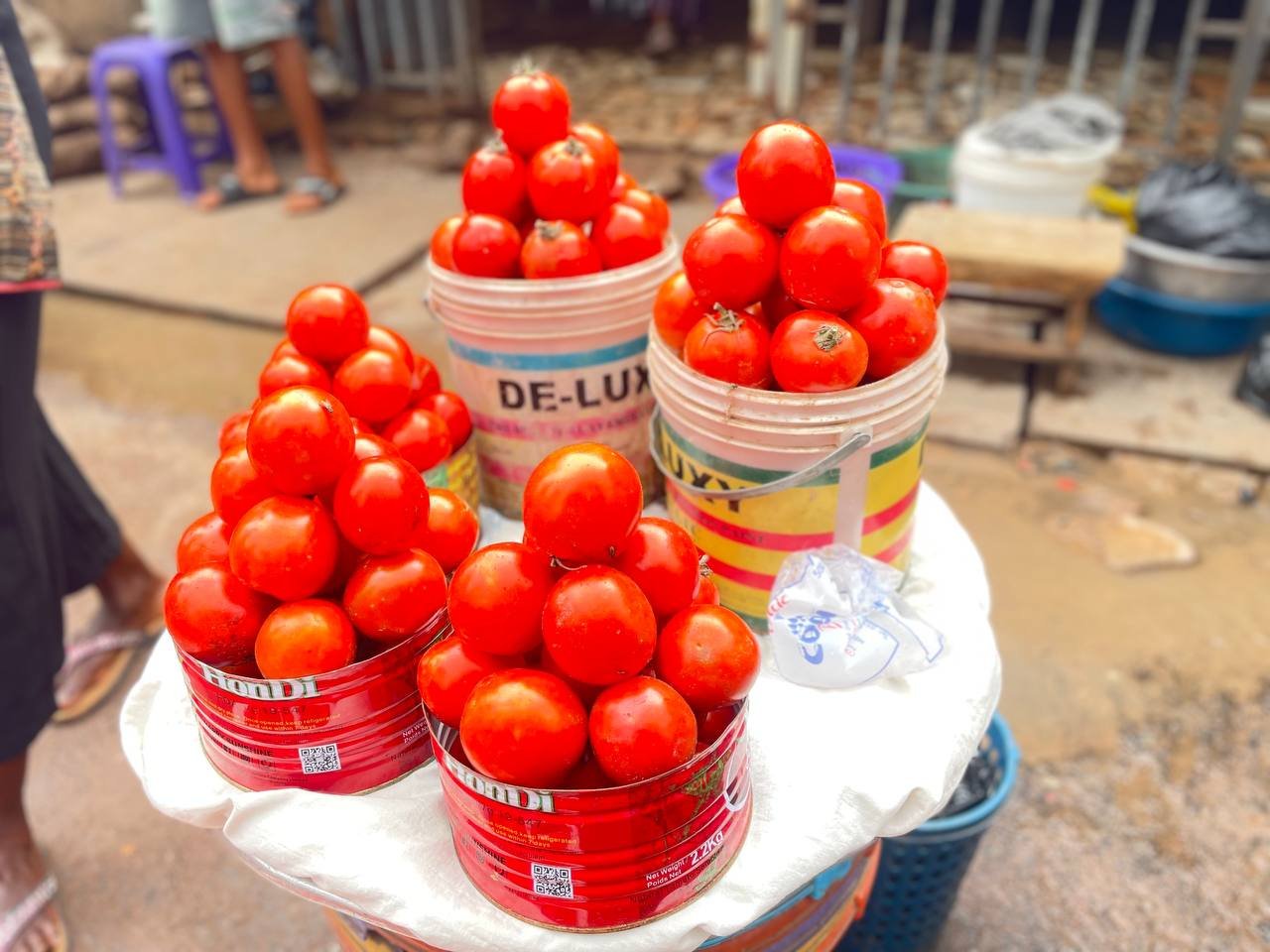
Fresh tomato prices jumped up by 158.3% year-on-year (y-on-y) in August 2026, making it the biggest price mover recorded by the Ghana Statistical Service (GSS) last month. Corrections Policy
This steep price jump for tomatoes comes at a time when overall food inflation has, contrary to public perception, just barely declined month-on-month in August to 3.0% from 3.1% in July.
Presenting the August Consumer Price Index, Government Statistician, Dr Alhassan Iddrisu said, “Fresh Tomatoes more than doubled in price (+158.3%) while Lime fell 33.7%, the overall Y-on-Y inflation of 5.0% hides very different experiences at the market,” Dr Iddrisu noted, “While some food products recorded significant price increases, others recorded considerable price fall in August.
This emphasizes that different price experiences existed for different commodities at the market.” Last month, new figures from the GSS revealed that fresh tomatoes have more than doubled in price – recording the highest year-on-year price increase out of all the categories monitored by the service for the period. Editorial Standards
Fresh tomato prices increased to 158.3 percent y-o-y in August. Ginger recorded the second-highest price gain last month with 128.3 percent increase, while shrimps followed with a price increase of 67.1 percent.

Shrimps price increased by 67.1 percent. Mango prices rose by 57.7 percent for the period. Fresh coconut and fresh green pepper both increased by 38.0 per cent and 30.5 per cent respectively last month. However, fresh tomato price did not share the fate of a number of other goods and services which decreased in price for the period.
Limes led the pack in this category with a 33.7% decrease in price for the period, followed by maize which fell by 31.3%. “Several other commodities such ascocoyam leaves , sweet apples , fresh green pepper, fresh coconut, fried fish and pawpaw all recorded decreased month-on-month inflation,” GSS noted in the report.
Food prices in August fell by 2.5percent Month-on-Month , according to GSS statistics released August 27th ,2026.
Explaining why the prices may seem to have risen when in fact food prices fell on month-on-month basis, Dr Iddrisu stated that “inflation measured as the rate of price change not price levels”, thus for instance “inflation measures how fast prices in general are rising or falling not how high they already are.” In August 2026, y-o-y inflation increased to 5.0% from 4.6% in July 2026. In spite of the slight monthly increase in overall inflation figure, the August figure remains drastically below that of 11.5 percent recorded in the same month last year in 2025. Editorial Ethics & Independence
Non-food items are still the primary drivers of price pressures in the Ghanaian economy with their inflation rate in August rising to 6.8percent, significantly higher than that of food which remained at 3.0percent.
The contribution of non-food items to overall inflation for the period was 70.9percent while that of food contributed 29.1percent. “Overall y-o-y inflation of 5.0 % can therefore be said that Non-food items contributed 70.9% and Food items contributed 29.1% of the total inflation,” Dr Iddrisu further stated. Meanwhile, inflation on Services category stood at 8.6percent in the period.
This compares with inflation on goods of 3.0percent. Inflation on domestically produced goods and services continued to be the main driver of price increase with a 86.2% contribution as compared to inflation on imported items which contributed 2.2%.