

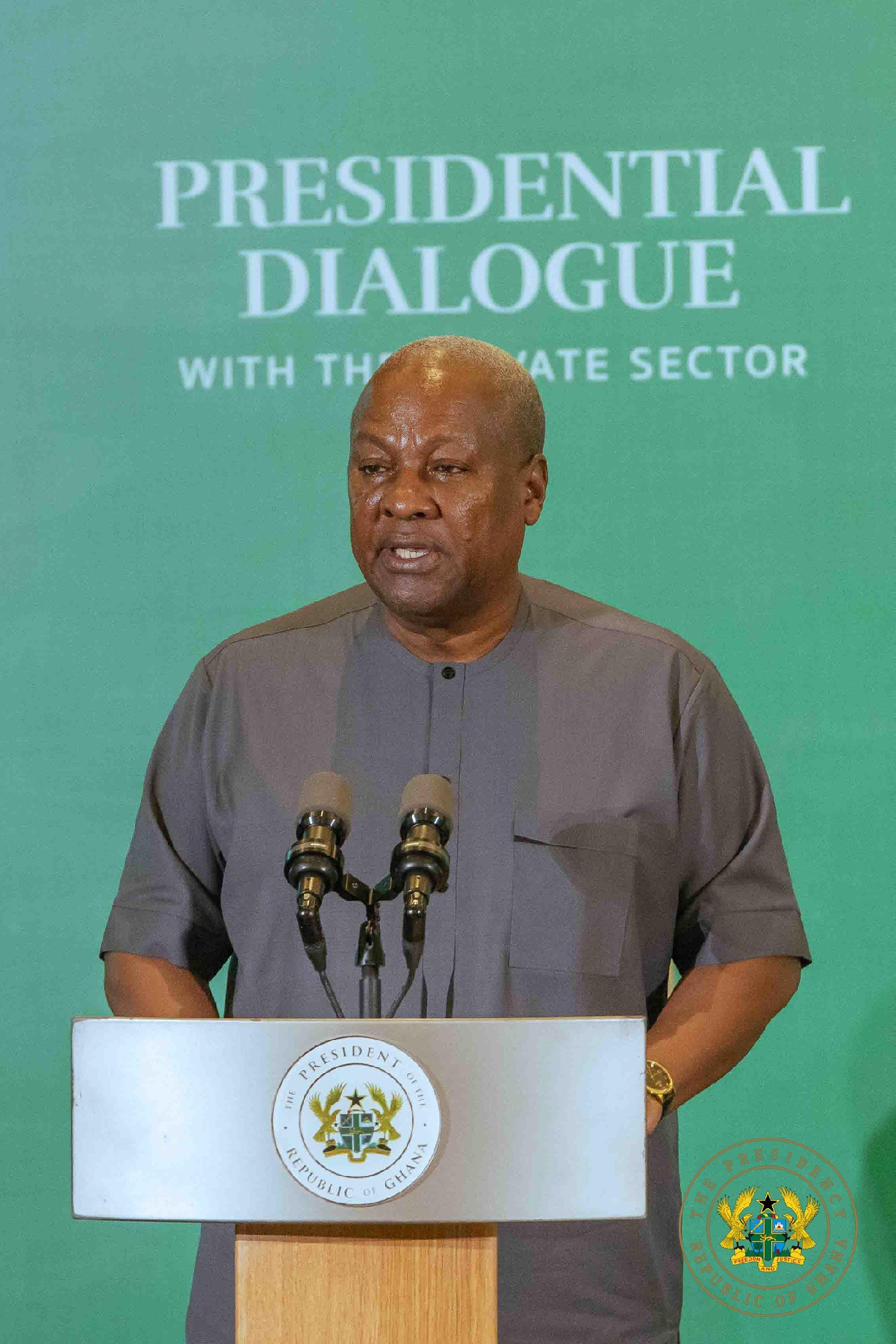
President John Dramani Mahama has called for deeper collaboration between government and the private sector, insisting that the country’s economic transformation must deliver real improvements in citizens’ daily lives rather than remain limited to macroeconomic statistics.
Speaking at the 10th Ghana CEO Summit in Accra, President Mahama addressed business leaders, investors and policymakers, reinforcing his administration’s commitment to building an enabling environment that supports enterprise growth, investment and job creation. He emphasized that sustainable national development depends on a strong partnership between the public and private sectors.
“When businesses thrive, Government succeeds and the nation prospers,” the President said, underscoring what he described as the mutual dependence between policy direction and private sector performance. His remarks were aimed at strengthening confidence among investors and corporate leaders at a time Ghana continues to pursue economic recovery and structural reform.
The Ghana CEO Summit, which has become one of the country’s leading platforms for dialogue between government and industry, brought together key figures from both the public and private sectors. Among those present were Presidential Advisor Joyce Bawah Mogtari, Minister for Trade, Agribusiness and Industry Elizabeth Ofosu-Adjare, Governor of the Bank of Ghana Dr. Johnson Pandit Asiama, and Chief Executive Officer of Telecel Ghana Patricia Obo-Nai, alongside several other senior executives and policymakers.

President Mahama stressed that economic policy must be people-centered, warning against overreliance on abstract indicators that fail to reflect the lived realities of citizens. His message reflected a broader policy direction aimed at aligning macroeconomic stability with inclusive growth, employment creation and improved living standards.
In a significant gesture during the event, President Mahama was appointed Patron of the Ghana CEO Summit, a symbolic recognition of his administration’s stated commitment to strengthening engagement with the private sector and promoting dialogue on national economic priorities.
The President’s remarks come at a time Ghana is navigating a delicate phase of economic adjustment following years of fiscal challenges, debt restructuring and engagement with international financial institutions. Government officials have recently highlighted improvements in key indicators such as inflation, debt levels and investor confidence, while also emphasizing the need to sustain reforms to avoid a return to previous instability.
By framing economic transformation as a shared responsibility between government and business, Mahama’s message sought to reinforce confidence in Ghana’s economic direction and encourage private capital participation in national development.
Analysts say such engagements are increasingly important as Ghana seeks to position itself as a competitive investment destination in West Africa, especially as regional economies compete for limited global capital flows. Strengthening public-private partnerships is widely seen as a key factor in unlocking infrastructure development, industrial expansion and job creation.

The summit also highlighted growing interest in sectors such as fintech, agribusiness, telecommunications and manufacturing, where collaboration between government policy and private sector innovation is expected to play a decisive role in shaping future growth.
While challenges remain, including infrastructure gaps, regulatory complexity and access to financing, the government’s renewed focus on dialogue with business leaders signals an effort to build consensus around long-term economic strategy.
For many participants at the summit, the key takeaway was clear: Ghana’s economic future will depend not only on government policy decisions but also on the strength and confidence of its private sector ecosystem.
Mozambique mining reforms reshape resource control and economic strategy