

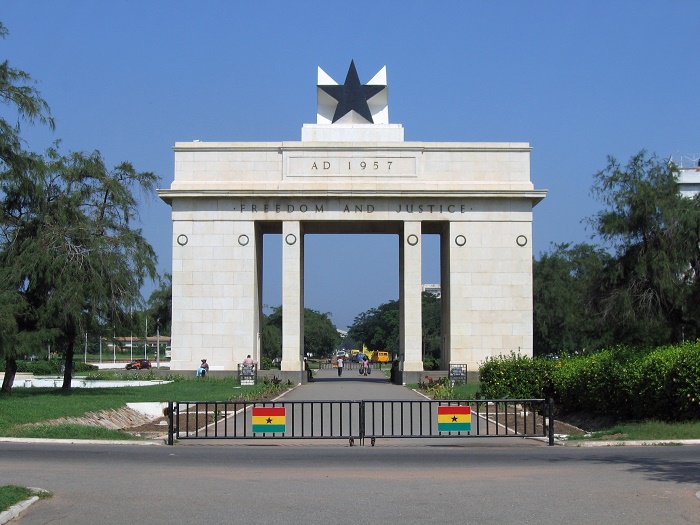
The Office of Government Machinery has disclosed that GH¢21 million was paid to contractors for renovation works at the Black Star Square in preparation for Ghana’s 67th Independence Day celebration, despite the national event ultimately being held in the Eastern Region.
The revelation has raised questions about expenditure planning and public procurement decisions, particularly given that significant public funds were committed to upgrading a ceremonial venue that did not host the main national celebration.
Black Star Square, also known as Independence Square, is one of Ghana’s most symbolic national landmarks and traditionally serves as the central location for Independence Day parades and official state ceremonies. Renovation and maintenance of the site are typically justified on the basis of its historical significance and its role in national events.

However, the shift of this year’s Independence Day celebration away from the capital has brought renewed attention to the timing and justification of the expenditure. Critics argue that spending such a substantial amount on preparations for an event that was relocated raises concerns about planning coordination and value for money in public spending.
The GH¢21 million payment reportedly went to contractors engaged to refurbish and upgrade parts of the square, although full details of the scope of work have not been publicly broken down in detail. Infrastructure maintenance projects of this nature often include repairs to ceremonial grounds, lighting systems, seating areas, security installations and general aesthetic improvements to accommodate large public gatherings.
Government officials typically justify such spending by pointing to the need to preserve national monuments and ensure readiness for future state functions. Black Star Square is not only used for Independence Day celebrations but also for major national events, political gatherings and international ceremonies, making it a high priority asset within state infrastructure.
Still, the timing of the expenditure has become the central issue of public discussion, particularly because the 67th Independence Day celebration was not held at the square. Instead, the national programme took place in the Eastern Region, a decision that itself reflects a broader policy shift toward decentralising national events and promoting regional participation in state celebrations.
Decentralisation of national events has been framed by policymakers as a way to distribute economic activity, increase national inclusion and reduce over concentration of ceremonial activities in Accra. However, such changes also require careful alignment of infrastructure spending with actual event locations to avoid perceptions of inefficiency or waste.

The disclosure also comes at a time when public financial management remains a sensitive issue in Ghana, with increasing scrutiny on government procurement, contract execution and the effectiveness of capital expenditure. Large scale renovation projects, particularly those involving iconic public spaces, are often closely watched due to their visibility and symbolic importance.
Analysts note that while maintenance of national landmarks is necessary, transparency around contract scope, procurement processes and project justification is essential to maintaining public trust. Without clear communication, such expenditures can easily become politically controversial, especially when outcomes do not match initial expectations.
The situation highlights a broader governance challenge: balancing infrastructure maintenance of key national assets with evolving policy decisions such as event relocation and regional rotation of national programmes. When these two policy directions are not synchronised, it can lead to questions about planning efficiency and resource allocation.
As discussions continue, attention is likely to focus on whether the renovation works will still provide long term value for future events and whether the expenditure aligns with approved public financial management frameworks.
For now, the GH¢21 million payment has become part of a wider national conversation about accountability, planning discipline and the efficient use of public funds in major state projects.
Ghana Education Service Releases Funds for 2025 WASSCE Practical Examinations