


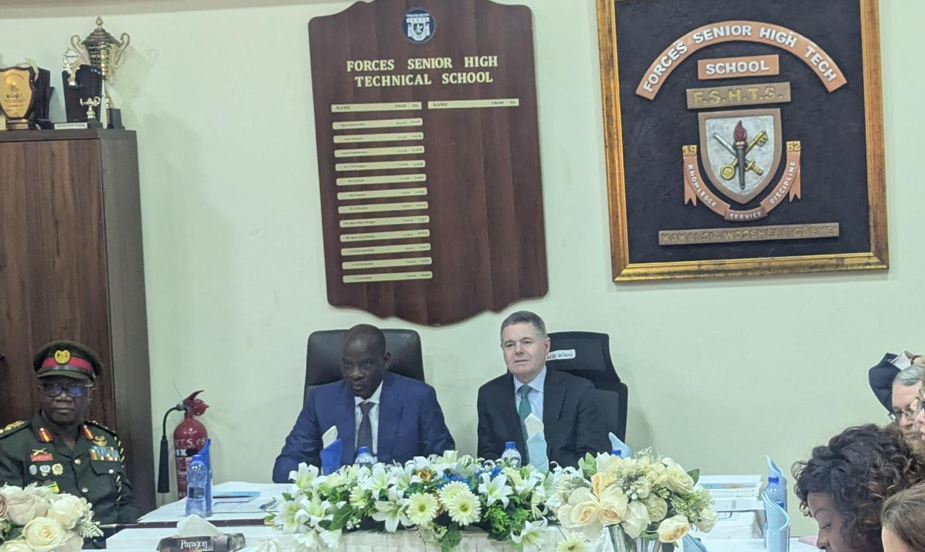
Secondary education reform in Ghana receives a major boost with the World Bank’s confirmed US$300 million commitment to the Secondary Education Transformation for Access, Relevance and Results for Jobs (STARR-J) project. Education Minister Haruna Iddrisu announced the funding, nearly double the initial US$180 million discussed last year, during a joint visit with World Bank Managing Director Paschal Donohoe to the Armed Forces Senior High Technical School in Accra. The initiative targets rehabilitation and equipping of senior high schools, with strong emphasis on technical and vocational education and training (TVET), aiming to reverse the theory-heavy model and better align skills with labour-market needs.
Secondary Education Reform Tackles Free SHS Legacy Challenges
The surge in secondary enrolment following the 2017 free Senior High School policy, up 60% in the early years, overstretched infrastructure and teaching capacity, leading to the double-track system that rotated cohorts and created long out-of-school periods. While the proportion of double-track schools has fallen from 58% in 2018 to 38% by 2026, many facilities remain inadequate, particularly in Category C institutions targeted for upgrading to Category B or A status.
STARR-J directly confronts these gaps through three core components: construction, rehabilitation, and equipping of schools and TVET centres; enhancement of curriculum relevance and teaching quality; and improved assessment and evidence-based sector management. The project builds on the success of the Ghana Accountability for Learning Outcomes Project (GALOP) at basic level, which trained over 70,000 teachers and reached more than 3.1 million pupils, exceeding targets.
Secondary Education Reform Prioritises TVET Transformation
A key pillar of secondary education reform under STARR-J is shifting TVET delivery from the current 90% theory–10% practical ratio toward a 70% practical–30% theory balance. Minister Iddrisu emphasized that robust workshops, laboratories, and equipment, funded by the World Bank, are essential to make this pivot feasible. At least four major garrison schools will receive targeted support, signaling early focus on military-affiliated institutions with strong technical traditions.
This reorientation responds to long-standing critiques that Ghanaian secondary graduates often lack employable hands-on skills, contributing to high youth unemployment despite educational attainment. By investing in practical training infrastructure, the project seeks to produce job-ready graduates in high-demand fields such as construction, renewable energy, manufacturing, and information technology.
Why Secondary Education Reform Matters for Economic Future
Secondary education reform through STARR-J is strategically timed as Ghana seeks to transition from commodity dependence toward a skills-driven, industrial economy. Better-equipped TVET pathways can reduce skills mismatches, increase productivity in key sectors, and support AfCFTA integration by building a workforce competitive in regional value chains. The US$300 million infusion, Ghana’s largest single World Bank commitment to secondary education, also signals strong multilateral confidence in the government’s education roadmap under President Mahama.
Secondary Education Reform Benefits Businesses
Businesses stand to gain significantly from secondary education reform. A larger pool of technically proficient graduates reduces recruitment and training costs for employers in manufacturing, construction, energy, and ICT. Improved practical skills mean faster onboarding, higher initial productivity, and lower error rates on the job. Sectors facing chronic skills shortages, such as renewable energy installation, automotive repair, and digital services, will find a more capable talent pipeline, supporting expansion and innovation.
Over time, stronger TVET outcomes can enhance firm competitiveness, attract foreign direct investment seeking skilled labour, and stimulate private-sector partnerships in curriculum design and apprenticeship programmes. Reduced youth unemployment also eases social pressures and expands the consumer base for goods and services.
Secondary Education Reform Improves Household Opportunities
Households benefit directly from secondary education reform through expanded access to quality, relevant schooling. Parents in rural and underserved areas gain assurance that children, especially those in TVET streams, can acquire marketable skills rather than theoretical knowledge alone. Better-equipped schools reduce the need for expensive private supplementation, while practical training increases future employability and earning potential.
For families, this translates to higher lifetime incomes, reduced poverty risk, and greater intergenerational mobility. Girls in technical programmes may find new pathways in non-traditional fields, promoting gender equity. Overall, a more skilled workforce supports stable remittances, stronger local economies, and improved living standards as graduates contribute productively to communities.
The Road Ahead for Secondary Education Reform
STARR-J’s success depends on swift implementation, transparent procurement, effective teacher training, and private-sector collaboration to ensure curricula remain aligned with industry needs. Sustained government commitment beyond World Bank funding will be essential to scale upgrades nationwide.
This US$300 million investment marks a pivotal step in Ghana’s secondary education reform journey, moving from access-focused expansion toward quality, relevance, and results. If executed well, it promises lasting dividends: a more employable youth cohort, dynamic businesses, and resilient households better equipped for the demands of a modern economy.
Wix.com reports strong bookings growth as website creation demand continues rising