

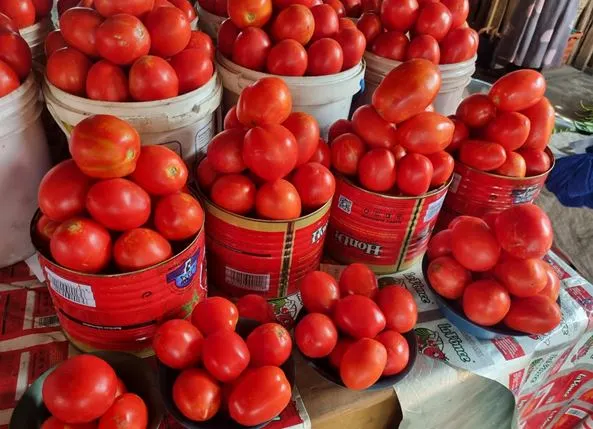
Ghana tomato import crisis is deepening as new data shows the country spends about GH¢760 million annually on imported fresh tomatoes and tomato paste. A report commissioned by the Chamber of Agribusiness Ghana paints a troubling picture of rising foreign exchange outflows, job losses and missed industrial opportunities within the domestic agricultural sector.
At face value, the GH¢760 million import bill reflects Ghana’s heavy reliance on external supply, including significant volumes from neighbouring countries. But the broader Ghana tomato import crisis goes beyond direct import costs. When factoring in tax losses, post-harvest waste, foregone wages and security implications along cross-border trade routes, the total economic impact could reach as high as GH¢5.7 billion annually.
The Scale of the Ghana Tomato Import Crisis
The Ghana tomato import crisis is driven by both fresh tomato imports exceeding 75,000 tonnes and a similar volume of tomato paste brought into the country each year. Despite Ghana’s favourable climate for tomato cultivation, only a small fraction of processed tomato products on the market originate from local farms. Much of what is sold as finished paste is imported in bulk and repackaged domestically.
Compounding the Ghana tomato import crisis is the country’s ranking as the world’s second-largest importer of tomato paste after Germany, according to industry data. This statistic underscores the scale of dependence on foreign processors, even though domestic farmers are capable of producing large volumes under the right conditions.
The imbalance reveals structural weaknesses in Ghana’s agricultural value chain. Production exists, but inconsistent supply, limited cold storage and weak processing capacity prevent the country from fully capturing value.
How the Ghana Tomato Import Crisis Hurts Businesses
For agribusinesses, the Ghana tomato import crisis represents both a challenge and a missed opportunity. Local processors struggle with irregular supply and quality issues, making it difficult to compete with imported paste that benefits from economies of scale abroad.
The report estimates that about GH¢250 million worth of locally grown tomatoes rot each year due to inadequate cold storage facilities, representing nearly 45 percent of domestic output. For farmers and traders, this translates into direct income losses. For processors, it means unreliable raw materials.
Beyond agriculture, the Ghana tomato import crisis affects the broader industrial ecosystem. An estimated 250,000 potential jobs are not realised because the sector is underdeveloped. This results in roughly GH¢4.5 billion in lost wages annually, income that could have circulated within local communities, supporting retail, housing and services.
Tax authorities also lose out. The report suggests that around GH¢220 million in income taxes, VAT and corporate taxes go uncollected each year due to limited domestic production and processing. In effect, the Ghana tomato import crisis reduces government revenue that could otherwise fund infrastructure or social services.
Household Impact of the Ghana Tomato Import Crisis
For households, the Ghana tomato import crisis manifests in multiple ways. First, heavy reliance on imports exposes consumers to price volatility linked to exchange rate fluctuations and cross-border disruptions. If supply routes are interrupted or the cedi weakens, tomato prices can spike, straining family budgets.
Second, the lack of local job creation means fewer employment opportunities, especially in rural areas where farming and agro-processing could absorb significant labour. Young people who might otherwise find work in tomato farming, storage or processing are left searching for alternatives.
The Ghana tomato import crisis also affects food security. When nearly half of locally produced tomatoes go to waste, it highlights inefficiencies that undermine national self-sufficiency. Improved storage and processing could stabilise supply and prices, benefiting consumers directly.
Investment as a Solution to the Ghana Tomato Import Crisis
The Chamber of Agribusiness Ghana proposes a five-year investment strategy costing GH¢3.2 billion to tackle the Ghana tomato import crisis. The focus would be on boosting production, improving quality standards and strengthening cold chain infrastructure.
If implemented effectively, the strategy could generate economic returns exceeding GH¢5 billion by 2030. More importantly, it could transform the Ghana tomato import crisis into an opportunity for industrial expansion and rural development.
However, financing remains a key hurdle. Public-private partnerships, concessional loans and targeted subsidies may be necessary to unlock large-scale processing capacity. Without coordinated action, Ghana risks remaining trapped in a cycle of import dependence.
The Ghana tomato import crisis is not merely an agricultural issue; it is an economic and social challenge. Each year, hundreds of millions of cedis leave the country to pay for products that could, in theory, be grown and processed locally. The result is lost jobs, weakened rural economies and reduced tax revenue.
For businesses, resolving the Ghana tomato import crisis could open new markets and stimulate value addition across the supply chain. For households, it could mean more stable prices, increased employment and stronger food security.
Ultimately, the Ghana tomato import crisis highlights the importance of building resilient local industries. By investing in infrastructure, technology and coordinated policy reforms, Ghana has the potential to shift from being a major importer to a competitive producer. The question is whether stakeholders will seize the opportunity before the economic costs escalate further.