

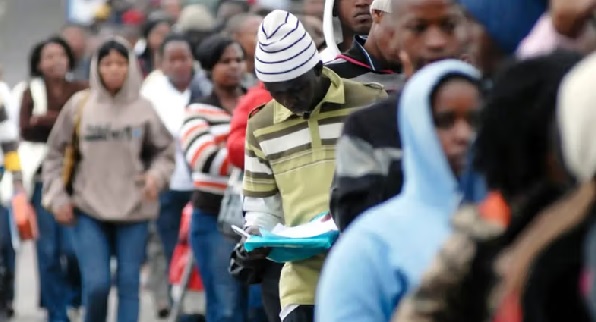
South Africa unemployment rate has fallen to its lowest level since 2020, offering cautious optimism for Africa’s most industrialised economy. According to the latest labour force data, the jobless rate declined to 31.4 percent in the final quarter of 2025, down from 31.9 percent in the previous quarter. While the improvement is modest, it marks a symbolic turning point after years of stubbornly high unemployment following the pandemic shock.
The latest figures from Statistics South Africa suggest that employment gains in community and social services as well as construction helped push the South Africa unemployment rate lower. Economists had anticipated a slightly weaker outcome, making the drop a small but notable surprise.
Yet beneath the headline improvement lies a more complex reality. More than 8.4 million South Africans remain without work, underscoring how deep the labour market crisis still runs. The South Africa unemployment rate remains one of the highest globally, even as it edges downward.
Why the South Africa Unemployment Rate Matters
For businesses, the South Africa unemployment rate is more than a statistic; it is a measure of consumer purchasing power. When more people are employed, household incomes stabilise, retail demand strengthens, and small enterprises benefit from increased spending. Even a fractional improvement can lift sentiment in sectors such as construction materials, food retail and transport services.
Construction’s contribution to the latest improvement is particularly significant. Infrastructure projects and private sector building activity tend to have multiplier effects, creating jobs across supply chains. If sustained, these gains could support broader economic momentum.
For households, the decline in the South Africa unemployment rate signals potential relief. Employment provides not only income but also social stability. Families with at least one working member are better positioned to manage debt, afford education and healthcare, and build modest savings buffers. In a country where economic inequality remains pronounced, incremental job growth can translate into meaningful improvements in daily living conditions.
However, the scale of unemployment means that many households remain under financial strain. High joblessness has long forced extended families to rely on a single income earner or on social grants. Until the South Africa unemployment rate falls more substantially, economic vulnerability will persist.
Youth Pressure and Policy Response
One of the most pressing concerns is youth unemployment, which remains significantly higher than the national average. The government has responded by launching a 2.5 billion rand Youth Fund aimed at supporting entrepreneurship and small businesses. By improving access to finance, policymakers hope to stimulate job creation from the ground up.
President Cyril Ramaphosa has reiterated commitments to structural reforms designed to attract investment and improve efficiency in the public sector. Meanwhile, Finance Minister Enoch Godongwana is expected to outline further measures in the upcoming national budget.
The South Africa unemployment rate is closely tied to investor confidence. When international and domestic investors see credible reform efforts, capital inflows can increase, supporting industrial expansion and job creation. Conversely, policy uncertainty or slow reform implementation could stall progress and keep the labour market under pressure.
Migration and Labour Market Tensions
South Africa’s economic scale, estimated at around $410 billion, continues to draw job seekers from across the region, particularly neighbouring Zimbabwe and Mozambique. As a regional hub, the country faces the dual challenge of managing migration while addressing domestic joblessness.
In response to mounting economic pressures, authorities have intensified deportations of undocumented migrants. While such measures may resonate politically, the broader issue remains structural: the economy must grow faster to absorb both local and foreign labour supply.
For businesses, migrant labour often fills critical gaps in agriculture, construction and informal trade. Sudden labour shortages or regulatory uncertainty can disrupt operations. For households, tensions over employment opportunities can strain social cohesion, particularly in economically fragile communities.
Insight Explains
The recent dip in the South Africa unemployment rate is encouraging but not transformative. It suggests that targeted sectoral growth, particularly in construction and social services, can generate measurable employment gains. Yet with joblessness still above 30 percent, the country remains far from a labour market recovery.
For businesses, sustained improvement would mean stronger consumer demand, more predictable sales and improved credit performance among customers. For banks and financial institutions, lower unemployment reduces default risk and expands the pool of potential borrowers.
For households, a durable decline in the South Africa unemployment rate could ease dependence on government support and informal survival strategies. Employment improves mental well-being, strengthens community resilience and fosters upward mobility.
The key question is sustainability. Temporary job gains may boost quarterly figures, but long-term progress depends on structural reforms, infrastructure investment and a stable policy environment. If government initiatives such as the Youth Fund and broader economic reforms gain traction, the South Africa unemployment rate could gradually trend downward.
Until then, the latest data represents cautious optimism rather than a definitive breakthrough. The direction is positive, but the journey toward inclusive employment remains long.
E-Commerce growth turns digital trade into tax target in Cameroon