

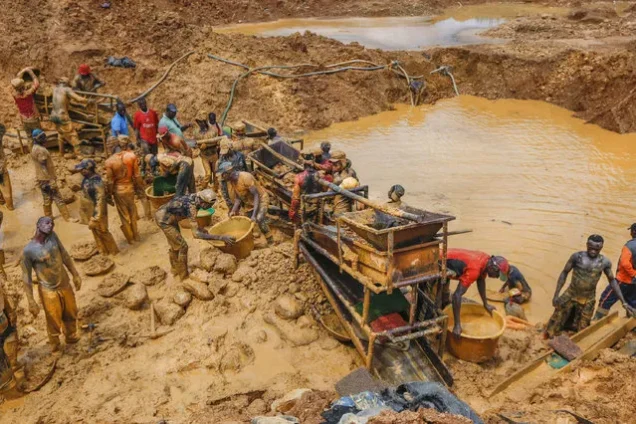
The galamsey fight has once again taken centre stage in Ghana’s national conversation after sharp criticism from banking executive John Awuah, who questioned the effectiveness of civil society organisations (CSOs) in confronting illegal mining. His remarks go beyond political commentary; they strike at the heart of accountability in a country grappling with environmental degradation, polluted water bodies and long-term public health risks.
The debate over the galamsey fight is not new. However, John Awuah’s intervention highlights a growing frustration among sections of the public who believe that despite years of taskforces, committees and public statements, illegal mining continues to devastate forests and rivers with little sustained resistance from institutions expected to serve as independent watchdogs.

For businesses and households, this discussion is not abstract. The outcome of the galamsey fight will shape economic stability, health outcomes and long-term development prospects.
Why the Galamsey Fight Matters for the Economy
The galamsey fight directly affects Ghana’s economic structure. On one hand, gold exports contribute significantly to foreign exchange earnings. On the other, the destruction caused by unregulated mining undermines agriculture, fisheries and tourism, sectors that employ millions.
If farmlands are degraded and water sources contaminated, agricultural productivity declines. This reduces incomes for rural households and increases food prices nationwide. In such a scenario, the economic gains from gold exports may be offset by higher import bills for food and increased healthcare costs.
Moreover, investor confidence is influenced by environmental governance. Weak enforcement in the galamsey fight signals broader regulatory uncertainty. International investors often assess environmental, social and governance (ESG) standards before committing capital. Persistent illegal mining can therefore undermine Ghana’s credibility in global markets.
One of the most alarming dimensions of the galamsey fight is its public health implications. Illegal mining activities frequently involve mercury and other toxic chemicals that contaminate water bodies. Communities relying on these water sources face heightened risks of chronic diseases, including kidney failure and neurological disorders.
For households, this translates into higher medical expenses and reduced productivity. A breadwinner battling illness affects not only immediate family welfare but also broader economic participation. If environmental damage continues unchecked, the long-term cost to Ghana’s healthcare system could be enormous.
Awuah’s rhetorical question, what good are increased gold revenues if citizens suffer long-term health consequences?, reframes the galamsey fight as a human development issue rather than a purely environmental one.
Successive governments have launched multiple anti-illegal mining initiatives, each branded with distinct names and mandates. Yet the persistence of the problem raises questions about coordination, political will and institutional independence.
Critics argue that the repeated formation of taskforces without measurable outcomes weakens public trust in the galamsey fight. When citizens perceive anti-galamsey campaigns as symbolic rather than transformative, confidence in governance erodes.
This erosion has economic consequences. Businesses depend on predictable policy enforcement. If enforcement appears selective or politically influenced, compliance incentives weaken across sectors.
Civil Society’s Role in the Galamsey Fight
Central to Awuah’s critique is the role of CSOs. Traditionally, civil society serves as a bridge between citizens and the state, amplifying concerns, conducting research and holding power accountable. In the galamsey fight, effective CSO engagement could mean sustained advocacy, legal challenges, independent monitoring and community mobilisation.
The question raised is whether press conferences and public statements are sufficient. True influence in the galamsey fight would require consistent pressure, data-driven advocacy and measurable benchmarks for progress.
If civil society is perceived as passive or politically aligned, its ability to influence national policy diminishes. This creates a vacuum in accountability, leaving environmental governance vulnerable to short-term political interests.
How the Galamsey Fight Affects Ordinary Ghanaians
For the average Ghanaian household, the galamsey fight determines water quality, food security and future employment opportunities. Contaminated rivers increase water treatment costs, which may be passed on to consumers through higher utility tariffs. Farmers facing degraded soils may see declining yields, leading to reduced incomes.
Urban businesses also feel the ripple effects. Increased food prices affect restaurants and retailers. Rising healthcare burdens reduce disposable income, affecting consumption patterns across sectors.
In essence, the galamsey fight is interconnected with inflation, public health expenditure and social stability.
The renewed scrutiny of the galamsey fight places pressure not only on CSOs but also on traditional leaders, religious institutions and policymakers. Ghana’s environmental crisis cannot be resolved through fragmented initiatives. It requires sustained coordination, transparent metrics and non-partisan commitment.
If addressed decisively, the galamsey fight could strengthen institutional credibility and protect long-term economic prospects. If mishandled, it risks entrenching environmental damage that may take generations to reverse.
The debate sparked by Awuah ultimately asks a deeper question: Is Ghana prepared to prioritise sustainable development over short-term gains? The answer will determine whether the galamsey fight becomes a turning point in governance or another missed opportunity.