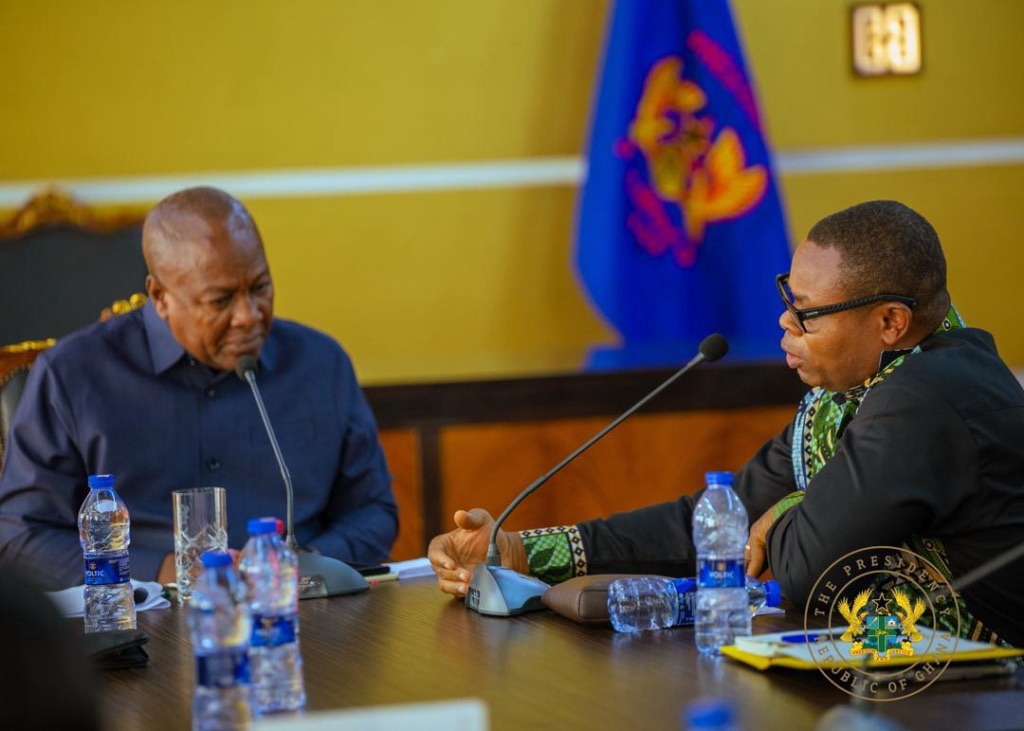
Mahama engages CSOs on Governance Advisory Council to deepen accountability

0
207

President John Dramani Mahama has initiated steps toward the establishment of a Governance Advisory Council, meeting with representatives of various Civil Society Organisations (CSOs) at the Presidency to deliberate on the proposed body’s formation and mandate.

The meeting, held at Jubilee House, aligns with a key pledge from President Mahama’s 2024 election campaign, aimed at enhancing accountabilitytransparency, and inclusive governance.

Accoun

In his remarks, President Mahama underscored the Council’s central role in monitoring and advising government on critical national issues including human rightscorruption, and the state of governance.

“This council is a commitment to the Ghanaian people — a promise to foster a more transparent and accountable government,” he said.

A statement released after the engagement emphasized the President’s vision of building a governance structure that draws on the experience and integrity of stakeholders from civil society, religious groups, traditional leadership, academia, labour unions, and ordinary citizens.

Accoun

“President Mahama believes that by bringing together the wisdom and expertise of civil society, religious leaders, traditional authorities, academia, labour, and ordinary Ghanaians, we can create a powerful mechanism for ensuring that our governance truly reflects the values and aspirations of our nation,” the statement read.

As promised during his campaign, the President expects the Governance Advisory Council to operate independently, producing an annual report on human rightscorruption, and governance in Ghana. The report will be made publicly accessible and will serve as a guiding document for government action and reform.

Accoun

“This annual report will not be just another document gathering dust on a shelf,” President Mahama said during his campaign. “It will be a living, breathing instrument for change — holding us accountable and pushing us to do better on issues ranging from human rights violations and corruption to media freedoms and the fight against torture and crime.”

To ensure the successful implementation of this initiative, Dr. Valerie Sawyerr, Senior Presidential Advisor for Governmental Affairs, has been tasked with leading the process of establishing the Council.

The move has been widely welcomed by governance experts and civic advocates, who view it as a step toward restoring public trust in institutions and reinforcing democratic accountability.

Author

  • Accoun

    Abraham Kofi Amudzegbe is a Level 300 Nursing student at the University
    of Ghana, Legon, an author, student leader, and youth advocate with a
    strong passion for public service, leadership, and student empowerment.
    Through his writing, he explores topics related to education, youth
    development, leadership, health, and social impact, contributing
    meaningful perspectives on issues that affect students and young people.

    As an author at Insight Ghana, Abraham leverages his strong communication
    and research skills to produce informative and thought-provoking content.
    His work reflects a commitment to advocacy, public engagement, and
    fostering conversations that inspire positive change within society.

    Abraham currently serves in several leadership capacities, including
    Vice President of the Volta Region Students Association (VORSA Legon),
    Public Relations Officer (PRO) of the University of Ghana Nursing and
    Midwifery Students Association (UGHANMSA), Deputy Head of the Business
    and Political Chamber of PENSA Legon, Public Relations Officer (PRO) of
    the Oti Region Students Association (ORSA), and a Member of the
    University of Ghana Parliament House.

    Over the years, he has led and supported numerous student-centered
    initiatives, including academic tutorials, mentorship programmes,
    welfare interventions, and advocacy campaigns aimed at improving the
    student experience and promoting collective growth.

    As an aspiring President of the University of Ghana Students'
    Representative Council (UGSRC) for the 2026/2027 academic year,
    Abraham seeks to champion a vision centered on student welfare,
    accountability, inclusiveness, innovation, and effective representation.

Previous articleAlonso declares ‘start of new era’ at Real Madrid
Next article“Every vehicle is linked to a Ghana Card; we don’t need manual toll gates anymore” – President Mahama
Abraham kofi Amudzegbe

Abraham Kofi Amudzegbe is a Level 300 Nursing student at the University of Ghana, Legon, an author, student leader, and youth advocate with a strong passion for public service, leadership, and student empowerment. Through his writing, he explores topics related to education, youth development, leadership, health, and social impact, contributing meaningful perspectives on issues that affect students and young people.

As an author at Insight Ghana, Abraham leverages his strong communication and research skills to produce informative and thought-provoking content. His work reflects a commitment to advocacy, public engagement, and fostering conversations that inspire positive change within society.

Abraham currently serves in several leadership capacities, including Vice President of the Volta Region Students Association (VORSA Legon), Public Relations Officer (PRO) of the University of Ghana Nursing and Midwifery Students Association (UGHANMSA), Deputy Head of the Business and Political Chamber of PENSA Legon, Public Relations Officer (PRO) of the Oti Region Students Association (ORSA), and a Member of the University of Ghana Parliament House.

Over the years, he has led and supported numerous student-centered initiatives, including academic tutorials, mentorship programmes, welfare interventions, and advocacy campaigns aimed at improving the student experience and promoting collective growth.

As an aspiring President of the University of Ghana Students' Representative Council (UGSRC) for the 2026/2027 academic year, Abraham seeks to champion a vision centered on student welfare, accountability, inclusiveness, innovation, and effective representation.