

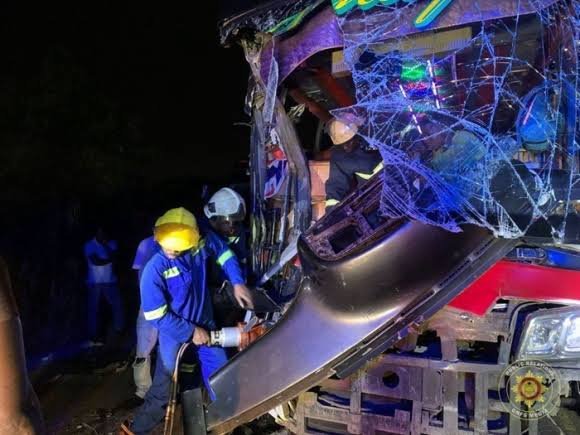
Sixty-eight passengers were rescued after two Granbird buses collided at Duapompo on the Kumasi–Accra Highway on Sunday night, leaving several passengers injured. Each bus was carrying 34 passengers at the time of the crash, according to the Ghana National Fire Service.

Sixty-eight passengers have been rescued following a collision involving two Granbird buses on the Kumasi–Accra Highway at Duapompo.
The crash occurred at approximately 10:31 p.m. on Sunday when the two buses collided.
According to reports, each bus was carrying 34 passengers, meaning a total of 68 people were involved in the incident.
The accident resulted in several injuries and required the intervention of emergency responders.
The Ghana National Fire Service was among the emergency agencies involved in responding to the crash.
Firefighters and other responders worked to assist passengers and manage the situation at the scene.
The incident highlights the risks associated with night-time travel on Ghana’s major highways.
The Kumasi–Accra Highway is one of the country’s busiest transport routes, carrying large numbers of passengers, commercial vehicles and private motorists.
Long-distance buses regularly operate along the route, connecting communities and major commercial centres.
Road crashes involving passenger buses can have serious consequences because of the number of people travelling in each vehicle.
In this case, 68 passengers were travelling in the two buses when the collision occurred.
Emergency response is therefore critical when such incidents happen.

Firefighters and other emergency personnel may be required to rescue trapped passengers, provide first aid and coordinate transportation of injured people to medical facilities.
The successful rescue of all 68 passengers demonstrates the importance of emergency preparedness along major highways.
However, the injuries sustained by passengers also highlight the continuing need for stronger road-safety measures.
The exact cause of the collision has not been established in the available report.
Investigations will be necessary to determine the circumstances surrounding the crash.
Factors such as vehicle speed, road conditions, driver behaviour, visibility, mechanical condition and traffic conditions can be examined during investigations into road crashes.
Authorities are expected to establish the facts before drawing conclusions about responsibility.
For passengers, the incident is another reminder of the importance of road safety during long-distance journeys.
Drivers operating commercial passenger vehicles have a particular responsibility because they transport large numbers of people.
Maintaining safe speeds, remaining alert and complying with traffic regulations are essential to reducing the risk of crashes.
Passengers also depend on transport companies to ensure that vehicles are properly maintained and drivers are fit to operate them.
Transport operators therefore have an important role in preventing crashes.
Regular vehicle maintenance can help identify mechanical problems before they become dangerous.
Driver training and proper scheduling can also contribute to safer journeys.
The incident also demonstrates the importance of road infrastructure.
Clear road markings, appropriate lighting, warning signs and safe road designs can help reduce risks, particularly at night.
Emergency agencies need access to major highways so they can respond quickly when accidents occur.
Delays in emergency response can worsen the consequences of serious crashes.
The rescue operation at Duapompo therefore demonstrates the importance of maintaining emergency services capable of responding to road incidents.

For the families of injured passengers, the immediate concern is their recovery.
Those who sustained injuries may require medical attention and follow-up care.
Road crashes can also impose financial and emotional costs on families.
Beyond the immediate victims, accidents can disrupt traffic and affect other road users.
A major crash involving buses can cause congestion if vehicles or debris block part of a highway.
Emergency responders must therefore work quickly to secure accident scenes and restore safe traffic movement.
The authorities may also review the circumstances surrounding the accident to determine whether additional road-safety measures are necessary at the location.
The Kumasi–Accra Highway remains an important route for Ghana’s economy and transportation network.
Thousands of people travel between the country’s major cities and communities using the road.
Ensuring its safety is therefore a national concern.
The latest crash reinforces the importance of responsible driving, vehicle maintenance and effective emergency response.
Although all 68 passengers were rescued, several people sustained injuries.
Investigations are expected to provide further information about what caused the two buses to collide.
Meanwhile, road users are encouraged to exercise caution, especially during night travel and on busy highways.
The incident serves as another reminder that road safety requires cooperation between drivers, passengers, transport operators, emergency agencies and road authorities.
Authorities will continue to monitor the situation as investigations into the Duapompo collision proceed.