

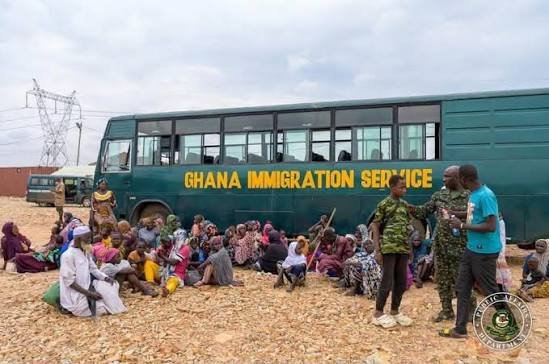

The Ghana Immigration Service has apprehended more than 1,055 people in an intelligence-led operation targeting alleged exploitative street-begging networks in the Greater Accra and Ashanti regions, while rescuing 662 children, 145 men and 248 women believed to have been vulnerable to exploitation.
The Ghana Immigration Service has carried out a major operation targeting alleged exploitative street-begging networks in parts of Greater Accra and the Ashanti Region.
The operation resulted in the apprehension of more than 1,055 people and the rescue of hundreds of vulnerable individuals, according to information released by the Ghana Immigration Service.
The exercise took place in the early hours of Saturday, August 29, 2026, and focused on suspected networks allegedly involved in the exploitation of foreign nationals, particularly women and children.
The GIS said the operation was intelligence-led and targeted locations believed to be associated with organised street begging.
Among those rescued were 662 children, 145 men and 248 women.
The figures demonstrate the scale of the operation and the number of vulnerable people authorities encountered.
Several Ghanaian nationals were also apprehended over suspected involvement in the networks as local agents.
The operation covered several locations in Greater Accra, including Abossey Okai, Sabon Zongo, Madina Zongo Junction, Madina, Ashaiman and Tema.

The authorities’ focus on street-begging networks reflects concerns that vulnerable people can be exploited through organised activities.
Children are particularly vulnerable because they may have limited ability to protect themselves or understand the circumstances in which they are being used.
The operation therefore had both an immigration and a protection component.
The Ghana Immigration Service is responsible for regulating migration and managing Ghana’s borders, but operations involving vulnerable people can also require cooperation with other government agencies.
Individuals rescued during such operations may require screening, identification, protection and appropriate support.
Children may require additional welfare and safeguarding measures.
The authorities will also need to determine the circumstances under which the individuals entered Ghana and whether they have valid documentation.
The operation highlights the challenges associated with irregular migration and human exploitation.
Cross-border movements within West Africa are common because of regional economic and social ties.
However, vulnerable migrants can become targets for exploitation when they lack adequate protection or legal support.
Street begging can involve complex social and economic factors, including poverty, migration and organised exploitation.
Authorities therefore face the challenge of distinguishing vulnerable individuals from people who may be organising or profiting from exploitative activities.
The GIS operation sought to target networks rather than simply remove individuals from the streets.
The involvement of alleged local agents demonstrates the possibility of cooperation between foreign nationals and Ghanaian individuals within such networks.
Investigations will be important in determining the exact roles played by those apprehended.
Authorities are expected to conduct further screening and investigations before determining the appropriate action for individuals involved.
Those found to have been victims of exploitation may require assistance rather than punitive measures.
The presence of hundreds of children in the operation also highlights the need for child-protection agencies to become involved.
Children should be assessed to determine their identities, family circumstances and welfare needs.
Where necessary, authorities may need to work with families, social welfare agencies and relevant diplomatic representatives.
The operation also has implications for Ghana’s cities.
Street begging is visible in several urban communities, particularly at busy intersections, markets and commercial areas.

The government and local authorities have periodically expressed concerns about the safety and welfare of people involved in street begging.
However, long-term solutions require addressing the economic and social factors that contribute to the practice.
The latest operation therefore goes beyond immigration enforcement.
It raises questions about child protection, migration management, poverty and organised exploitation.
The Ghana Immigration Service’s intelligence-led approach indicates an attempt to identify networks behind the activity rather than focusing only on individuals found begging.
Intelligence gathering can help authorities understand how people are recruited, transported and organised.
It can also help investigators identify individuals who may be profiting from the exploitation of vulnerable people.
The operation will therefore require continued investigation after the initial apprehensions.
Authorities may also need to cooperate with neighbouring countries where individuals involved in the networks originate.
Cross-border cooperation can help identify families, establish identities and prevent people from being moved through the region for exploitative purposes.
For Ghana, addressing exploitation requires cooperation between immigration authorities, police, social welfare institutions, local assemblies and community organisations.
Public awareness can also help residents identify suspicious situations and report possible exploitation.
The GIS operation demonstrates the scale of the challenge and the importance of intelligence-led enforcement.
With more than 1,055 people apprehended and 1,055? Wait—the reported figure is more than 1,055 apprehended, while the specific rescued breakdown totals 1,055—authorities will now need to process those involved carefully and determine who may be victims and who may be suspects.
The rescued children, women and men are expected to undergo appropriate screening and assessment.
The operation represents a significant intervention in efforts to address alleged exploitation through street begging in Ghana’s major urban centres.
Further investigations are expected to establish the full structure of the networks and determine whether additional action is required.
The Ghana Immigration Service has demonstrated through the operation that authorities are increasingly using intelligence and coordinated enforcement to address organised exploitation and protect vulnerable people.
By: Oppong Frimpong Richard