

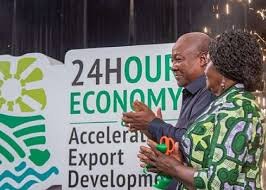
Ghana’s 24-Hour Economy and Accelerated Export Development Programme has attracted about US$5.5 billion in project commitments, largely from private-sector investors, one year after its launch, according to Presidential Advisor Augustus Goosie Tanoh.

Ghana’s flagship 24-Hour Economy and Accelerated Export Development Programme has attracted approximately US$5.5 billion in project commitments, with the majority of the proposed investments expected to come from the private sector.
The figure was disclosed by Presidential Advisor on the 24-Hour Economy and Accelerated Export Development, Augustus Goosie Tanoh, during a media engagement in Accra.
The programme was launched in July 2025 with the objective of transforming Ghana’s economy from one heavily dependent on imports and the export of raw materials into a more productive economy capable of operating around the clock.
According to Mr Tanoh, the programme is designed to create an environment in which private investors can establish and expand businesses while government provides the necessary support for project preparation and facilitation.
He explained that the government’s role was not primarily to finance all the projects directly. Instead, government would help develop viable projects, demonstrate their commercial potential and create the conditions required to attract private capital.
The approach is intended to encourage businesses to invest in manufacturing, agriculture, renewable energy, logistics and other productive sectors.
Mr Tanoh said the programme had already attracted significant investor interest because of the economic framework supporting it.

Among the major projects identified under the programme is a WAPCo solar project valued at about US$1.45 billion. Renewable energy and renewable natural gas projects are also estimated to account for between US$2 billion and US$3 billion in potential investment.
Another major project is the Buipe solar and battery project, which is expected to generate approximately 1,500 megawatts of electricity and create about 13,000 jobs.
Reliable electricity remains an important requirement for Ghana’s industrial development. The government has therefore identified renewable energy projects as part of the broader strategy to support increased production.
The programme is also targeting the creation of 1.7 million jobs by the end of 2028.
However, Mr Tanoh explained that the transformation of Ghana’s productive economy would not happen immediately.
He said the country needed to gradually increase factory capacity, improve infrastructure, strengthen logistics and make financing more accessible to businesses.
The advisor noted that factories operating at low levels of capacity cannot suddenly move to full production without addressing the underlying challenges affecting their operations.
The programme therefore covers several sectors, including agriculture, manufacturing, infrastructure, logistics and access to finance.
The objective is to create a connected productive system in which businesses can operate more efficiently and produce goods for both domestic and international markets.
Mr Tanoh also clarified misconceptions surrounding the 24-hour markets being established in some parts of the country.
He said the 24-Hour Economy Secretariat does not control or oversee those markets. Instead, the markets are being financed by district assemblies and implemented through the Ministry of Local Government and the assemblies.
The clarification followed concerns about the use of the 24-Hour Economy branding on the markets.

The advisor explained that his secretariat had faced legal challenges relating to some market projects despite not being responsible for deciding their locations or implementation.
The distinction between the broader 24-Hour Economy programme and the 24-hour markets is therefore important for understanding how the government’s initiatives are structured.
The programme’s emphasis on private-sector investment also means that investors will be expected to demonstrate that proposed projects are financially viable.
Mr Tanoh said large projects would require investors to demonstrate sufficient equity before agreements could be finalized.
This requirement is intended to ensure that announced project commitments translate into actual investments rather than remaining only proposals.
The government has therefore placed emphasis on the bankability of projects being developed under the programme.
The expected investments could have significant implications for employment if projects move from the commitment stage into construction and operations.
New factories and industrial projects could create direct jobs while also generating indirect employment through suppliers, transport companies, contractors and service providers.
Increased domestic production could also help reduce Ghana’s dependence on imported goods.
The government has repeatedly argued that increasing local production is necessary to strengthen the economy and improve Ghana’s capacity to generate foreign exchange.
Export-oriented production is another important component of the programme.
Businesses capable of producing goods that meet international standards could gain access to regional and international markets, potentially increasing Ghana’s export earnings.
However, successful implementation will depend on several factors, including access to affordable financing, reliable electricity, efficient transportation networks and a stable business environment.
The government is also expected to monitor the progress of projects to ensure that commitments translate into actual economic activity.
The US$5.5 billion figure therefore represents a significant milestone for the programme, but the eventual economic impact will depend on how many of the committed projects reach implementation.
Mr Tanoh maintained that the programme should be viewed as a long-term reconstruction of Ghana’s productive system rather than a short-term intervention.
The government hopes that increased production, investment and exports will eventually contribute to job creation and stronger economic growth.
As the programme enters its second year, attention will increasingly shift from announced commitments to actual projects, employment created and goods produced.
The success of the initiative will ultimately depend on whether the investments can be converted into productive businesses capable of operating sustainably and contributing to Ghana’s economic development.
By: Oppong Frimpong Richard